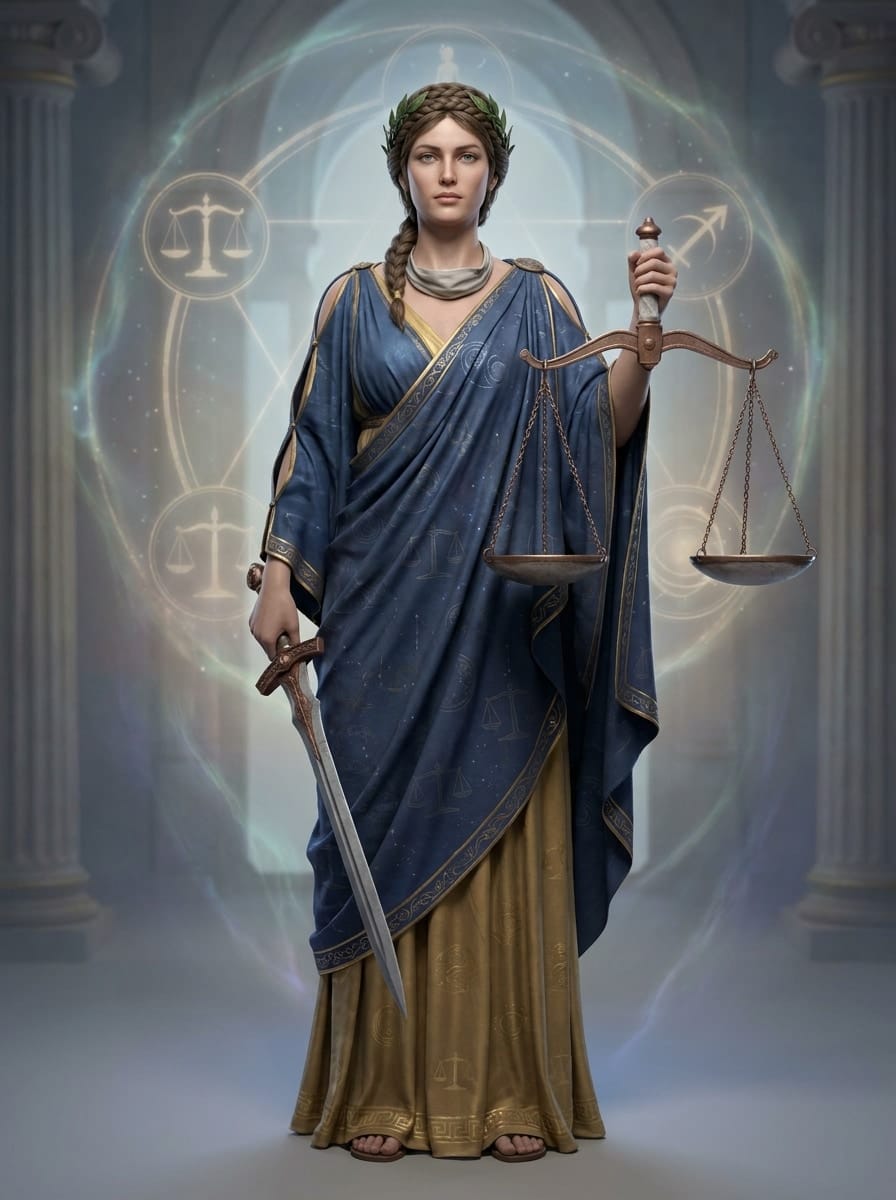
Greek Mythology
Themis — Greek Mythology
Titan Goddess of Justice, Oracles, and Divine Order
Themis is the daughter of Uranus and Gaia, an ancient goddess among the Titans who embodies divine law, just order, oaths, and rightful distribution. Hesiod names her as one of Zeus’s wives, and by him she gives birth to the Horae and the Moirai, making Olympus’s power answer not only to thunder and victory, but also to order, season, and allotted fate. In myth she often appears as a prophetess, counselor, and guardian of sacred norms, close to the ancient wisdom of the earth while also taking part in the new order under Zeus’s rule.
Domain
Justice, Divine Law, Order, Oaths, Oracles, Fate, Seasons
Symbols
Scales, Oracle Seat, Staff, Oaths, Delphi, Horae, Moirai
Article
Origin and Lineage
Themis belongs to one of the oldest genealogies in Greek mythology. In the Theogony, Hesiod names her as one of the Titan goddesses born to Uranus and Gaia, so her authority does not come from Olympian kingship, but from the cosmic order that existed when heaven and earth were first divided. Her name itself is bound to the idea of “what is right” or “what has been established,” pointing to a sacred order older than human law: gods and mortals alike must recognize boundaries, sequence, oaths, and due allotment.
In Hesiod’s account, Themis is one of the wives Zeus marries after Metis. Joined with Zeus, she gives birth to the three Horae—Eunomia, Dike, and Eirene—and to the three Moirai—Clotho, Lachesis, and Atropos. This genealogy is deeply symbolic: if Zeus’s new kingship is to be stable, it cannot rely only on violent conquest over the Titans, but must be joined to the just order Themis represents. The seasons, justice, peace, and fate born from her womb become the basic measures by which both the divine world and the human world can function.
Divine Roles and Attributes
Themis does not govern one narrow field of activity, but the sacred dimension of “order itself.” She is associated with justice, oaths, councils, ritual law, oracles, proper sacrifice, and the limits that should be observed between host and guest. She does not punish with thunder as Zeus does, nor does she intervene in the wars of cities through strategy like Athena. More often, she represents the standard that exists before judgment, reminding gods and mortals that every action must answer for its place within cosmic order.
She is also closely linked to prophetic tradition. In the Eumenides, when Aeschylus describes the succession of the Delphic oracle, he places Themis among the ancient holders of prophecy after Gaia and before Phoebe and Apollo. This makes her not only a symbol of law and justice, but also a bridge between earth’s wisdom and Olympian oracle. In the Homeric Hymn to Apollo, Themis is present when the newborn Apollo receives divine food, showing her connection with sacred order, ritual legitimacy, and the moment when a new god enters the order of the divine world.
Major Myths
Themis’s mythic actions are usually not expressed through force or adventure, but through genealogy, prophecy, and institutional arrangement. In the Theogony, her marriage to Zeus incorporates the ancient Titan order into Olympian kingship; the Horae and Moirai she bears also place structural limits of justice, season, peace, and fate upon Zeus’s rule. This arrangement preserves a tension within Greek myth: although Zeus is king of the gods, he is not an arbitrary absolute will. His kingship must be matched with the lawfulness Themis represents.
In the Delphic tradition, Themis belongs to the prophetic authority before Apollo. She receives the earth prophecy of Gaia and passes the authority of oracle onward to the later Olympian gods. This tradition gives her an ancient, solemn, and understated character: she is not a combatant who seizes a divine throne, but a goddess who witnesses how authority is lawfully transferred. Other tragic traditions also connect Themis with the knowledge of Prometheus, and some accounts even bring her identity close to Gaia’s, showing that different poets could understand her as a meeting point of earth wisdom, foreknowledge of destiny, and just norm.
Worship and Influence
Themis was not the most dramatic popular deity in the Greek world, but she had deep influence in the imagination of oracles, oaths, lawcourts, and civic order. The “sacred law” she represents is not merely human-made legislation, but a rightful order that should be acknowledged even before a city establishes its laws. The Delphic oracle tradition places her before Apollo, which also shows how the Greeks could link prophecy, justice, and the ancient authority of the earth.
In later art and thought, Themis is often associated with scales, justice, courts, and the image of impartial fairness; yet in classical myth she is not merely an abstract emblem of law. She is a Titan goddess, the consort of Zeus, mother of fate and season, and an ancient witness able to preserve continuity between old and new divine powers. Her influence lies not in frequent appearances, but in the fact that whenever oaths, judgments, oracles, and legitimacy are invoked, the measure she represents is already present.
Character Overview
Themis’s character should be understood as steady, clear-sighted, severe, and never theatrical. She does not pursue blood debts like the Erinyes, nor does she enter conflict through the dignity of marriage as Hera does. She is closer to a boundary that is not easily seen, but cannot be crossed. She can acknowledge the transfer of power, and she can also see how power decays if it is severed from law. Her gentleness is not weakness, and her silence is not absence, but the posture of an ancient authority: when gods and mortals argue over who has the right to act, Themis is concerned with whether the action is fitting, whether the oath is true, and whether order can still bear the weight.