Greek Mythology
Hyperion — Greek Mythology
Titan Father of Light
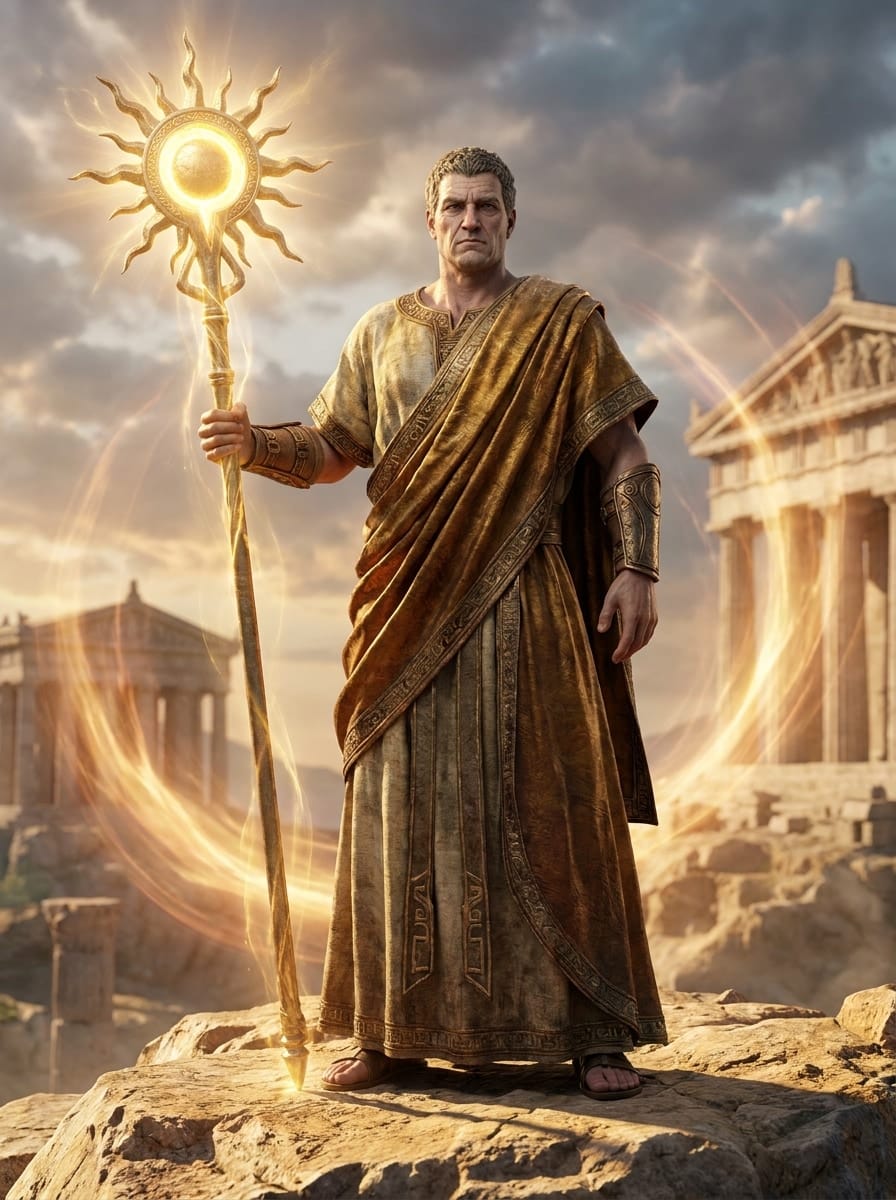
Hyperion is one of the older generation of Titans in Greek mythology, a son of Uranus and Gaia, consort of Theia, and father of Helios, Selene, and Eos. In the surviving myths he rarely acts as an independent figure; instead, he appears more often as a luminous ancestor, a “walker on high.” His name and family bind the sun, moon, and dawn into a single Titan bloodline, while also marking the cosmic order that preceded the Olympian gods.
Domain
Titan race, ancient light, heights of the sky, solar lineage, bloodline of moon and dawn
Symbols
High heaven, first light, solar wheel, moonlight, colors of dawn, Titan bloodline
Article
Origin and Lineage
Hyperion belongs to the generation of Titans born to Uranus and Gaia, making him a peer of Cronus, Rhea, Oceanus, Coeus, Crius, Iapetus, Themis, Mnemosyne, Tethys, Phoebe, and Theia. In the Theogony, Hesiod lists him among the earliest Titan siblings, placing him within the divine cosmic race before the Olympian order rather than among the active protagonists of later heroic tales.
His consort is Theia, herself a Titan. Their union produces Helios, Selene, and Eos: the sun, the moon, and the dawn are thus set within one family of light. Much of Hyperion’s mythic importance comes from this lineage. He is like an ancient source: he does not often speak for himself, yet the three great forms of heavenly light rise from his bloodline.
Divine Role and Attributes
Hyperion’s name is often understood as “he who walks on high” or “the one above the heavens,” an idea that fits his image as a Titan of light. In ancient poetry, “son of Hyperion” can refer to Helios, showing how closely his identity is tied to the solar lineage. Yet in the older genealogical accounts, Hyperion is not simply the sun god himself; he is the father of the sun god.
His domain, therefore, is best understood as the sky-light of the pre-Olympian age, the upper air, the inheritance of light, and the transmission of cosmic order. He is not the Apollonian light of art and prophecy, nor the visible sun driven daily across the sky by Helios. He is an older, quieter ancestor of light. Such a role is best presented with solemnity, distance, few words, and great weight.
Major Myths
In Hesiod’s Theogony, Hyperion’s most important “action” is not an adventure but an act of generation: with Theia he fathers Helios, Selene, and Eos, giving the cycle of day and night and the movement of the heavens a place within the divine genealogy. This lineage separates light out from the structure of the post-chaos world and gives later stories of sun, moon, and dawn a Titan foundation.
Pseudo-Apollodorus’ Bibliotheca continues the Titan genealogy and recounts the war between Zeus and the Olympian gods on one side and the Titans on the other. In such traditions, Hyperion is usually not singled out as a commander or rebel in his own right, but appears as one member of the Titans as a whole. After the Titanomachy, the authority of the older divine race is replaced by the Olympian order. For Hyperion, this means his mythic position often remains that of an ancient light surpassed by a new heaven.
Worship and Influence
Hyperion does not have the rich ritual traditions or broadly visible personal cult associated with figures such as Zeus, Apollo, or Helios. His influence is preserved mainly in poetry, genealogy, and divine names: whenever poets mention the paternal line of Helios or speak of the source of heavenly light in the age of the Titans, Hyperion appears as an ancestor.
That influence is not weak; it simply takes a different form. He is more like a deep beam within the architecture of the mythic cosmos than a central god of the temple square. Through him, the sun, moon, and dawn are not merely natural phenomena, but three manifestations of an ancient divine bloodline. Through him, Greek mythology links visible light with the invisible order of lineage.
Character Overview
Hyperion is best understood as a calm, ancient, and distant Titan. His personality is not shaped by frequent miracles, love affairs, punishments, or war stories, but by fatherhood, bloodline, and the lost authority of the pre-Olympian world. His light is not cheerful brightness; it is a severe radiance from on high, from the borders of an older world.
In characterization, Hyperion should not be written as a simple sun god, nor exaggerated into an all-knowing ruler of the cosmos. He can remember the ancient order of Uranus and Gaia, and he can acknowledge that the age of Zeus has replaced Titan rule. He speaks as a father, a witness, and a guardian of old light: proud, yet also marked by the silence of one pushed by history into shadow.