Greek Mythology
Mnemosyne — Greek Mythology
Goddess of Memory and Mother of the Muses
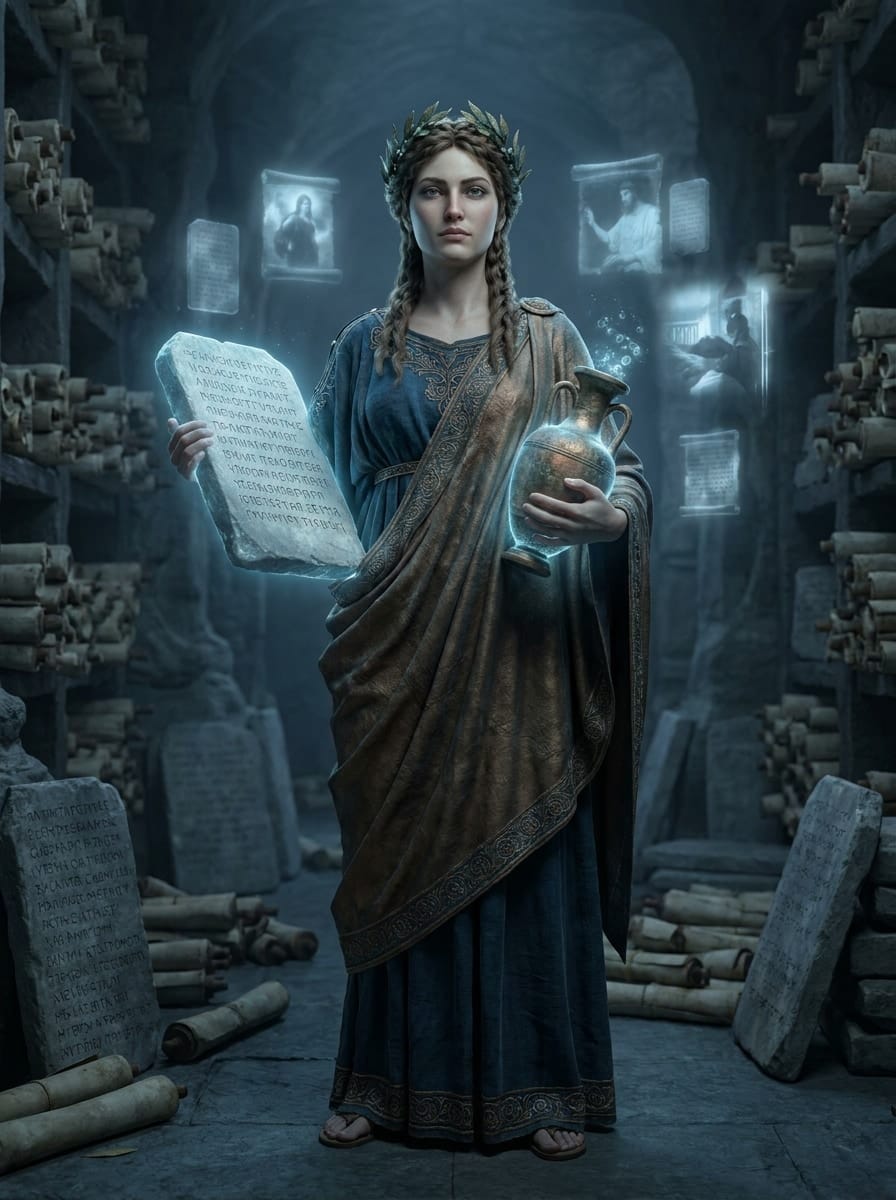
Mnemosyne is a Titan goddess in Greek mythology, governing memory, recollection, and the foundations that allow poetic tradition to endure. Hesiod names her as a daughter of Uranus and Gaia and one of Zeus’s consorts; in Pieria she lay with Zeus for nine nights and bore the nine Muses, giving song, epic, dance, history, and sacred praise a voice that could be passed on. She does not enter divine conflicts as often as the Olympians do, yet she supports the mythic world in a deeper way: without her, gods, mortals, poets, and rituals alike would struggle to remember what must be revered, told, and handed down.
Domain
Memory, recollection, poetic tradition, mother-source of the Muses, genealogy and transmission
Symbols
Spring of Memory, Muses, poetry, hymns, scrolls, laurel, Pieria
Article
Origins and Lineage
Mnemosyne belongs to the generation of the Titans, one of the goddesses born from Uranus the sky and Gaia the earth. In the Theogony, Hesiod places her among the Titan gods, of the same generation as Cronus, Rhea, Themis, Phoebe, and others. Her very name is bound to “memory,” so she is not merely a deity who presides over a single craft, but a force within the mythic order that preserves experience, bloodlines, divine names, and songs.
Her most important kinship comes from her union with Zeus. The Theogony recounts that Zeus slept with her in Pieria for nine nights, after which she gave birth to the nine Muses. This genealogy makes her the maternal source of poetry, music, dance, history, astronomy, hymns, and many other arts; what the Muses inherit from her is not only inspiration, but the ability to remember, arrange, and sing the deeds of gods and heroes.
Divine Functions and Attributes
Mnemosyne’s central divine office is memory. For the ancient Greek poetic tradition, memory was not a private mood but the condition that allowed epic singers, ritual chanters, and civic communities to preserve truth. Poets call upon the Muses for song, and the Muses themselves come from Mnemosyne; myth therefore binds “singing” and “remembering” closely together. Without memory, hymns would lose the names of the gods, families would lose their lineages, heroes would lose their renown, and oaths and guilt would be forgotten as well.
Her presence is usually calm and profound. Unlike the thunder of Zeus, the strategy of Athena, or the radiance of Apollo, Mnemosyne’s power does not always appear through action, but maintains order behind the act of telling. She preserves not only glory, but also trauma, punishment, deception, arrogance, and the debts between gods and mortals that cannot easily be erased. Memory makes praise possible, but it also prevents forgetting from becoming a simple substitute for accountability.
Major Myths
Mnemosyne’s best-known story appears in Hesiod’s Theogony: Zeus meets with her for nine nights, and from that union the nine Muses are born. The Muses later become the sacred voices invoked by poets; they know the songs of past, present, and future, and they can also make people forget their sorrows. On the surface, this story is only a genealogical birth passage, but in truth it explains how Greek myth comes to be sung: myth needs the goddess of memory as its root and the Muses as its branches and leaves before it can become a tradition that may be recited and transmitted.
In Orphic tradition and later religious imagination, memory is also connected with the fate of the soul. Certain inscriptions on gold tablets link “Memory” with the dead person’s correct choices in the underworld, instructing the soul to avoid the waters of forgetfulness and seek the spring of Memory. Such materials do not always make Mnemosyne an active narrative character, yet they show that her domain can extend from poetry to the soul’s identity, ritual knowledge, and the path after death: remembering who one is and what one must say may concern salvation or loss.
Worship and Influence
The worship of Mnemosyne was not as large or conspicuous as that of the major Olympian gods, but she occupies a crucial place in poetry, education, ritual, and philosophical imagination. She is often linked with the Muses, especially when the source of poetic inspiration, the authority of song, and the transmission of knowledge are emphasized. For a world dependent on oral tradition, memory was not an accessory but the storehouse of culture itself.
Her influence also appears in the Greek contrast between “truth” and “forgetfulness.” Poetry preserves glory, ritual preserves divine names, genealogy preserves order, and law and oaths also need shared memory in order to endure. Mnemosyne can therefore be understood as the personification of civilizational memory: she keeps human beings from living only in the instant, and she keeps the stories of the gods from dispersing with the death of a single generation.
Character Overview
Mnemosyne is best understood as a quiet Titan goddess who must not be underestimated. She is not famous for war, jealousy, or punishment, yet she holds a power more enduring than blades: who is remembered, who is forgotten, what is sung, and what is buried. She is both gentle and severe, because memory can soothe grief and also uncover guilt; it can grant heroes immortality and also force the arrogant to face their own names forever.
In character dialogue, she should not be treated merely as an abstract “wise elder.” She speaks like the mythic tradition itself: she values names, lineages, oaths, songs, and overlooked details; she is wary of careless alterations to the past; she is willing to help people order confused memories, but she will not promise to make all pain disappear. Her mercy is not forgetfulness, but the survival of memory in a form that has order, restraint, and meaning.