Greek Mythology
Philoctetes — Greek Mythology
The Abandoned Hero Who Held the Bow of Heracles
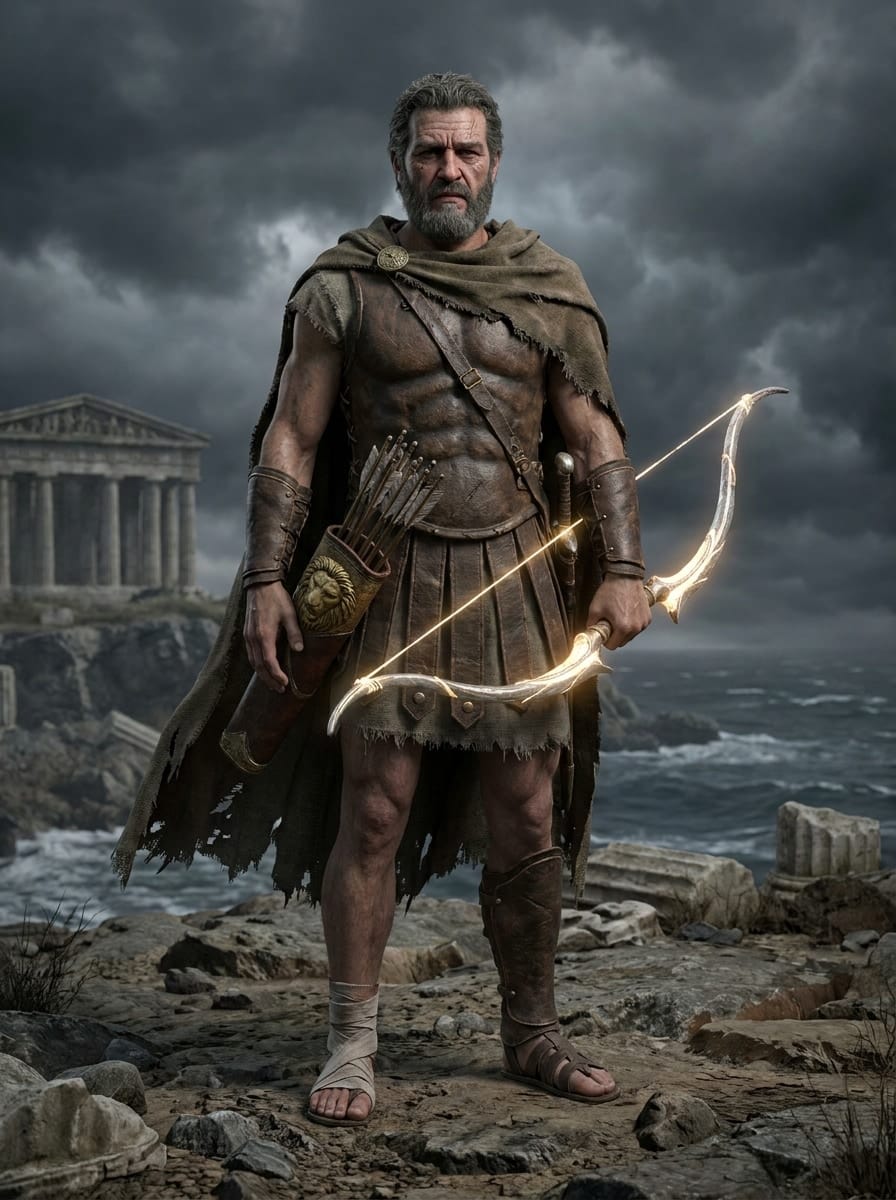
Philoctetes is the son of Poeas and an archer among the Greek expeditionary force, who received the divine bow and poisoned arrows after helping Heracles. On the way to Troy, he was bitten by a venomous snake beside an altar; the wound festered and stank, and his cries of pain became unbearable to his companions. Agamemnon, Menelaus, and Odysseus therefore abandoned him on the island of Lemnos. Years later, a prophecy declared that Troy could fall only through his divine bow, forcing the Greeks to return to the deserted island and ask back the man they had betrayed.
Domain
Archery, Trojan War, exile, pain, betrayal, heroic return
Symbols
The divine bow of Heracles, poisoned arrows, snake-bitten foot, cave on Lemnos, seashore, old altar
Article
Origin and Lineage
Philoctetes is usually said to be the son of Poeas, king of Meliboea, and one of the Greek heroes who joined the expedition to Troy. His fame does not always shine as brightly as that of Achilles, Agamemnon, or Odysseus, but he possesses an inheritance that determines the fate of the war: the bow and arrows of Heracles. According to tradition, when Heracles was near death and needed someone to light his funeral pyre, Philoctetes—or his father Poeas—helped him, and so received this extraordinary weapon. That origin makes Philoctetes more than an ordinary archer: he is the heir to Heracles’ strength and to an old bond of gratitude.
Divine Roles and Attributes
Philoctetes is not a god, but a hero defined by archery, endurance, pain, and the memory of betrayal. His power is concentrated in the divine bow and poisoned arrows left by Heracles; the weapon is both glory and burden, because when the Greeks truly need him, it is often not out of pity for him but because the war needs his bow. His image is often accompanied by a rotting foot wound, a rocky cave on a deserted island, survival by the sea, unending pain, and deep resentment toward Odysseus and the other Greek commanders.
Major Myths
On the journey to Troy, the Greek fleet stopped at an island to take on water and offer sacrifice. Philoctetes found an old altar and was about to honor the gods when a venomous snake lurking in the grass bit his foot. The injury quickly worsened: the wound ulcerated, gave off a foul smell, and made him cry out day and night in agony. At first the commanders tried to heal him, but later they came to see him as a burden and an ill omen. After Agamemnon, Menelaus, and Odysseus conferred, they left him asleep by a sea cave on Lemnos, giving him only a little food, clothing, and his bow and arrows.
When Philoctetes awoke, the fleet had already sailed away. Dragging his wounded leg, he shouted from the shore, but no one turned back. He could only survive by hunting with the divine bow and endure long years on the deserted island. In the tenth year of the Trojan War, after Achilles had died, the Greek camp learned a prophecy: Troy would not fall unless Achilles’ son Neoptolemus joined the fighting and Philoctetes returned with the bow and arrows of Heracles. Odysseus therefore brought the young Neoptolemus to Lemnos. Sophocles’ tragedy especially emphasizes the moral conflict of this return: Odysseus argues for trickery, Neoptolemus struggles between deception and honesty, and Philoctetes wavers between old wounds, anger, and the call of the common Greek cause.
Worship and Influence
In Greek tradition, Philoctetes is not known chiefly for a large-scale divine cult, but rather as a tragic heroic figure. His story asks how a collective at war sacrifices an individual, how heroic honor can be exploited by political calculation, and whether a suffering person can ever trust again those who once harmed him. Later literature and drama often treat him as a symbol of the abandoned, the wounded or ill, and those who refuse to be turned into tools. Ancient traditions do not fully agree about the place and details of his snakebite; some accounts mention Chryse or a related sacred site. Still, “the poisoned wound, the island isolation on Lemnos, the bow of Heracles, and the summons back to Troy” form the most stable core of the story.
Character Overview
Philoctetes’ strength comes from his precise bow, but also from a will that long suffering has not erased. He is not a flawless saint: he can resent, curse, refuse cooperation, and treat the divine bow as the last remnant of his dignity. Yet his anger is not empty rage; it is the still-bleeding memory of being abandoned for years by his allies. As a chat character, he should feel wary, blunt, and acutely sensitive to pain, not easily won over by fine words. He honors the gift of Heracles and honest promises, despises Odysseus-like schemes, yet also knows that war, prophecy, and fate often force a person back to the very shore he least wants to face.