Greek Mythology
Neoptolemus — Greek Mythology
Son of Achilles, young hero of Troy’s final battle
Neoptolemus is the son of Achilles, summoned to the Trojan battlefield by prophecy after his father’s death. Raised on Scyros, he enters the war carrying both Achilles’ armor and Achilles’ name; in the quest to bring back Philoctetes, he is caught between Odysseus’ schemes and his own sense of shame, revealing the still-unformed conscience of a young hero. Yet in traditions of Troy’s fall, he is also remembered for brutal slaughter, becoming a figure in whom victory, inheritance, violence, and postwar retribution are tightly intertwined.
Domain
Trojan War, heroic inheritance, young warrior, final battle and fall of the city, glory and shame
Symbols
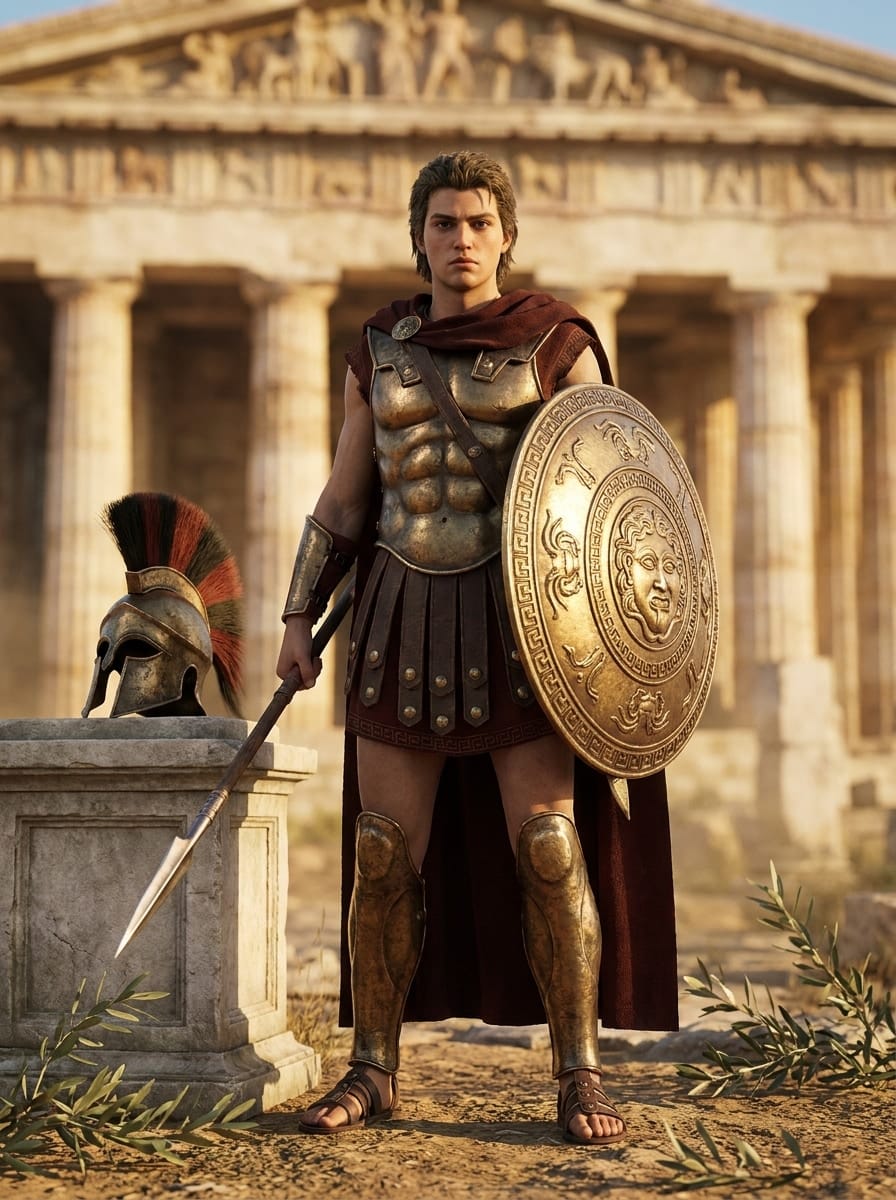
Achilles’ armor, spear, bronze shield, coast of Scyros, walls of Troy, bow of Heracles
Article
Origins and Lineage
Neoptolemus is the son of Achilles, and his mother is usually said to be Deidamia, daughter of Lycomedes, king of Scyros. His birth already carries the feeling of a war arriving late: Achilles has long since become the sharpest and most dangerous hero among the Greek forces on the Trojan shore, while this son did not sail with his father from the beginning, but grew up on the island of Scyros.
In the project story “Neoptolemus and the Return of Philoctetes,” he is written as a youth who has never truly seen his father on the battlefield. To him, Achilles is not an everyday father, but a distant flame, a heavy name, and a tomb already standing in the sea wind. For that reason, his entrance is not simple inheritance, but a coming-of-age forced to the front by prophecy, military need, and a father’s fame.
Divine Role and Attributes
Neoptolemus is not a god, but a warrior figure in the heroic tradition. His central attribute is not a fixed divine office, but “inheritance”: he inherits Achilles’ bloodline, armor, place in battle, and the heroic temperament that burns between glory and ruin. He is linked with the spear, bronze armor, seagoing ships, Scyros, and the last battle for Troy.
His image is marked by tension. On one hand, in the story of Philoctetes he still feels shame and refuses to treat lies as glory; on the other, in later traditions about the fall of Troy, he shows the cruelty of the victor, killing the aged Priam and becoming entangled in the postwar fates of the Trojan royal women. He is therefore neither a pure youth nor a simple tyrant, but a young hero rapidly shaped by war and stained by it.
Major Myths
After Achilles dies, the Greeks learn that Troy cannot be taken by their existing strength alone. Prophecy declares that two conditions are required for the city to fall: Neoptolemus, son of Achilles, must come to the battlefield, and Philoctetes must return with the bow and arrows of Heracles. Odysseus therefore goes to Scyros to summon Neoptolemus, then takes him to Lemnos to find Philoctetes, whom the Greeks abandoned many years before.
In this part of the story, Neoptolemus’ character is especially clear. Odysseus argues that Philoctetes’ bow should be obtained through deception, because taking Troy matters more than telling the truth; the young Neoptolemus first obeys the scheme, but when he faces the wounded hero’s suffering, trust, and anger, he feels shame. Sophocles’ Philoctetes turns this conflict into his most important inner battlefield: he wants to win glory, yet does not want his first great deed to rest on base deceit.
Once he reaches Troy, he becomes a decisive force in the final battle. Later narratives and mythological handbooks often count him among the Greek warriors inside the Wooden Horse and have him kill Priam when the city falls; some traditions also connect him with the death of Astyanax, the allotment of Andromache to him, and the killing of Polyxena at Achilles’ tomb. Here Neoptolemus is no longer merely Achilles’ son arriving for his first war, but one of the sharpest and most polluted hands of Greek victory.
After the war, his fate is not truly peaceful. In Euripides’ Andromache and related traditions, he is entangled in marriage and hatred with Andromache, Hermione, and Orestes. Traditions differ about his death, but it is often connected with Delphi: he is killed at Apollo’s sanctuary, drawn into Orestes’ plot, or dies because of a dispute at the temple. Such an ending transforms him from the conqueror of Troy into yet another victim within the cycle of violence.
Worship and Influence
Neoptolemus is not the most central object of worship in the Greek heroic tradition, but he holds an important place in the closing phase of the Trojan War. His name is often linked with “Pyrrhus,” suggesting red hair or a fiery color; in royal traditions from regions such as Epirus, he could also serve as an ancestral figure, helping later rulers connect themselves to the heroic bloodline of Achilles.
In literature, his importance comes especially from two opposing memories: the young man in Sophocles who can still suffer over deception, and the victor in the traditions of the city’s fall who creates blood-debts at altars, before tombs, and among the ruins of palaces. This split makes him a concentrated figure for the ethical questions of the Trojan War: whether war permits lies, whether glory can cleanse brutality, and whether a father’s fame can drive a son into the same fire.
Character Overview
The core of Neoptolemus is not the bearing of a mature king, but inheritance arriving too soon. From the moment he appears, he is asked to decide the war like Achilles, yet he does not have Achilles’ long experience of battle; he longs to be worthy of his father’s name, yet before Odysseus’ schemes he reveals a young man’s unease.
For that reason, when speaking with him, he should not be written only as a proud warrior. He will speak of how heavy his father’s armor feels, of the sea wind of Scyros and the blood-reek of Troy, and he will repeatedly defend himself between glory and shame. He can see through weakness, but he cannot always overcome his own violence; he can reject a vile lie, and he may also do unforgivable things on the night of victory. Neoptolemus is the blade after Achilles—young, bright, eager, and already bloodstained.