Greek Mythology
Diomedes — Greek Mythology
The Spear-Hero of Argos
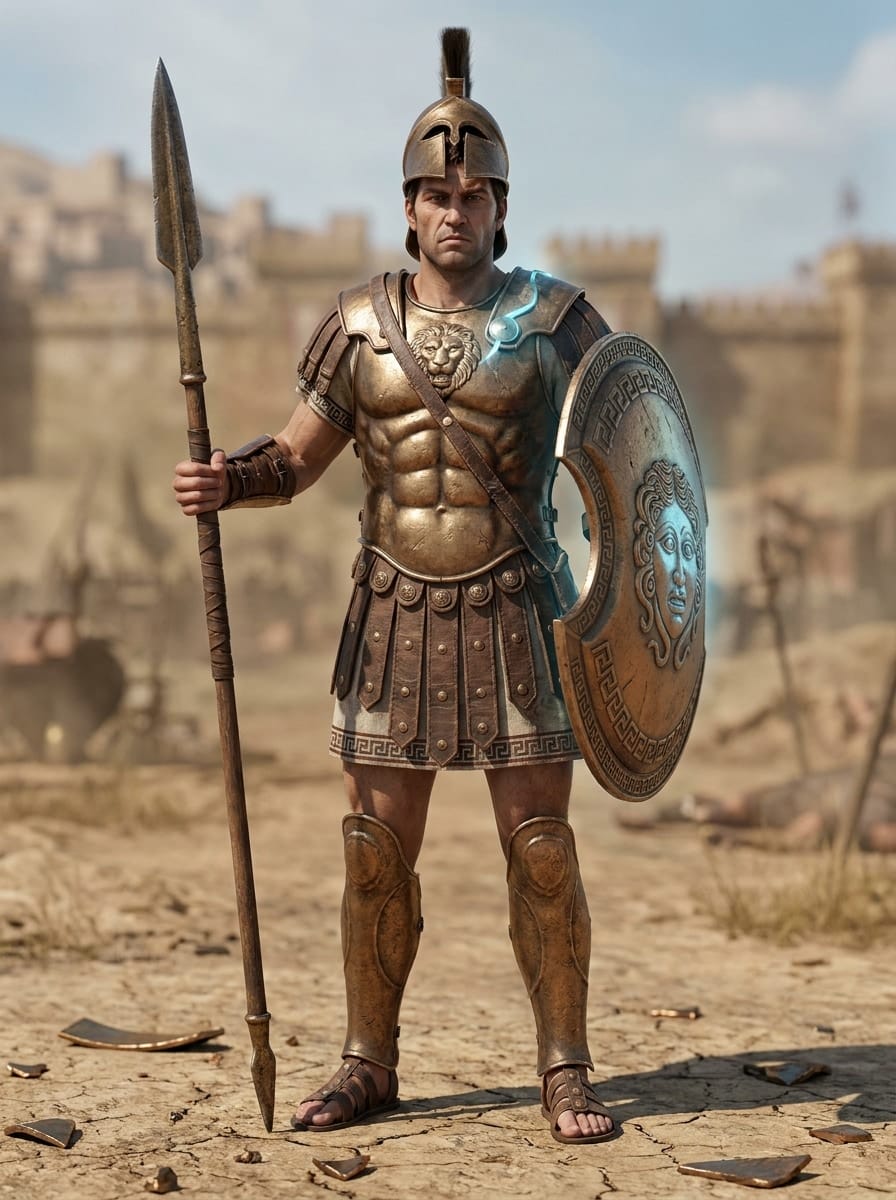
Diomedes is the son of Tydeus, the young king of Argos, and one of the bravest Greek heroes of the Trojan War, especially favored by Athena. On the battlefield he is known for composure, ferocity, and discipline. With Athena’s help he wounded Aphrodite and Ares, yet he was also driven back by Apollo, learning firsthand that the boundary between mortals and gods is not one to cross lightly.
Domain
Heroic warfare, kingship of Argos, Trojan War, Athena’s favor, spear and chariot, night raids and strategy
Symbols
Spear, firelight on the shield, chariot, bronze armor, Athena’s guidance, Trojan plain
Article
Origins and Lineage
Diomedes belongs to the heroic line of Argos, the son of Tydeus and Deipyle. Tydeus had fought among the Seven against Thebes and was famous for both courage and savagery. Diomedes inherited his father’s martial force, but in the Iliad he appears better able to heed divine will and judge the proper moment. Later tradition also places him among the Epigoni, the “sons after” the Seven: after their fathers failed against Thebes, the sons marched again and completed the revenge and conquest the earlier generation had left unfinished.
During the Trojan War, Diomedes is already king of Argos. Though young, he is not merely a hot-blooded youth rushing into battle, but a commander capable of standing on his own within the allied army. Homer’s narrative repeatedly links him with Athena: the goddess values his courage, but also requires him to keep within the measure of a mortal. This relationship shapes his central image—he may be thrust by a god into the brightest place on the battlefield, yet he must still remember that he is not a god.
Divine Role and Attributes
Diomedes is not a god, but a hero and king. His sphere is not a priestly office at the altar, but battlefield courage, command, night raids, discipline, and the ability to recognize the boundary of divine will. Unlike the wrath of Achilles, his ferocity resembles a trained assault: after being wounded he does not sink into pain, when pursuing an enemy he does not easily stop, and when facing gods he first listens to Athena’s prohibition.
His signature weapons are the spear, shield, and chariot. In the “Aristeia of Diomedes,” Athena makes his helmet and shield seem to blaze with fire, so that on the Trojan plain he appears like a flame advancing toward the enemy ranks. The firelight is not an ornament that makes him divine; it reveals his danger. He is, for a time, the sharpest spear-point among the mortals, and the hand through which the gods alter the course of battle.
Major Myths
Diomedes’ most famous moment comes in the middle phase of the Trojan War. After Achilles withdraws from the fighting, the Greek army comes under enormous pressure. With Athena’s help, Diomedes charges into the enemy ranks and kills or wounds many Trojans. The archer Pandarus strikes him in the shoulder and thinks that will be enough to stop him; Diomedes pulls out the arrow and prays to Athena to let him find the bowman. The goddess heals his wound, clears the mist from his eyes so that he can recognize mortals and gods on the battlefield, and warns him not to attack the gods at will—except that, if he meets Aphrodite, he may strike.
Soon afterward, Pandarus and Aeneas face him from the same chariot. Diomedes kills Pandarus and then wounds Aeneas with a great stone. Aphrodite rushes in to save her son, and Diomedes, acting within the boundary Athena has allowed, pursues and stabs her, forcing the goddess of love to abandon Aeneas and flee back to Olympus. Yet when Apollo shields Aeneas and repeatedly drives him back, Diomedes finally stops advancing, understanding that a mortal must not mistake a moment of divine aid for his own divinity.
The battle does not end there. Ares himself comes to the aid of the Trojans, and the Greeks are in grave danger. Athena then mounts the chariot with Diomedes, faces Ares, and with her own hand guides his spear true, so that he strikes the war god. Ares leaves the battlefield crying out in pain, and Diomedes’ fame reaches its height. But that height carries a warning with it: his glory comes from courage working together with the goddess, not from any mortal right to stand above Olympus at will.
In other passages of the Iliad, Diomedes often acts alongside Odysseus. He takes part in night reconnaissance and raids, and in the stories of Dolon and Rhesus he shows calm, speed, and ruthless battlefield judgment. Later tradition also tells how he and Odysseus stole the Palladium from the city of Troy, making him a model of combined intelligence and courage, not merely a warrior who charges head-on.
Worship and Influence
Diomedes was remembered in later tradition both in Greece and in southern Italy. Ancient geography and local legend often connect him with Argos, the return from Troy, and the Adriatic region. Some traditions say that after the war he left his homeland, founded cities in Italy, or received heroic honors there. Accounts of his later life differ from region to region: some emphasize that Aphrodite took revenge on him and obstructed his return home, while others stress the new honors he won in a foreign land.
These variations do not weaken his image; instead, they reveal a common fate of Greek heroes: victory on the battlefield does not guarantee stability in the household, the kingship, or the journey home. Diomedes’ influence comes chiefly from the heroic pattern shaped by the Iliad—brave, intelligent, favored by the gods, yet not forgetful of the distance between gods and mortals. He can be understood as an exemplar of the warrior, and also as a mortal who must practice restraint all the more carefully the closer he comes to the divine.
Character Overview
The core of Diomedes’ character is clear-eyed courage. He dares to pursue a goddess and wound the god of war, yet he is no blind blasphemer. He can hear Athena’s command, and he can halt before Apollo’s rebuke. His glory comes from an extremely sharp capacity for action, but also from an unusual sense of limits.
For that reason, he is not a gentle hero. On the battlefield he is brutal, swift, and almost without pity. Injury rouses his counterattack; deception or a hidden arrow makes him pursue the matter to the end. Yet he is not a warrior who only knows how to roar. He knows how to pray to the gods, how to work with companions, and how to stop himself when victory comes closest to arrogance. What is most worth remembering about Diomedes is that even when the fire blazes highest, he can still admit this truth: a mortal spear may pierce divine flesh, but it cannot make a mortal into a god.