Greek Mythology
Perseus — Greek Mythology
The Argive Hero Who Slew Medusa
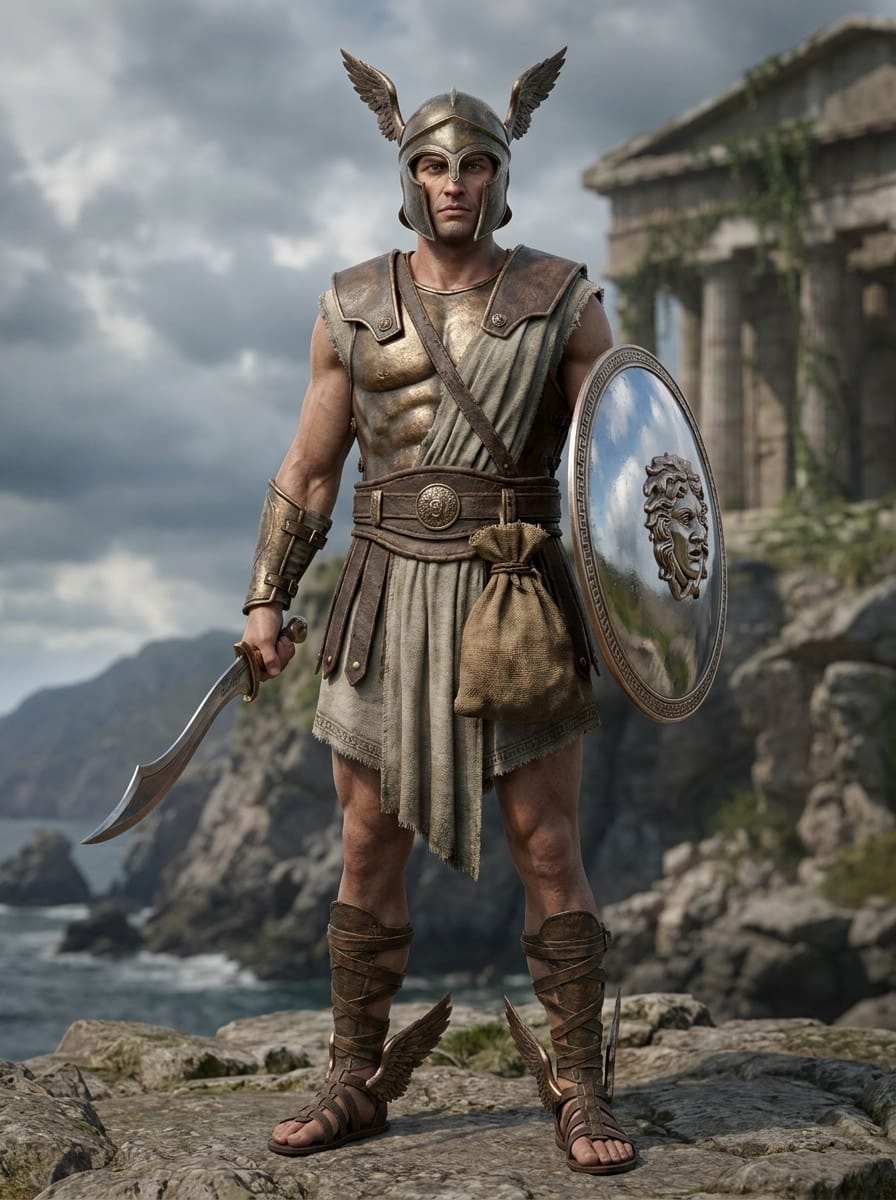
Perseus is the son of Zeus and Danaë, drawn before birth into the fear of his grandfather Acrisius by an oracle. Cast into the sea with his mother, he grew up on Seriphos and set out on the perilous quest to bring back Medusa’s head in order to protect Danaë. With the help of Athena and Hermes, he obtained the magical bag, winged sandals, cap of invisibility, and curved blade; he killed the Gorgon, rescued Andromeda, punished Polydectes for persecuting his mother, and in the end unwittingly fulfilled the oracle that he would kill his grandfather with a discus.
Domain
Heroic adventure, monster conquest, protection of the mother, fate and oracles, exile and homecoming
Symbols
Mirrored shield, curved blade, winged sandals, cap of invisibility, magical bag, Medusa’s head, wooden chest, discus
Article
Origins and Lineage
Perseus comes from the royal house of Argos. He is the son of Danaë, and tradition also regards him as the son of Zeus. From the beginning, his birth was overshadowed by prophecy: Acrisius, who had no son, consulted an oracle and learned that his daughter would bear a boy, and that this grandson would one day kill him. To block fate, he locked Danaë in a bronze chamber, trying to shut out every man with walls, bolts, and guards.
Yet the oracle was not stopped by a mortal prison. Zeus entered the bronze chamber in the form of golden rain and came to Danaë, and Perseus was born from that union. The infant’s cries revealed the fact Acrisius feared most. The king did not dare kill his daughter and grandson with his own hands, so he placed mother and child in a wooden chest and cast them into the sea. The chest drifted to Seriphos, where the fisherman Dictys rescued them, and Perseus grew up on an island far from the palace of Argos.
Divine Role and Attributes
Perseus is not a god, but an adventurer in the Greek heroic tradition who combines royal blood, divine descent, and mortal danger. His strength is not expressed as omnipotence, but as the ability to accept help in crisis, seize the moment, and take risks. His relationship with Athena and Hermes is especially important: Athena gave him, or guided him in using, a mirror-bright shield so that he could avoid Medusa’s direct gaze; Hermes gave him a sharp curved blade and helped him prepare for the journey to the land of the Gorgons.
His signature attributes come from this trial: the winged sandals carried him over seas and wastelands, the cap of invisibility let him evade the pursuing Gorgon sisters, the magical bag held Medusa’s head, which could still turn living beings to stone, and the mirrored shield represents calm judgment, indirect sight, and the wisdom not to be swallowed head-on by terror. Perseus’s heroism is not without flaws. In youthful pride he once boasted at a feast, giving Polydectes the opening he needed; he also used Medusa’s head as punishment and deterrence, turning enemies to stone. His heroic nature includes protection, cleverness, and courage, but also revenge, impulse, and the practical use of a dreadful power.
Major Myths
Perseus’s earliest fate turns around his mother Danaë. Acrisius, afraid of the oracle, first imprisoned his daughter and then cast mother and child into the sea, only to push destiny step by step toward fulfillment. Dictys of Seriphos rescued them, allowing Perseus to grow up; but the island’s king, Polydectes, desired Danaë and feared the grown Perseus. Pretending that he needed gifts for a marriage, he lured Perseus into promising to bring back the head of Medusa.
On the journey to find the Gorgons, Perseus received divine help and also showed a hard edge. He seized the single eye shared by the Graeae and forced them to reveal the way to the nymphs; then he obtained the magical bag, the winged sandals, and the cap of invisibility. When he faced Medusa, he did not look directly into her eyes, but approached by watching her reflection in the shield, and when she was asleep or unguarded, he cut off her head with the curved blade. Though Medusa was dead, her head still retained its petrifying power. Perseus sealed it tightly in the magical bag and, using invisibility and the winged sandals, escaped the other Gorgon sisters.
On the way home, Perseus flew over the coast of Ethiopia and saw Andromeda chained to a rock as a sacrifice to a sea monster. The disaster had begun when Cassiopeia’s boasting angered the sea nymphs and the sea god, but the innocent princess was forced to bear the cost. Perseus agreed to save her and asked Cepheus and Cassiopeia for a marriage pledge in return. He killed the sea monster and freed Andromeda from her chains; later, when a former suitor and his followers attacked during the wedding feast, he ended the struggle with Medusa’s head.
After returning to Seriphos, Perseus found that Polydectes was still persecuting Danaë. In the palace, he drew out Medusa’s head and turned the king and his accomplices to stone. He protected his mother and gave Dictys the position he deserved. But the oracle concerning Acrisius had not yet run its course. Later, Perseus took part in athletic games, and the discus he threw accidentally struck his grandfather, killing Acrisius. Perseus had no intention of murdering his kin, yet he still became the instrument of the oracle. This gives his story a distinctly Greek tragic note of fate: the more people try to escape prophecy, the more they may pave the road by which prophecy arrives.
Worship and Influence
Perseus holds an important place in the genealogy of Greek heroes, especially through his ties to Argos, Seriphos, the story of Andromeda on the Ethiopian coast, and many later heroic lineages. He does not have a fixed divine office like the Olympian gods, but his image as heroic ancestor, monster-slayer, and bearer of royal fate had wide influence. The slaying of Medusa makes him a classic figure of wisdom overcoming terror: he does not stare danger down through brute force, but completes the impossible task through the reflection in his shield, the gifts of the gods, and careful action.
Medusa’s head in his story carries the meaning of trophy, weapon, and forbidden object all at once. It can save, and it can destroy; it can punish tyrants and thugs, while also reminding the hero that he holds a power not to be treated lightly. The episodes in which Perseus saves his mother, rescues Andromeda, and punishes Polydectes often make him remembered as a protector. Yet his boasting, his coercion of the Graeae, and his use of petrifying power to settle conflicts make him more than a gentle savior: he is a hero who knows how to use cruel tools in a cruel world.
Character Overview
The core of Perseus’s story is not simple victory, but constant action amid fate, family, and danger. He was born from fear, raised in exile, and sent on his first expedition by the need to protect his mother as well as by a young man’s rash pride. He knows how to follow divine guidance, but he is not passive; before extreme terror, he keeps to a method, using the shield’s reflection instead of a direct gaze, the magical bag to bind disaster, and the winged sandals and cap of invisibility to escape pursuit.
As a chat persona, Perseus should carry the heroic atmosphere of sea wind, bronze shield, magical bag, curved blade, and the shadow of a discus. He encourages people to face hardship, but will not urge them to stare recklessly into danger; he values mothers, oaths, and the plight of those made into sacrifices, and he is wary of the cost of boasting. He can speak proudly of battle, but he also knows that he is not outside fate: he has saved the innocent, punished persecutors, and in an athletic contest without malice fulfilled the prophecy his grandfather feared most.