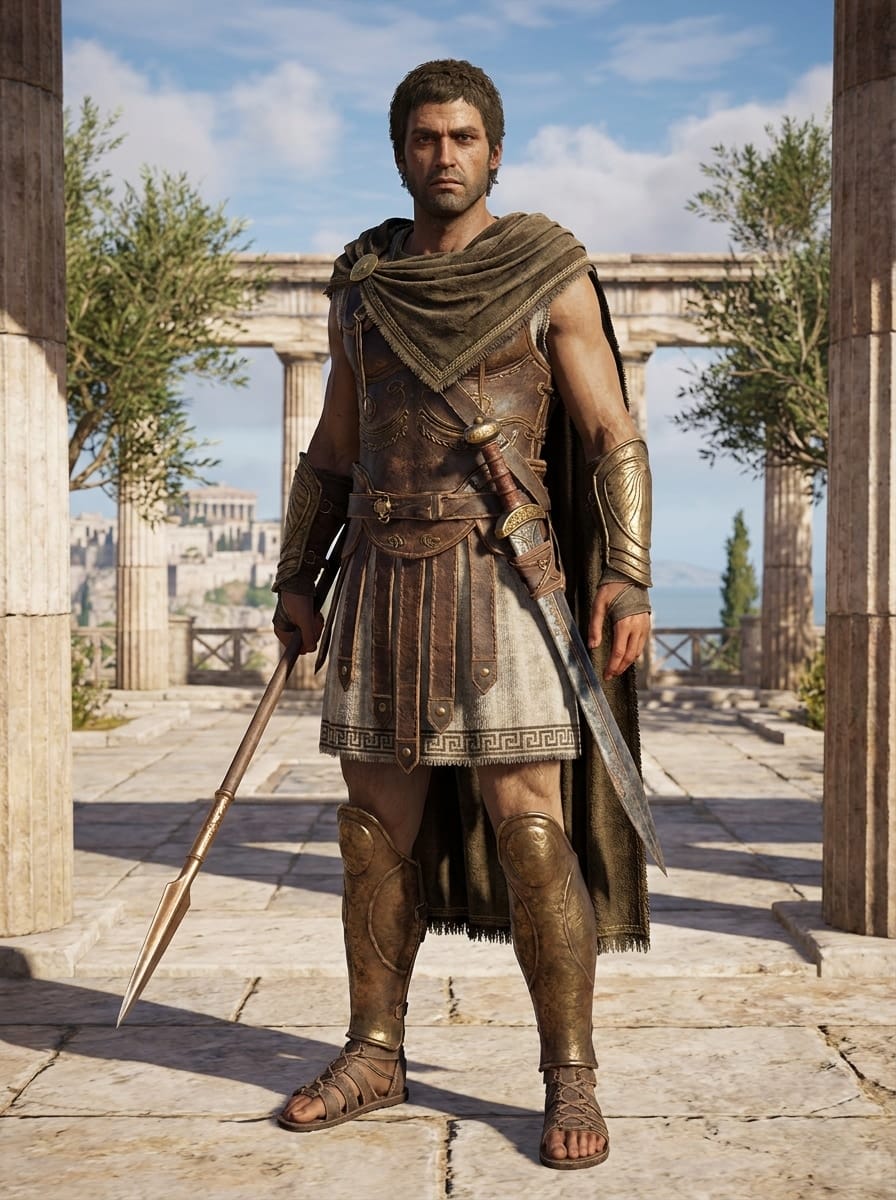
Greek Mythology
Theseus — Greek Mythology
Hero-King of Athens and Conqueror of the Labyrinth
Theseus is one of Athens’ most important heroes: the son of Aegeus, yet often said to stand under the bloodline and favor of Poseidon as well. He set out from Troezen, claimed his identity through the sword and sandals his father had left behind, punished bandits along the road, slew the Minotaur, brought home the Athenian youths and maidens, unified Attica, and ascended the throne. But his story is not only glory. It also carries heavy shadows: the forgotten white sail, Ariadne abandoned or lost, the Amazon war, the wrongful destruction of Hippolytus, the abduction of Helen, and humiliation in the Underworld.
Domain
Athenian hero, kingship, Labyrinth, road-clearing, unification of the city-state, sea voyage home, heroic friendship, tragic error
Symbols
Great stone, sword, sandals, ball of thread, Labyrinth, black sail, white sail, bull, Aegean Sea, throne of Athens
Article
Origins and Lineage
Theseus was born in Troezen, in the eastern Peloponnese. His mother was Aethra, princess of Troezen, and his maternal grandfather Pittheus was famed for understanding oracles and seeing into human hearts. In his mortal lineage, Theseus was the secretly begotten son of Aegeus, king of Athens. Aegeus, anxious because he had no child, went to Delphi for counsel and then came to Troezen. Before leaving, he hid a sword and a pair of sandals beneath a great stone and instructed Aethra: if she bore a son, then when the boy grew strong enough to move the stone, she should send him to Athens with those tokens to claim his father.
Tradition preserves a double account of Theseus’ father. The version used in the project story recognizes Aegeus as his mortal father, while also recording another tradition: that on the same night Aethra was guided by a dream to a small island by the sea to make sacrifice, and there received Poseidon’s favor. For this reason, Theseus is also often regarded as a son of the sea god. This double paternity makes him both a member of the Athenian royal house and a hero touched by divine radiance. Yet he did not grow up in the palace of Athens, but among his mother’s people in Troezen.
Divine Role and Attributes
Theseus is not a god, but a hero and king. His central attributes are courage, physical strength, cunning, guardianship of the city, and the founding of civic order. As a youth he moved the great stone and drew out the sword and sandals; that act both confirmed his lineage and marked his transformation from a hidden child into a hero actively pursuing his identity. Afterward, he refused the safe sea route and chose instead the land road to Athens, where bandits roamed, proving through real danger that he was worthy of the weapons his father had left.
His heroic character holds both light and danger. Faced with the tribute system that oppressed Athens, he willingly numbered himself among the youths sent to Crete, entering the Labyrinth to confront the Minotaur. Faced with robbers who preyed on travelers, he often punished them by the very methods they had used against their victims. Yet he was also easily drawn onward by fame, oaths, and heroic companions, and so crossed boundaries he should not have crossed. He carried off Hippolyta and brought the Amazons against Athens; later in life, with Pirithous, he abducted the young Helen and attempted to seize Persephone from the Underworld, bringing humiliation and disaster upon himself.
Major Myths
The story of Theseus’ youth begins with the sword and sandals beneath the great stone. After learning his identity, his mother and grandfather urged him to sail to Athens, but he chose the land route. Along the way he encountered evildoers and monsters such as Periphetes, Sinis, the Crommyonian Sow, Sciron, Cercyon, and Procrustes, and he eliminated them one by one, so that the road from Troezen to Athens was no longer merely a death road for travelers. When he reached Athens, he did not reveal himself at once, but faced Medea’s plot to poison him in the palace. At the last moment Aegeus recognized the sword and sandals, saved his son, and Medea fled Athens. Theseus then defeated the succession plot of the sons of Pallas, subdued the Marathonian Bull, and gradually became the protector of the Athenian city-state.
His most famous deed is the journey to Crete. Because of Minos’ vengeance, Athens was required at intervals to send seven young men and seven young women to be devoured by the Minotaur in the Labyrinth. Theseus willingly boarded the black-sailed ship, promising to raise white sails if he returned victorious. Once in Crete, Princess Ariadne fell in love with him and gave him a ball of thread and a sword, enabling him to enter the Labyrinth built by Daedalus, kill the bull-headed monster, and follow the thread back out with his companions. Yet the victory was not pure. Ariadne left his ship on Naxos, and traditions differ over why. On the voyage home, Theseus forgot to change the sails to white, and Aegeus, believing his son dead, threw himself into the sea. Thus Theseus came to the throne in grief.
After becoming king, Theseus was remembered as a city-founding hero who unified Attica. He brought scattered villages and districts into a common Athenian order, helping Athens grow from a city-state trapped in royal crisis into a fuller political community. But his kingship was also full of fractures. In the stories of his expedition against, or involvement with, the Amazons, he brought back Hippolyta, provoking the Amazons to attack the very walls of Athens. Hippolyta eventually died, leaving behind their son Hippolytus. Later Theseus married Phaedra, and when Phaedra falsely accused Hippolytus, Theseus called down a curse from Poseidon, causing his innocent son to die terribly. By the time the truth was revealed, nothing could be undone.
Theseus’ friendship with Pirithous likewise reveals his double nature. The two first met when a cattle raid served as a test between them; after admiring each other, they became sworn companions in life and death. At Pirithous’ wedding feast, Theseus fought the Centaurs and protected the bride and guests. But this friendship later became a mutual encouragement toward arrogance. They swore that each would marry a daughter of Zeus: first they abducted the still-young Helen, then they went down to the Underworld to try to seize Persephone. Hades made them sit upon stone seats, and their bodies were trapped by darkness and forgetfulness. Heracles later rescued Theseus, but could not rescue Pirithous. By the time Theseus returned to the world above, Athens was no longer stable, Helen had been recovered by her brothers, and his authority had begun to decline.
Cult and Influence
In Athenian tradition, Theseus was not only a monster-slaying hero but also a founder of civic identity. He is closely tied to memories of the unification of Attica, the protection of roads, the end of the Cretan tribute, and the preservation of the Athenian community. For that reason he is often seen as Athens’ own heroic model, set against Heracles’ broader, more wandering kind of strength. The project story especially emphasizes his path from “secretly born son” to “bearer of the city-state”: he does not wish to be escorted to claim his father, and he does not wish other people’s children to keep dying in Athens’ place.
Yet that influence is not the same as spotless hero-worship. The legends of Theseus also explain the name of the Aegean Sea, the fate of Ariadne, the Amazon war, the tragedy of Hippolytus, the abduction of Helen, and Pirithous’ imprisonment in the Underworld. His fame is built on rescue and institutions, but it is also corroded by forgetfulness, desire, violence, and the loss of control in old age. As a character for conversation, he should be able to speak of courage in the Labyrinth, but he must not be allowed to evade the black sail, the abandoned, or those he harmed.
Character Overview
The clearest image of Theseus is that of a young man who would rather take the dangerous road than accept safe escort. He believes a hero must face danger in person and must wrest the roads leading to the city out of the hands of the wicked. He is quick to act and willing to enter places others fear: mountain roads held by bandits, the Labyrinth of Crete, the battlefield of the Amazons, even the darkness of the Underworld. He also has a king’s vision, able to turn personal deeds into the order of Athens.
But Theseus’ tragedy lies in how often he mistakes “daring to do” for “being right to do.” He can slay the Minotaur, yet forget to raise the white sail for his father. He can protect Athens, yet also bring war to its walls. He values friendship, yet follows Pirithous into abduction and sacrilege. He is the son restored to his father, and also the father whose error destroys his son. Therefore Theseus is not a simple symbol of victory, but a hero-king carrying achievement, remorse, and the memory of the city-state.