Greek Mythology
Jason — Greek Mythology
Leader of the Argonauts and Seeker of the Golden Fleece
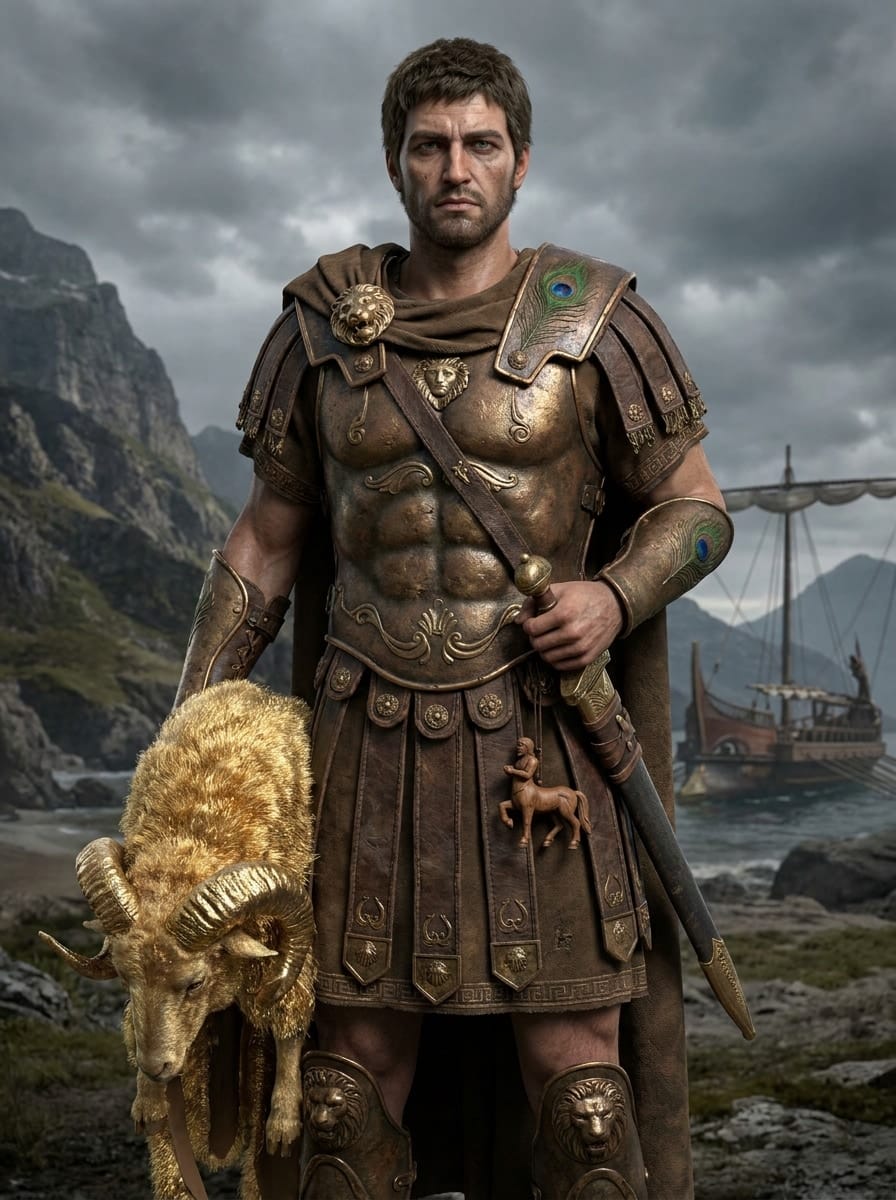
Jason is a descendant of the royal house of Iolcus and the leader of the Argonautic expedition. Raised in the mountains by Chiron, he returned as an adult to reclaim the throne stolen from his father, Aeson, only to be sent by the usurper Pelias to Colchis in search of the Golden Fleece. Hera protected him because he had once helped her when she appeared as an old woman, and Medea, driven both by the gods and by her own feelings, helped him survive the trials of the fire-breathing bronze bulls, the dragon’s-tooth warriors, and the dragon that guarded the fleece. Yet Jason’s later betrayal in marriage turned his heroic reputation toward the tragedy of Corinth.
Domain
Argonautic expedition, Golden Fleece, heroic seafaring, royal succession, oaths and betrayal
Symbols
Argo, Golden Fleece, one sandal, fire-breathing bronze bulls, dragon’s teeth, ship’s oar, Hera’s protection
Article
Origins and Lineage
Jason was born into the royal family of Iolcus, the son of Aeson. After Pelias seized power, Aeson’s household tried to save the child’s life by pretending that Jason had died and secretly sending him into the mountains, where he was raised by the centaur Chiron. Chiron was a teacher of medicine, music, and martial skill, and he often served as guardian to Greek heroes in their youth; Jason therefore grew up not amid court intrigue, but among forests, herbs, spears, and old heroic tales, learning restraint, courtesy, and courage.
When he came of age, Jason learned who he was and returned to Iolcus, intending to demand the throne that rightly belonged to his father. On the way, beside the river Anauros, he carried an old woman across the rushing water and lost one of his sandals. The old woman was in fact the goddess Hera; this act of kindness brought him to Hera’s attention and also sent him into Pelias’s fear as “the man with one sandal.” An oracle had warned Pelias to beware such a man, so Jason’s return bore the mark of fate from the start.
Divine Role and Attributes
Jason is not a god, but a heroic figure: his strength does not lie in overpowering every enemy by himself, but in gathering companions, maintaining dignity in public, accepting tasks that seem impossible, and turning a plot against him into an expedition with the help of gods and other people. His name is closely bound to the Argo, the Golden Fleece, seafaring, royal succession, and the fellowship of heroes. His relationship with Hera is also important: Hera hated Pelias for disrespecting her, and Jason’s kindness at the river made him someone the goddess could support.
His heroic image is deeply conflicted. In the earlier stories, he is gentle, brave, and courteous; when he faces Aeëtes, he first asks for the Golden Fleece as a guest rather than immediately taking it by force. When he confronts the fire-breathing bulls and the dragon’s-tooth warriors, he is afraid, but he cannot retreat. Yet his success depends profoundly on Medea’s ointment, schemes, and sacrifices. In the tragedy at Corinth, he reveals ambition, calculation, and self-justification: to regain a foothold near royal power, he abandons Medea and claims that marrying a princess is for the benefit of his wife and children, only to lose his new marriage, his children, and the peace of the rest of his life.
Major Myths
Jason’s first major story is his return to Iolcus and confrontation with Pelias. Pelias recognizes him as the “one-sandaled” man of the oracle, but does not dare kill him openly, so he lures him into accepting the voyage to seize the Golden Fleece from Colchis. The Golden Fleece hangs on an oak in the sacred grove of Ares, guarded by an unsleeping dragon; Pelias believes this will make Jason die at sea, but Jason gathers heroes from across Greece, builds the Argo, and begins the Argonautic expedition.
In Colchis, Jason enters the palace with his companions and explains his purpose to King Aeëtes. Aeëtes agrees outwardly, but secretly wants him dead, ordering him to yoke fire-breathing, bronze-hoofed bulls, plow the field of Ares, sow dragon’s teeth, and fight the armed warriors who spring from the earth. Hera and Athena bring the god of love into the affair; Medea is struck by love, struggles between pity and betrayal, and finally gives Jason an ointment made with the power of Hecate, telling him to use a stone to make the dragon’s-tooth warriors kill one another. Jason survives the trials and then obtains the Golden Fleece.
After his return, Jason does not smoothly take the throne of Iolcus. To help him avenge himself on Pelias, Medea tricks Pelias’s daughters into believing they can restore their old father’s youth, which leads to Pelias’s death and makes it impossible for her and Jason to remain in Iolcus. They move to Corinth and have children. Years later, Jason decides to marry the daughter of Creon, king of Corinth, in exchange for a more secure position. Medea sees this as a betrayal of everything she has sacrificed; she kills the princess and Creon with poisoned gifts, then kills her own children, cutting off Jason’s bloodline and hope together. At the end of the story, Jason is no longer the leader at the prow of a ship, but a man standing in an empty house, cursing Medea and unable to recover anything.
Worship and Influence
In Greek tradition, Jason exists chiefly as a figure of heroic legend rather than as a god with a widespread cultic office. His influence centers on the narrative core of the Argonautic expedition: this voyage links many heroes, gods, foreign kingdoms, magic, and maritime adventures, making Jason a classic figure of the “organizer” and the “one who undertakes the task.” He does not overwhelm the world through personal strength like Heracles, nor does he become famous as a solitary master of cunning like Odysseus; his story places greater emphasis on a leader’s dependence on alliances, divine help, and dangerous promises.
Literary tradition also keeps pushing Jason into a more complicated position. Apollonius’s Argonautica gives weight to the expedition, the love story, and Medea’s inner conflict; Euripides’s Medea shifts the focus to marriage, oaths, a foreign woman, and male political calculation. For that reason, Jason’s reputation is not simply radiant: he is both the hero of the Golden Fleece and the catalyst of the Corinthian tragedy.
Character Overview
Jason’s life is like a route that runs from the mountains to the sea, and then from glory to ruin. As a youth, he was educated by Chiron, courteous rather than reckless; when he returned to the city, he carried an old woman across a river, showing an uncalculated kindness; before Pelias and Aeëtes, he could preserve the dignity of a royal heir under the eyes of others. Yet his claim to heroism is always accompanied by debt: Hera’s protection, Medea’s ointment, the oars and counsel of his companions—all are indispensable parts of his success.
His tragedy is not that he was never helped, but that he later underestimated the cost of that help. Jason often sees himself as someone who must win kingship and public standing, and for that reason he is prone to interpreting affection, marriage, and oaths as parts of a political path. That self-justification shatters completely at Corinth: he tries to exchange a new marriage for security, only to provoke Medea’s most extreme revenge. Jason is therefore best understood as a flawed hero—brave, dignified, and skilled at gathering heroes, but also vain and calculating, seeing the abyss opened by broken oaths only after he has lost everything.