Greek Mythology
Patroclus — Greek Mythology
Achilles’ Beloved Companion and Fallen Hero
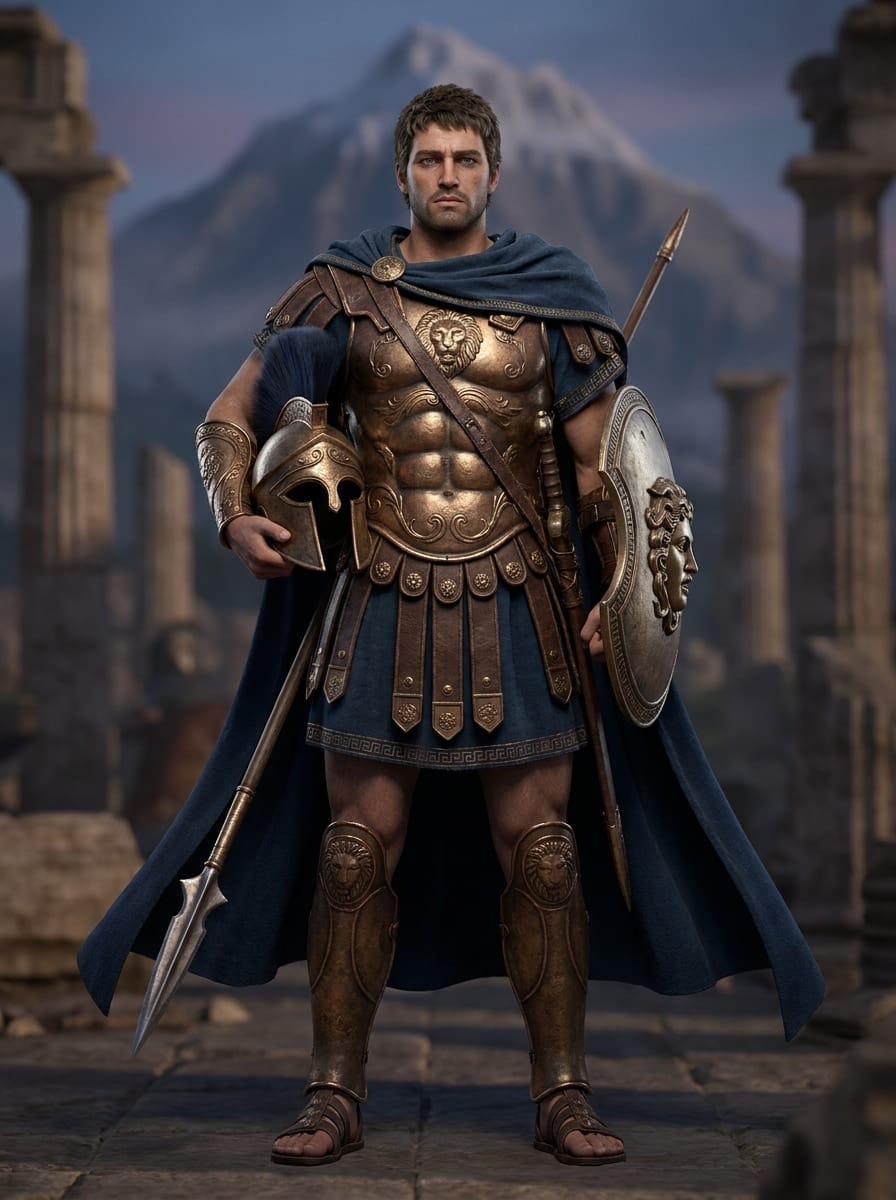
Patroclus is a hero of the Greek army and the closest companion of Achilles. When Achilles refuses to fight, Patroclus pleads for the endangered Greeks, puts on Achilles’ armor, and leads the Myrmidons into battle. He drives back the Trojans and kills Sarpedon, but after pushing beyond Achilles’ warning and pursuing the enemy to the walls of Troy, he is struck down in succession by Apollo, Euphorbus, and Hector. His death rekindles Achilles’ rage and becomes one of the crucial turning points of the *Iliad*, where friendship, pity, glory, and the cost of war are bound together.
Domain
Trojan War, heroic friendship, compassion, sacrifice, battlefield honor
Symbols
Achilles’ armor, the spear of the Myrmidons, fire beside the ships, the walls of Troy, funeral games
Article
Origins and Lineage
Patroclus belongs to the lineage of Greek heroes and is usually named as the son of Menoetius. In epic tradition, while still young, he accidentally killed a companion during a quarrel and was brought by his father to Peleus. There, in Phthia, he grew up alongside Achilles. This background makes him neither a mere attendant nor an observer standing apart from Achilles; from boyhood onward, he is placed within the fate of Peleus’ house, the Myrmidons, and the Trojan War.
His relationship with Achilles stands at the center of his mythic identity. Achilles is younger, more dazzling, and more difficult to restrain in anger; Patroclus often appears as the older and gentler companion, someone able to persuade Achilles, tend the wounded, and understand the suffering of the soldiers in the camp. For that reason, his death is not only the fall of a hero on the battlefield, but a disaster that strikes the most intimate place in Achilles’ heart.
Divine Role and Attributes
Patroclus is not a god, but a mortal hero of the Trojan War. His attributes do not come from a divine domain, but from the ethics of the battlefield: compassion for the wounded, loyalty to companions, and a willingness to face danger for a shared crisis. He does not become the center of the epic through unmatched force as Achilles does, but through a character moved by the pain of others.
His heroism carries a clear contradiction. On one hand, he asks for Achilles’ armor in order to save the Greeks who are close to ruin beside the ships; on the other, once he wears that armor, he is swept up by victory, glory, and the momentum of battle, forgetting the instruction to drive the enemy only as far as the ships. His compassion is real, and so is his overstepping. That mixture makes him one of the most tragically weighted heroes in the Iliad.
Major Myths
In the story of “The Death of Patroclus,” Achilles refuses to fight after being dishonored by Agamemnon. The Trojans seize the chance to break into the Greek camp, and Hector even brings fire against the Greek ships. Patroclus sees the flames beside the ships, the wounded falling back, and the healers in confusion, and he can no longer endure Achilles’ silence. He asks Achilles, if he still will not fight himself, at least to lend him his armor, so that Patroclus may lead the Myrmidons out and terrify the Trojans in Achilles’ name.
Achilles agrees, but plainly warns him to return once he has driven the enemy away from the ships, and not to pursue them to the walls of Troy. Patroclus puts on the armor and enters the battle, and the Trojans indeed fall back in fear. He kills many enemies, among them Sarpedon, son of Zeus. But success drives him onward. He passes beyond Achilles’ warning and presses straight toward the city wall. Apollo strikes him from concealment, knocking away his helmet and scattering his armor; Euphorbus wounds him first, and Hector then gives the fatal spear-thrust. As he dies, Patroclus foretells that Hector too will not live much longer.
His body then becomes the center of a fierce struggle between Greeks and Trojans. For Achilles, Patroclus’ death transforms a quarrel over personal honor into an unbearable grief for a lost friend. He returns to battle, hunts down Hector, and honors Patroclus with funeral games. Although Patroclus dies within the epic, he continues to govern what follows: his ghost, funeral, and memory all drive Achilles toward deeper rage and, ultimately, toward self-knowledge.
Worship and Influence
Patroclus does not possess the wide cultic offices of an Olympian god, but he holds an important place in heroic tradition and epic memory. His tomb, funeral, and Achilles’ mourning for him give him the character of heroic commemoration. He is remembered not because he founded a city or ruled over a force of nature, but because his death reveals the most fragile and most intense bonds within war.
In later reception, Patroclus is often treated as a symbol of loyalty, compassion, and sacrifice; yet in the epic itself, he is not merely a gentle victim. He can kill enemies, lead troops, and be tempted by glory into going too far. His image endures because he lets us see, all at once, the light of friendship, the frenzy of war, and the truth that even a good man can be dragged by the battlefield into destruction.
Character Overview
The core of Patroclus is not the simple pathos of “dying in Achilles’ place,” but the more complex fate of “entering the trap of glory through compassion.” First he weeps for the Greeks beside the ships; then he puts on armor that is not his own and, for a brief time, becomes the Achilles whom the battlefield mistakes him for. In that moment, he saves his companions and loses the measure that would have let him turn back.
As a chat character, he should carry a tone that is gentle, earnest, sorrowful, and not weak. He cares for the wounded and the vulnerable, and he repeatedly warns others not to let pride outweigh responsibility; yet he will not deny that he himself was once carried away by victory. He is especially suited to speak about friendship, counsel, the cost of war, responsibility, and overstepping boundaries. In the voice of one who lived it, he can say: borrowed armor may frighten enemies away, but it cannot bear another person’s fate for you.