Greek Mythology
Ajax the Greater — Greek Mythology
The Great Shield-Hero of the Greek Army
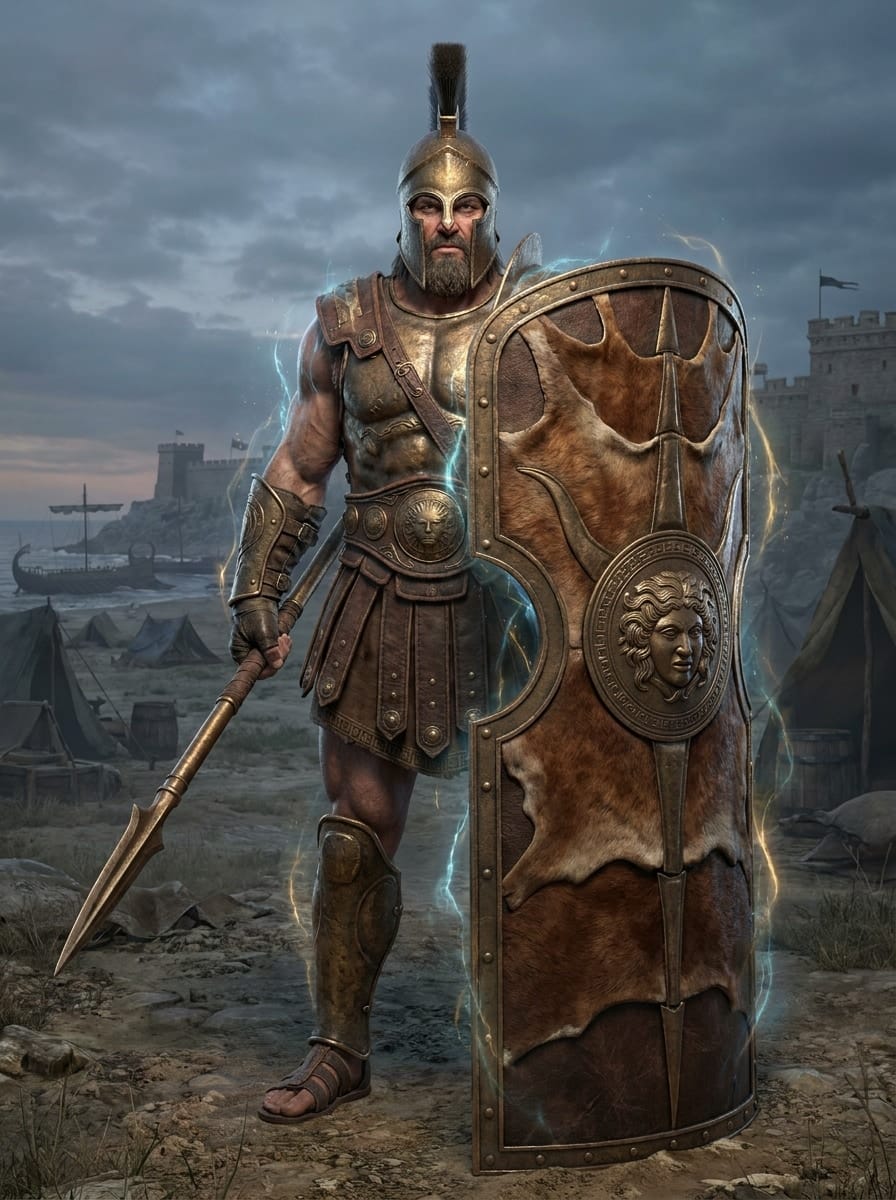
Ajax the Greater is one of the fiercest Greek heroes of the Trojan War, the son of Telamon, famed for his towering body, heavy shield, and courage in facing enemies head-on. He was chosen by lot to fight Hector and stood against him until dusk without yielding; after Achilles died, he guarded the body and held back the pursuing Trojans. But when Achilles’ divinely made armor was awarded to Odysseus, his sense of honor was shattered by shame, rage, and madness, and he finally took his own life, becoming a tragic image of Greek heroic glory and vulnerability intertwined.
Domain
Trojan War, heroic combat, shield defense, honor and humiliation, tragic death
Symbols
Great shield, spear, Hector’s sword, Achilles’ armor, ships of Salamis
Article
Origins and Lineage
Ajax the Greater comes from Salamis and is the son of Telamon, often called “Ajax son of Telamon” to distinguish him from Lesser Ajax, son of Oileus. He belongs to the company of Greek heroes who sailed against Troy, fighting in the camp alongside Achilles, Odysseus, Diomedes, Menelaus, and others. In tradition, he does not win fame through cleverness, prophecy, or kingship, but through his body, his shield, and a battle-will that refuses to retreat.
Divine Role and Attributes
Ajax the Greater is not a god, but a hero of war. His central traits are defense, strength, silent courage, and a relentless attachment to honor. In the stories, he often stands like a stretch of city wall in the most dangerous place, using his massive shield to hold off showers of spears and protect comrades and corpses alike. He lacks Odysseus’ eloquence and political cunning, and he does not have Achilles’ almost superhuman speed; his authority comes from facing the enemy directly, speaking little, and refusing to be crushed by disgrace. For that very reason, his tragedy grows from the same bone: when achievement is disputed and honor is taken away by judgment, he cannot turn humiliation into endurance.
Major Myths
After Achilles withdraws from battle, Hector challenges the Greek army, and the Greek leaders cast lots to decide who will face him. Ajax the Greater draws the lot and walks beneath the walls of Troy to duel Hector. The two attack each other with spears, stones, and close combat, fighting until dusk without a victor. Nightfall forces them to stop, and they exchange gifts: Hector gives Ajax a sword, and Ajax gives Hector a belt. The duel shows Ajax’s standing among the Greeks—when Achilles, the strongest of them, is absent, the man able to meet Hector’s force head-on is Ajax the Greater.
After Achilles dies, another moment of Ajax’s glory becomes the turning point of his fate. Greeks and Trojans fight savagely over Achilles’ body; Ajax rushes to the corpse, shields the fallen hero with his great shield, and uses his own body to block the flying spears, while Odysseus maneuvers nearby in support and helps organize the Greek withdrawal back toward the ships. Later, Thetis places Achilles’ divinely made armor in the camp as a prize, to be awarded to the man who did the most to recover the body. Ajax believes that, with shield and body, he preserved Achilles and should rightly inherit that honor; Odysseus argues on the strength of his intelligence, eloquence, and strategic service. The decision ultimately favors Odysseus.
Defeat drives Ajax into shame and rage. In the tragic tradition, Athena deranges his mind: he intends to kill the Greek leaders, but instead mistakes livestock for his enemies and slaughters them. When he comes back to himself, he finds that he has lost not only the armor but also his dignity, and so he kills himself with the sword Hector gave him. This ending makes the gift from his duel with Hector bitterly ironic: respect on the battlefield becomes, in the end, the instrument of self-destruction. In the underworld scene of the Odyssey, Odysseus tries to make peace with Ajax’s shade, but Ajax silently walks away, showing that this wound to honor remains unhealed even after death.
Worship and Influence
In Greek tradition, Ajax the Greater is not only a warrior but also a major heroic memory of Salamis. Later literature especially values his tragic dimension: Homeric epic emphasizes his wall-like reliability in battle, while tragedy pushes his code of honor to the edge of collapse. His image joins two standards of heroism: one is open courage on the public battlefield, and the other is the order within the Greek coalition, where words, judgments, and politics measure merit. It is precisely at the collision point of these two standards that Ajax appears especially isolated.
Character Overview
Ajax the Greater’s strength is not complex, but it is not shallow. He is the kind of man who would rather stand in a rain of spears than bend himself in words. He protects the dead, faces Hector, and holds the camp beside the ships, proving himself the firmest shield of the Greek army; but he is also proud and unyielding, unable to endure the humiliation of being judged second-best by his companions. His story is not a simple hymn to martial courage, but a story about how heroic honor can sustain a person—and how, amid injustice, jealousy, divine interference, and one’s own fixation, it can crush that person as well.