Greek Mythology
Aeneas — Greek Mythology
Trojan Survivor and Exiled Founder
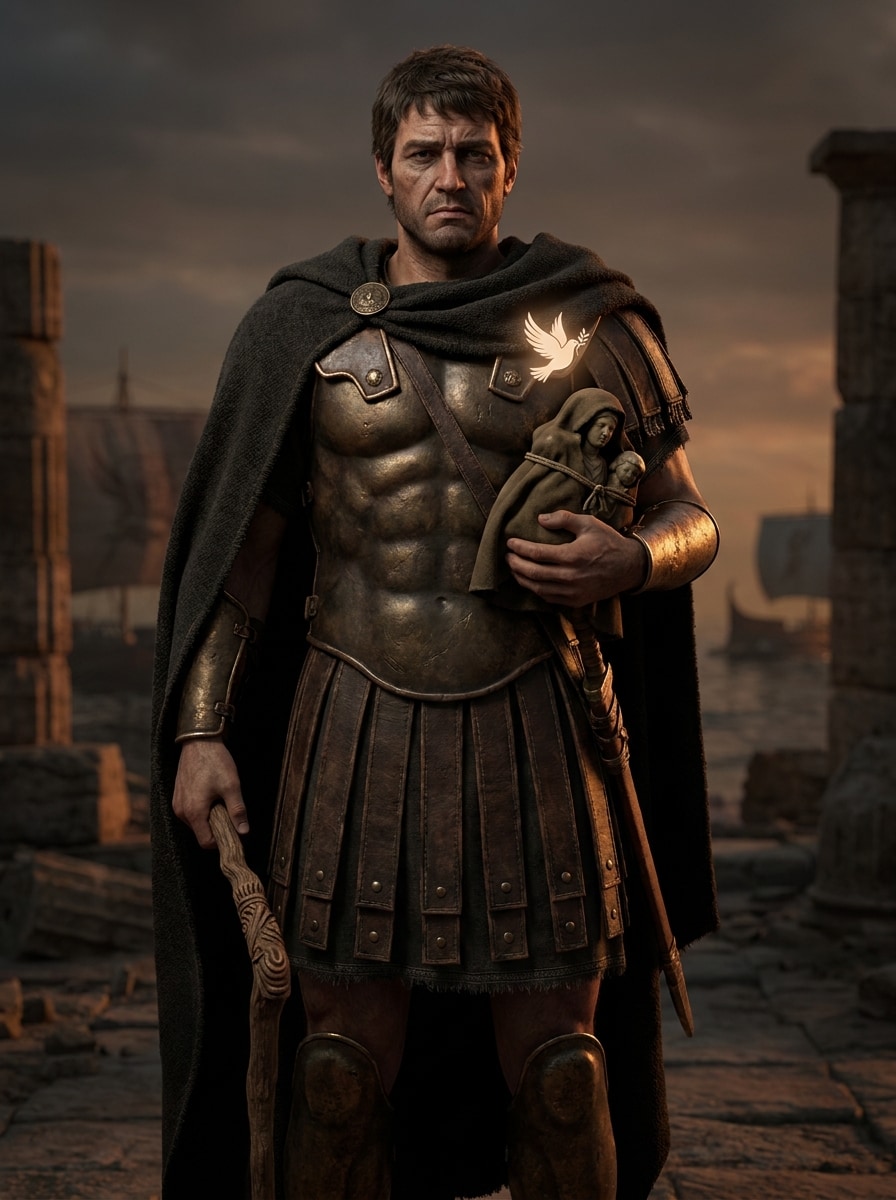
Aeneas is the son of Trojan royalty and Aphrodite: both a Trojan warrior protected by the gods in Homeric epic and, in later tradition, the exiled hero who carries his father, household gods, and surviving people out of the ruins. He is not remembered chiefly for simple victory, but for piety, endurance, duty, and the pain of being drawn onward by fate. In Greek material, he often stands behind Hector as Troy’s remaining hope; in later Roman tradition, he becomes the source of a new people’s and a new city’s memory.
Domain
Trojan War, exile, family inheritance, piety, founding ancestor, heroic bloodline
Symbols
Household gods, burning Troy, carrying his father, fleet, shield, Dardanian bloodline
Article
Origins and Lineage
Aeneas comes from the Trojan royal house. His father Anchises belongs to the line of Dardanus, while his mother is Aphrodite, goddess of love and desire. The Homeric Hymn to Aphrodite tells how the goddess, through Zeus’s design, fell in love with the mortal Anchises and bore Aeneas. From the beginning, then, his birth carries both glory and unease: he is the child of a goddess, yet he must endure war, loss, and migration among mortals. Aphrodite warns Anchises not to boast carelessly of this union between goddess and man, showing that Aeneas’s birth is not merely a gift, but the result of divine desire, Zeus’s order, and human frailty interwoven.
Divine Role and Attributes
Aeneas is not a god, but a hero. His strength does not appear as Achilles-like blazing glory, nor only as Hector-like guardianship of the city. His central attribute is to endure and carry forward. In the Iliad, he fights bravely and receives different forms of protection from Aphrodite, Apollo, Poseidon, and other gods, because fate does not allow him to perish before the walls of Troy. Poseidon even rescues him when he encounters Achilles, making clear that although Aeneas belongs to the side destined to lose, he is preserved as the future of the Trojan bloodline.
Major Myths
In the Trojan War, Aeneas is an important Trojan allied commander. He clashes with Diomedes and, after being wounded, is rescued by his mother Aphrodite; Aphrodite herself is then injured by a mortal hero, exposing the rift between divine kinship and the brutality of the battlefield. Apollo later shields Aeneas so that he can return to the fight. Still later, he faces Achilles and would nearly have been killed if Poseidon had not intervened. The Homeric tradition emphasizes that Aeneas is preserved not because he is stronger than every other hero, but because the gods and fate have reserved another road for him.
Later Greek compilations such as the Bibliotheca continue to preserve his identity as a Trojan survivor. Still later Latin tradition, especially Virgil’s Aeneid, expands his exile into a full foundation epic: he carries his father Anchises, brings the household gods out of burning Troy, endures wandering at sea, love and separation in Carthage, revelation in the underworld, and war in Italy. Although these episodes belong to Roman literary tradition, they deeply shaped later understandings of Aeneas: he is the man who sacrifices personal desire in obedience to a future mission, and the hero who transforms ruins into ancestral memory.
Worship and Influence
In the Greek world, Aeneas did not possess a unified and widespread cultic office like the Olympian gods, but as a Trojan survivor and symbol of the Dardanian bloodline, he connects Greek epic, local genealogies, and Roman origin narrative. Roman tradition especially strengthened his image of “piety,” presenting him as a figure who bears responsibility for father, gods, family, and the city to come. For this reason, Aeneas’s influence crosses the boundary between Greek heroic narrative and Roman state myth: he is not the conqueror who destroys a city, but the man who carries a flame out of a destroyed one.
Character Overview
Aeneas’s fascination lies in contradiction. He is the son of a goddess, yet often seems more passive than many heroes; he fights bravely, yet survives again and again through divine intervention; he represents the future, yet must first pass through the burning of his homeland, the scattering of his kin, and the sacrifice of private feeling. To call him only a perfect founding ancestor would erase his pain and hesitation; to see him only as a man led around by fate would underestimate his will to keep moving through the ruins. His heroism lies not in never wavering, but in carrying his father, household gods, and survivors toward the next chapter of history even after he has wavered.