Greek Mythology
Orpheus — Greek Mythology
The Thracian Singer and Walker of the Underworld
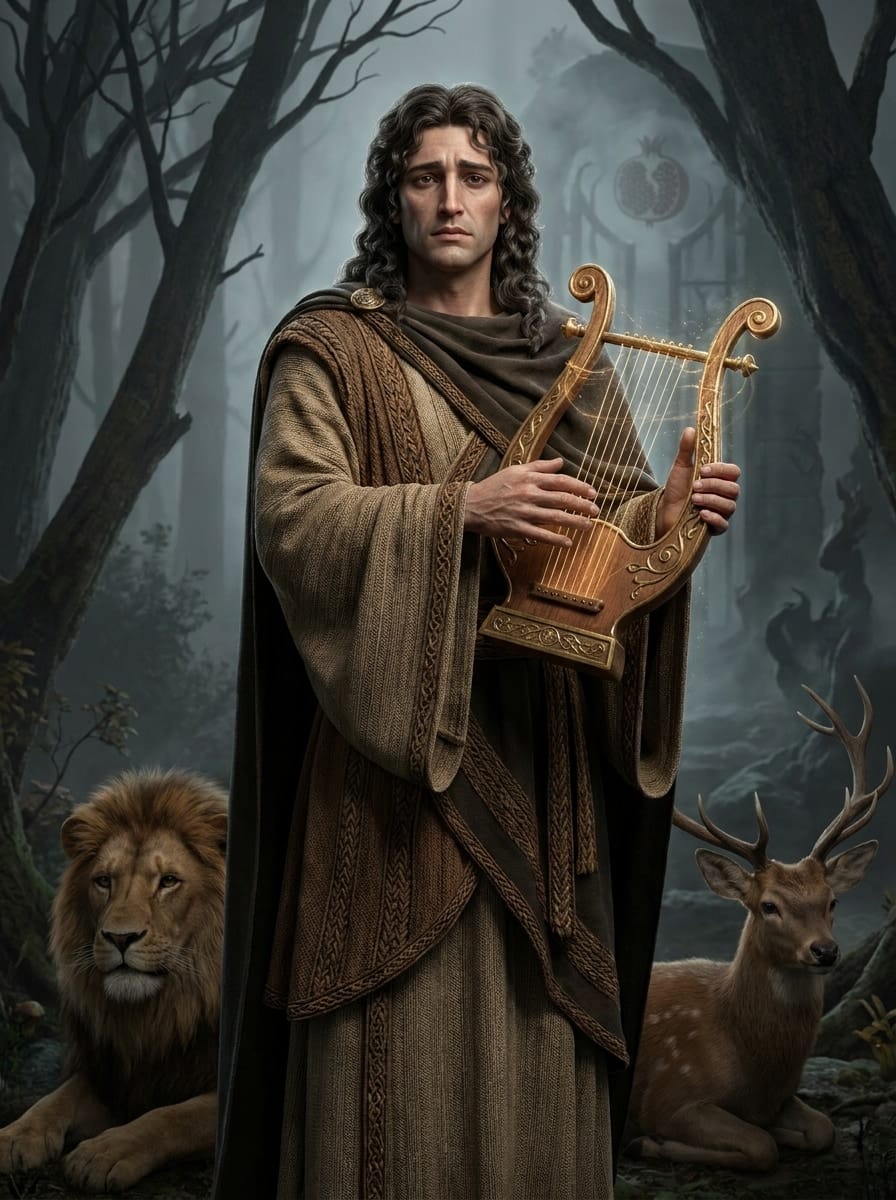
Orpheus is one of the most famous singers in Greek mythology, often said to be the son of the Muse Calliope and also linked to the lyre-playing Apollo bestowed on him. His song could soothe wild beasts, move trees, and even touch Hades and Persephone in the Underworld; yet at the final moment, while leading Eurydice back to the world above, he looked back and lost his beloved forever. Later, refusing new love, he sang in the hills and forests of Thrace until he was killed by frenzied Maenads. His head and lyre drifted away on the water, but in legend his song never truly ceased.
Domain
Music, poetry, song, mourning, descent to the Underworld, tragic love, mystery teachings
Symbols
Lyre, strings, singing voice, Thracian forests and hills, venomous snake, road to the Underworld, drifting head
Article
Origins and Lineage
Orpheus comes from Thrace and is a hero in Greek mythology famed for song rather than force. Traditions about his parentage do not fully agree: a common account names his mother as Calliope, one of the Muses, making him naturally close to poetry, memory, and sacred song; other tellings emphasize Apollo’s affection for him and say the god gave him the lyre or the art of playing it. Whatever the exact version, Orpheus’s identity is tightly bound to music, poetry, and divine inspiration. He is not a Heracles-like hero of strength, but a man whose voice passes through wilderness, ship’s hold, and the threshold of the dead.
Divine Roles and Attributes
Orpheus is not an Olympian god, yet his singing has an almost miraculous power. When he plucks the lyre, wild beasts fall quiet, trees draw near, and rivers seem to lower their voices; in the tradition of the Argonauts’ voyage, his song can also hearten his companions and resist dangerous temptation. His power does not lie in command but in moving the heart: stones, trees, animals, the dead, and the gods of the Underworld can all soften for a time because of his music. For that very reason, he also reveals a profound limit—his song can make death yield, but it cannot abolish death; it can move everyone, yet it cannot guarantee that he himself will keep faith amid fear and longing.
Major Myths
Orpheus’s best-known story is the tragedy of him and Eurydice. Not long after their marriage, Eurydice was bitten by a venomous snake in the grass and died; some traditions connect the accident with the pursuit of Aristaeus. Grieving, Orpheus descended into the Underworld with his lyre, using his song to move the ferryman, the guard dog, and the suffering dead, until at last he came before Hades and Persephone and begged them to return his wife. The lord and queen of the dead made an exceptional concession and allowed Eurydice to follow him back to the world above, on one condition: until he had left the darkness and seen the sunlight, he must not look back at her.
Orpheus agreed to the condition, but as he neared the surface and could not hear footsteps behind him, his resolve faltered. Afraid that Eurydice was not truly following, he finally turned around. That single glance let him see his wife—and lose her for a second time. Eurydice was drawn back into the darkness of the Underworld, and this time she could not return. This moment makes Orpheus a symbol of love, mourning, failed trust, and the limits of being human: his greatest gift almost defeats death, only to be overcome by doubt at the final step.
In later stories, Orpheus returned to Thrace and accepted no new love, singing only of Eurydice among hillsides, woods, and riverbanks. The rejected Thracian women, especially against the background of Dionysian frenzy, attacked him out of humiliation and resentment. At first, stones and branches seemed softened by his song and fell at his feet; but drums, cymbals, and wild cries eventually drowned out the lyre, and the Maenads killed him. Legend says his head and lyre drifted down the river, still singing; some accounts let him meet Eurydice again in the Underworld after death.
Worship and Influence
In Greek tradition, Orpheus is not only a story figure but also an important name in poetry, music, mystery teachings, and ideas about the fate of the soul after death. Later ages attributed various religious poems, purification ideas, and knowledge of the Underworld to “Orpheus,” making him a figure poised between hero, singer, revealer, and witness of the dead. Poets, musicians, and artists have retold his story again and again because it pushes the power of music to its limit: song can make gods weep and briefly open hell, but it cannot free human beings completely from loss, doubt, and death.
Character Overview
Orpheus’s fascination lies in the fact that his gentleness and his failure are equally real. He can make the world listen, but he cannot keep himself free from fear; he loves Eurydice deeply, yet it is because of love that he looks back; he soothes beasts and spirits with his song, yet cannot calm the resentment of the rejected or the madness of Dionysian revelry. He is not simply a perfect saint of art, nor merely a sorrowing lover, but a hero who stakes his whole life on song: when the lyre sounds, the world becomes soft for a while; when the lyre is swallowed by uproar, he is as fragile as any mortal.