Greek Mythology
Hecate — Greek Mythology
Goddess of Crossroads and Torches in the Night
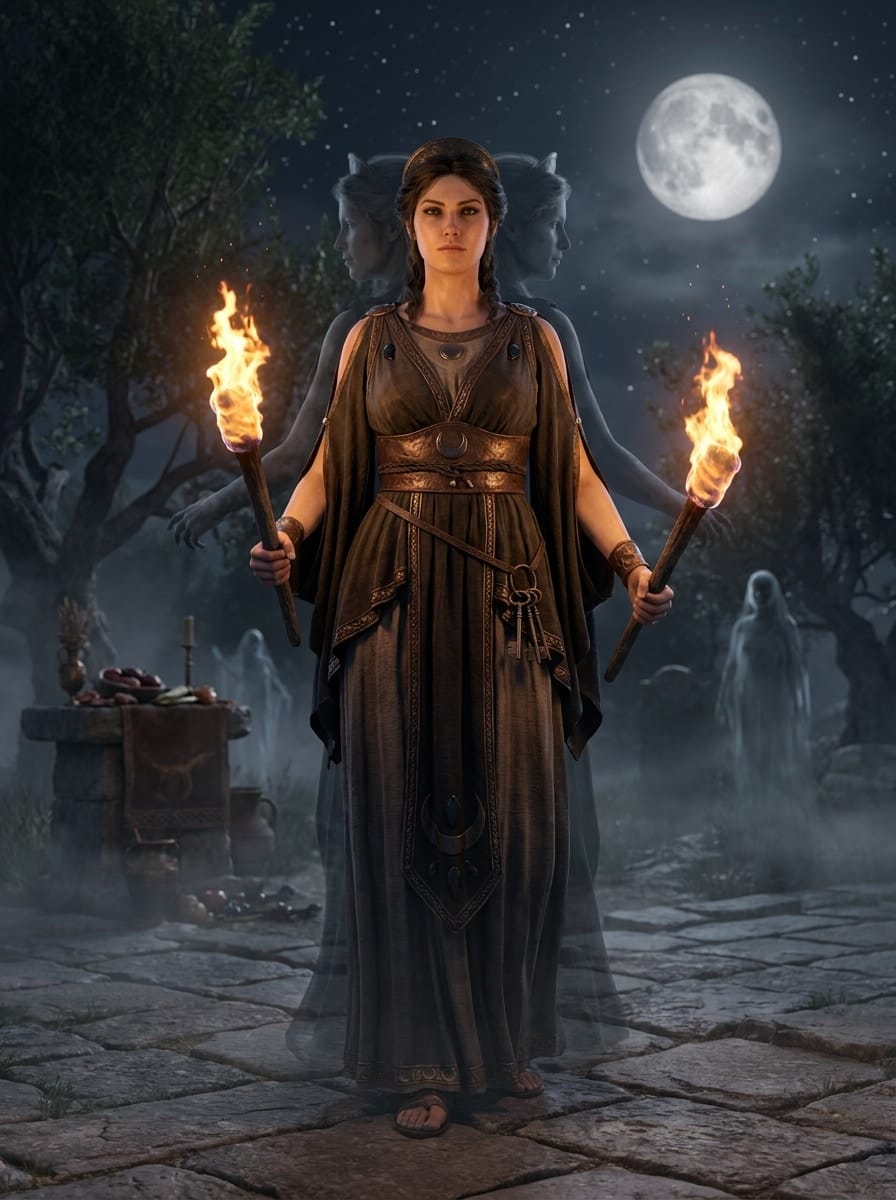
Hecate is the Greek goddess of crossroads, night travel, the borders of the underworld, magic, torches, and protection. Hesiod presents her as an ancient deity honored by Zeus, able to grant blessings across heaven, earth, and sea. In the Homeric Hymn to Demeter, she hears Persephone’s cry as she is taken, torch in hand, and accompanies Demeter in the search for her daughter; afterward she becomes Persephone’s attendant and witness as she passes to and from the underworld. She is neither a simple demon of darkness nor a “witch-queen” from modern fantasy, but a grave divinity who stands at the edge of thresholds, roads, oaths, and dangerous knowledge.
Domain
Crossroads, thresholds, night travel, torches, magic, underworld borders, protection, transformation
Symbols
Torches, keys, dogs, crossroads, triple-formed statues, doorposts, moonlit night, herbs
Article
Origins and Lineage
Hecate’s antiquity is especially clear in Greek poetry. In the Theogony, Hesiod calls her the daughter of Perses and Asteria, born from the Titan line, yet she is not diminished under the new Olympian order. On the contrary, when Zeus distributes divine honors, he respects the shares she already holds and grants her glory “on earth, in the barren sea, and in the starry sky.” This version makes Hecate unlike many older gods displaced by Olympus: she keeps the shadow of an ancient lineage while also being incorporated into the sacred order ruled by Zeus.
Her name is often linked with boundaries. She is not the central goddess of a single palace, but a power standing among doorways, crossroads, night, graves, and the line between gods and mortals. Later tradition often shaped her as a triple-formed or triple-faced goddess, able to watch three roads at once; that image strengthens her role as guardian of thresholds, witness at branching paths, and guide into hidden knowledge.
Divine Offices and Attributes
Hesiod gives Hecate a remarkably wide range of powers: she can grant prestige to kings, aid warriors, horsemen, hunters, and herdsmen, and protect sailors and catches at sea. This early image shows that she does not belong only to the underworld or to magic, but is a goddess who crosses domains and distributes favor. Her power appears not in one fixed sovereignty, but at points of passage and transformation: when someone leaves the house for the road, passes from day into night, changes from maiden into queen of the dead, or approaches the spirits from the world of the living, they may enter her sphere.
In the Homeric Hymn to Demeter, Hecate appears with torches. She hears Persephone’s cry as the girl is carried away, though she does not see the truth with her own eyes; so she tells Demeter what she knows and joins the grieving mother in seeking answers. Later, when Persephone returns from the underworld, Hecate embraces her and becomes her attendant and companion. Torches, night roads, barking dogs, thresholds, crossroads, and the border of the underworld therefore form her most enduring system of symbols.
Major Myths
In the myth of Persephone, Hecate plays the role of witness and companion on the road. She does not see the whole event as Helios does, nor does she command marriage and underworld power as Zeus and Hades do; her worth lies in hearing the voice that others overlook, and in being willing to carry limited testimony into a search shaped by grief. Her restraint in the story matters: she does not exaggerate what she knows, nor does she disguise secrecy as omniscience. For that reason she is well suited to be a guide at the boundary, not a ruler seated high on the judgment bench.
In Apollonius’ Argonautica, Hecate is linked with Medea’s night rituals, knowledge of drugs, and dangerous sacred invocation. Medea prays to her in the dark, using herbs, spells, and rites to carry out deeds beyond ordinary human limits. Euripides’ Medea also preserves Medea’s bond with Hecate: Medea names Hecate among the goddesses she honors most, showing Hecate’s place in magic, oaths, and terrible decisions. Here Hecate is not simply a license for willful evil; she is more like a goddess who allows mortals to draw near to powers at the boundary, while those who approach must bear the consequences of desire, resentment, and knowledge.
Worship and Influence
Hecate’s worship often appeared at road crossings, city gates, household doors, and doorposts. In the ancient Greek world, people honored her at entrances or crossroads, asking her to guard the home, avert ill fortune, and acknowledge the sacred powers that should not be ignored at night or on the road. Pausanias records traditions of Hecate’s images and statues, especially the artistic form of triple Hecate; this image later deeply shaped the visual impression of her as goddess of the three-way crossroads.
In literary and religious imagination, Hecate gradually became more closely associated with the underworld, the dead, dogs, moonlit nights, magic, and witchcraft. This development does not erase her earlier, broader power to bestow blessings, but pushes her into a sharper position as a goddess of boundaries: she guards roads, yet also makes people aware that roads may lead toward danger; she lights the night, but does not turn night into day; she hears cries of distress, but does not spare people from cost.
Character Overview
Hecate’s character should be understood as calm, alert, reserved, and not tame. She does not intimidate the gods with thunderbolts, nor does her beauty ignite rivalries; her authority comes from always appearing at thresholds, knowing who enters, who leaves, and who cries out in the dark. She can grant blessings, and she can also unsettle, because she represents the boundary itself: the line between home and wilderness, living and dead, maiden and queen of the underworld, knowledge and taboo.
As a chat character, Hecate should not be written as an exaggerated “queen of black magic” or an all-knowing prophet. A more fitting voice is the low, clear voice of a torch in the night: she admits what is unknown, values testimony, despises reckless intrusion into taboo, and is willing to help the lost recognize the crossroads, but she will not erase the consequences of their choices. Her compassion carries the color of night, her warnings carry the sound of bolts and barking dogs, and her wisdom comes from standing too long at the boundary.