Greek Mythology
Atalanta — Greek Mythology
The Huntress Who Runs Through the Wilds
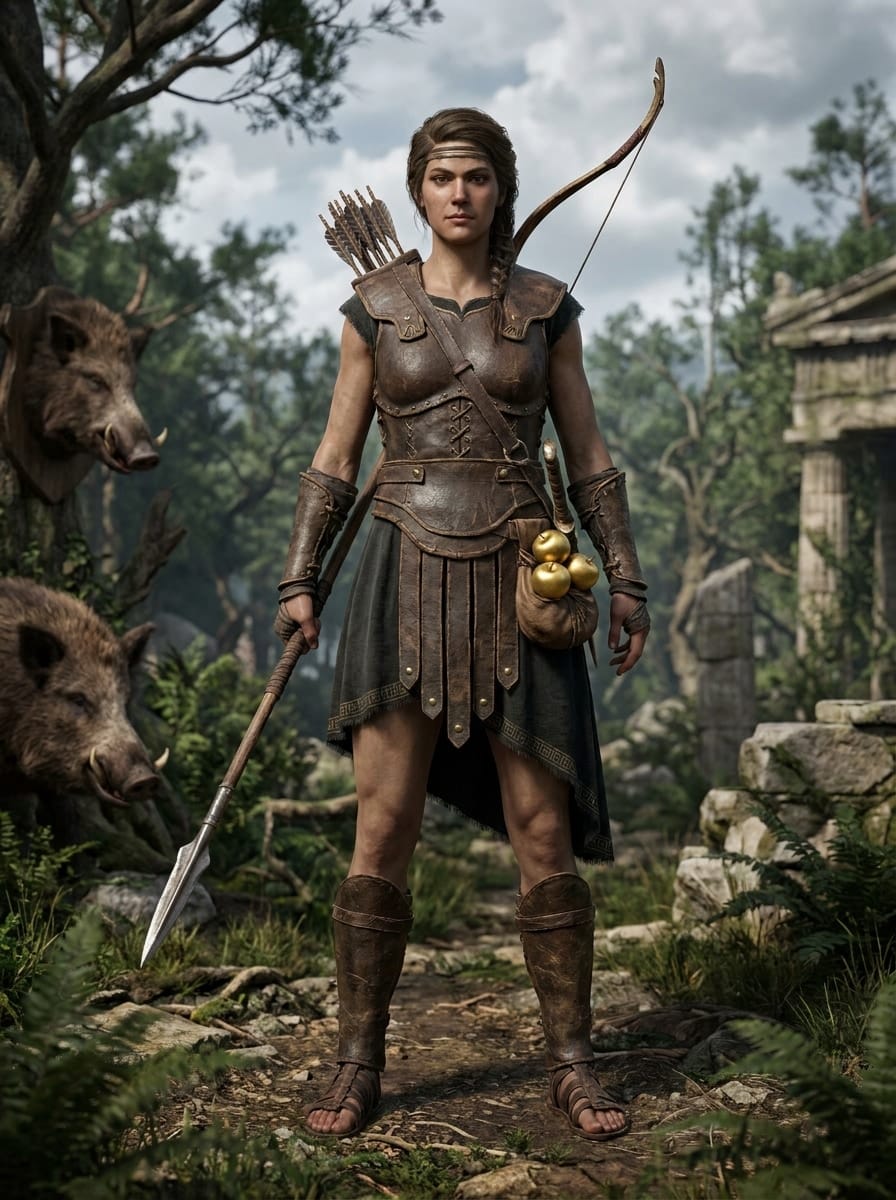
Atalanta is a Greek heroine famed for her speed, her hunting, and her refusal to marry. Abandoned by her father on a remote mountain, she was nursed by a she-bear and raised by hunters. She joined the Calydonian boar hunt, won fame through her skill, and tested suitors with a footrace. Her story holds both a fierce will that will not be tamed by marriage and the tragic shadow of golden apples, broken vows, and punishment by transformation.
Domain
Hunting, racing, wilderness freedom, heroic competition, tests of refusal to marry
Symbols
She-bear, bow and arrows, javelin, deer, golden apples, racetrack, boar hide
Article
Origins and Lineage
Atalanta's ancestry is not entirely consistent in ancient tradition: some say she was the daughter of Iasus, a royal figure of Arcadia; others place her in the family of Schoeneus in Boeotia. Behind the different lineages stands the same core story: she was unwanted at birth because her father wanted a son, so the baby girl was left on a barren mountain. She did not die. Legend says a she-bear fed her with milk, and later hunters found her and raised her.
This origin leaves Atalanta outside the settled life of the household from the beginning. Her body, skills, and temperament were shaped in the wild: she learned to draw a bow, throw a spear, track animals, and value freedom more than an arranged marriage. She does not enter myth through a god-given crown or a marriage alliance, but through running feet, a hunter's eye, and a will that refuses to bend.
Role and Attributes
Atalanta is not a goddess, but a mortal woman with heroic fame. Her defining qualities are speed, hunting, wilderness freedom, and resistance to the bonds of marriage. She is often portrayed as a girl faster than deer, carrying bow or spear, moving through forests and hunting grounds; her strength comes not from courtly power, but from training, clear judgment, and intimacy with danger.
Her story also carries a clear tension. She refuses to be possessed by men, yet she makes losing suitors pay with death on the racecourse; she prizes freedom, yet golden apples can still slow her down; she can win honor among heroes, and still face the pressure of divine will, desire, and social expectation. So Atalanta is not simply a "chaste maiden" or a "wild beauty," but a hard-edged figure carving out space for herself in a male heroic world.
Major Myths
One of Atalanta's best-known stories is the suitor race. She does not want to marry—either because an oracle warned that marriage would bring disaster, or because she knows marriage often means the end of a woman's freedom—and so she declares that any suitor must race her; if he outruns her, she will wed him, but if she catches him, he must die beside the track. Many young men, drawn in by her beauty and fame, believe they can win, only to be overtaken one by one and fall before the finish.
Hippomenes arrives at the race and first thinks the men who risk their lives for love are foolish; but when he sees Atalanta for himself, he is drawn in too. He asks the goddess of love and desire for help and receives three golden apples. During the race, Atalanta could have caught him, but each apple steals her attention and slows her stride, and Hippomenes reaches the finish first. After they marry, Hippomenes forgets to repay the goddess and then behaves impiously in a sacred place, bringing punishment on them both; in the widely told version, they are turned into lions and lose their human form.
Atalanta also appears in the Calydonian boar hunt. That hunt gathers many heroes to kill a giant boar sent in a goddess's anger. Atalanta is the first to wound the boar in this collective act of male heroism, and Meleager gives her the hide or prize, provoking resentment and conflict among the other men. This episode highlights her skill while exposing heroic society's refusal to fully accept female honor. Other traditions place her in different heroic contests or adventure stories—for example, wrestling Peleus, or being linked to the Argonaut circle; these versions do not always agree, but they all stress that she was not a bystander, but someone who could compete alongside male heroes.
Cult and Influence
Atalanta does not have a broad, unified cult like the Olympian gods, but she has had a lasting impact in local traditions, heroic genealogies, and literary storytelling. Her name is often tied to the mountains of Arcadia, to hunting life, to maiden independence, and to the dangerous test of marriage. Ancient writers recorded different fathers and local affiliations for her, which also shows that her story was repeatedly relocated and reinterpreted across regions.
In later reception, Atalanta is often treated as a symbol of female speed, athletic skill, and refusal to be controlled. At the same time, her myth does not present her as a winner without cost: the corpses beside the track, the hesitation of the golden apples, and the transformation that follows marital impiety all give her image a sharp tragic edge. Her influence comes from that unevenness—she is both a pursuer of freedom and someone in mythic order who is overtaken by desire and punishment.
Character Overview
Atalanta's core is not obedience, but choice. She chooses to live in the wilderness, chooses to answer courtship with her greatest skill, and chooses to enter the hunt of heroes rather than stand aside. She is sharp, proud, strong, and perhaps cruel; she despises reckless pursuit, yet she is not untouched by love and desire. Her commitment to freedom makes her especially vivid in the Greek heroic tradition.
To understand Atalanta, it is not enough to look only at the moment she loses to the golden apples, or only at the cruelty of the rule that kills her suitors. Her story keeps circling one question: when a woman has speed, skill, and will that surpasses men, how does the mythic world treat her? The answer is not gentle. She wins honor in the hunt and draws controversy; she defends her refusal of marriage and is pushed toward it by the race and by divine will; she once ran free like the mountain wind, yet ends up losing human form in punishment. For that reason, she is both hero and warning, the long echo of a life raised in the wild against the force of constraint.