Greek Mythology
Oedipus — Greek Mythology
The Tragic King of Thebes Who Solved the Riddle of the Sphinx
Oedipus was the son of King Laius of Thebes and Queen Jocasta. Because of an oracle that foretold he would “kill his father and marry his mother,” he was abandoned as an infant on Mount Cithaeron, but was rescued and raised in Corinth. He left home to escape the oracle, only to kill his true father at a crossroads; after solving the riddle of the Sphinx, he became king of Thebes and married his true mother. Later, while investigating the source of a plague, he uncovered the truth with his own hands, blinded himself, and went into exile, ending his life at Colonus under the protection of Theseus and with Antigone beside him.
Domain
Theban kingship, tragic hero, riddles and questioning, oracles and fate, exile, protection at Colonus
Symbols
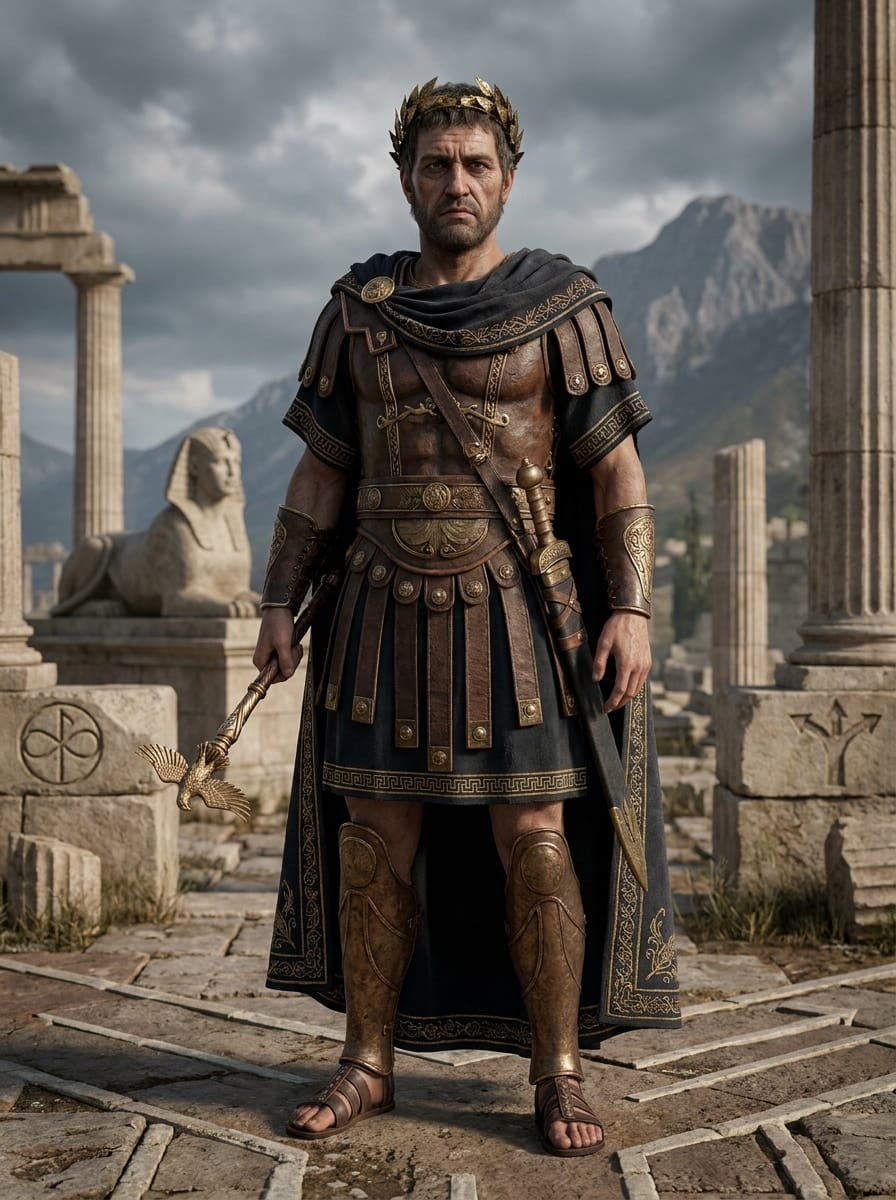
swollen ankles, crossroads, riddle of the Sphinx, royal scepter, golden pins, blinded eyes, Antigone’s hand, sacred grove of Colonus
Article
Origin and Lineage
Oedipus was born into the royal house of Thebes, the son of Laius and Jocasta. From the beginning, his birth was overshadowed by prophecy: Laius had heard an oracle from Apollo that if he had a son, that son would kill his father and marry his own mother. When the boy was born, there was no celebration in the palace, only fear. Laius ordered the child’s ankles pierced and gave him to a shepherd to be exposed on Mount Cithaeron, hoping that wilderness, hunger, and beasts would destroy the future disaster for the royal house.
The shepherd could not bring himself to kill the infant and handed him over to a man from Corinth. The child was taken to Corinth and adopted by King Polybus and Queen Merope. Because his injured ankles were swollen, he was named Oedipus. As a young man, Oedipus believed the Corinthian royal family was his true kin, until a taunt at a banquet shook his sense of identity. He went to Delphi to ask about his birth, but received instead the oracle that he would “kill his father and marry his mother.” To protect the parents he believed were his own, he left Corinth and set out on the road toward Thebes.
Divine Roles and Attributes
Oedipus is not a god, but one of the most tragic heroes and kings in Greek mythology. His power does not lie in miracles, but in keen intelligence, forceful will, and a temperament that refuses to stop questioning. That same gift allows him to solve the riddle of the Sphinx and save Thebes from terror; and that same temperament drives him, during the plague, to interrogate prophets, shepherds, and messengers until every clue from the old blood-crime leads back to himself.
His defining attributes contradict one another: he is the savior of the city, yet also the source of its pollution; he is the solver of riddles, yet for years does not know his own origin; he once possesses kingship, marriage, and children, but ends as a blind exile. The story of Oedipus binds together “sight” and “ignorance,” “fate” and “choice,” “the pursuit of justice” and “the destruction of the self.”
Major Myths
The fate of Oedipus is joined together by several decisive actions. To evade the oracle, he leaves Corinth, but at a crossroads he clashes with a party of travelers and a chariot. Young and proud, he refuses to yield, and in the quarrel and rage that follow he kills the old man in the chariot and his attendants. He does not know that the old man is Laius, king of Thebes, and his own birth father; he believes he has killed an arrogant stranger, when in truth he has already fulfilled the first half of the oracle.
Near Thebes, Oedipus encounters the Sphinx, who has taken possession of the road. The monster kills by riddles and has plunged the city into fear. Oedipus gives the correct answer, and the Sphinx destroys herself; the Thebans therefore give him the throne and marry him to Jocasta, the widow of the former king. Years later, a plague strikes Thebes, and an oracle declares that the city can be purified only by finding the killer of Laius. Oedipus publicly swears to hunt down the murderer, summons Tiresias, questions Creon, presses Jocasta and the surviving shepherd, and hears from a Corinthian messenger that he was not Polybus’s natural son. At last, the shepherd’s testimony brings every clue together: the abandoned infant, the adopted son of Corinth, the killer at the crossroads, and the king of Thebes are all one man.
When the truth is revealed, Jocasta takes her own life. Oedipus blinds himself with the golden pins from her garments and asks to be exiled. He loses both his throne and the light of day, and later wanders in exile supported by his daughter Antigone. When he reaches Colonus, outside Athens, he enters the sacred ground of the dread goddesses and recognizes it as the endpoint foretold by prophecy. Creon and Polynices both try to use the protective power that the place of his death will bring, but Oedipus entrusts his final resting place to Theseus, king of Athens, and departs this life amid a mysterious summons, leaving his blessing to the land that received him.
Worship and Influence
The mythic core of Oedipus is preserved in the Theban Cycle and in the Athenian tragic tradition, especially in connection with Sophocles’ Oedipus Tyrannus, Oedipus at Colonus, and the family background of Antigone. He is not simply a victorious hero, but a tragic figure known for devastating knowledge: his wisdom saves the city, and also reveals the pollution of the city and of himself; his pursuit of justice does not defeat an external enemy, but turns the man on the throne into the one on trial.
In the Colonus tradition, the later life of Oedipus also takes on a heroic coloring. After blindness, exile, and humiliation, he does not end merely as a polluted man, but becomes, within sacred ground and under Athenian protection, a dead hero capable of granting blessing or protection. This ending does not erase his guilt or suffering, but it changes his meaning: he is both a man shattered by fate and a man who uses his final choice to decide where he belongs.
Character Overview
Oedipus cannot be reduced to an innocent victim, nor to a guilty tyrant. It is true that he walks unknowingly into the net of prophecy, but his rage at the crossroads, his suspicion of Tiresias and Creon, and the violence of his questioning of the shepherd all show that his own character takes part in shaping the tragedy. At the same time, he dares to bear the anxiety of the whole city during the plague, dares to hear the oracle before everyone, dares to investigate to the end, and dares to punish himself in the face of truth.
For this reason, Oedipus is best understood as a tragic personality of relentless questioning. His life begins with wounded feet, passes through mistaken kinship, blood on the road, victory over a riddle, the splendor of kingship, and judgment amid plague, and finally enters the exile after blindness and the rest of Colonus. He reminds us that a person may solve the monster’s riddle through intelligence, yet still fail to see himself clearly; and once truth has been summoned, it will not punish only one’s enemies.