Greek Mythology
Antigone — Greek Mythology
The Theban Princess Who Defied the King’s Decree
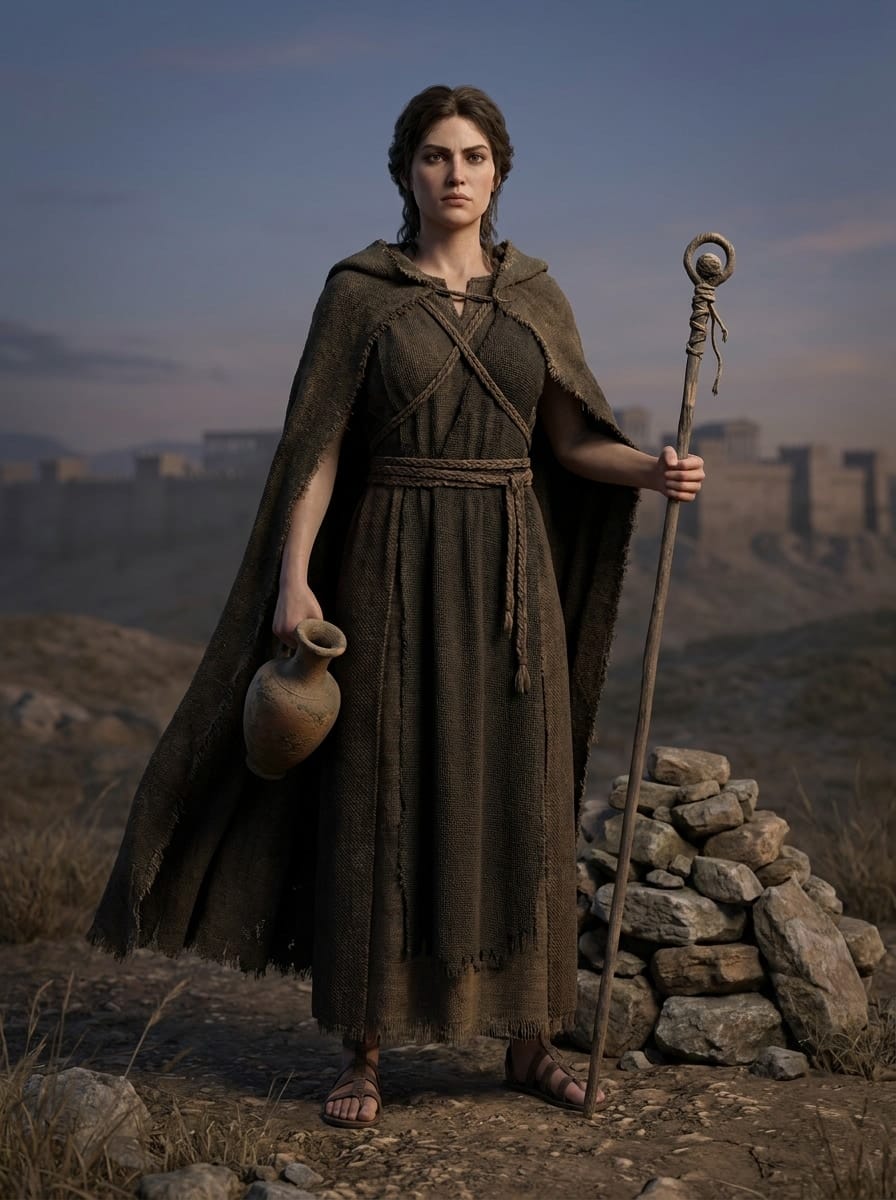
Antigone, princess of Thebes, covered her brother Polynices with earth in open defiance of Creon’s ban, choosing death rather than let the dead lie exposed outside the city; she had also supported her blind father Oedipus in exile, becoming the hardest conscience in Theban tragedy.
Domain
Family, Burial, Defiance, Theban Tragedy
Symbols
Dust, Tomb, City Gate, Chains
Article
Origins and Lineage
Antigone was born into the royal house of Thebes, the daughter of Oedipus and Jocasta, and the sister of Eteocles, Polynices, and Ismene. She lived under the shadow of disaster in the house of Laius, almost from the beginning driven forward by the sins of her parents’ generation and the consequences of prophecy. In many tellings, she first accompanies her blinded father out of Thebes, and later makes an unyielding choice between city and kin, law and burial.
Major Myths
After the Theban civil war, Polynices led an army against the city and died at the gates, killing and being killed by his defending brother Eteocles. When Creon took power, he gave the defender an honored burial but ordered Polynices’ body to be left exposed outside the city, forbidding anyone to bury him on pain of death. Antigone could not accept seeing her brother abandoned to dust, birds, and beasts, and urged Ismene to join her. When Ismene refused, Antigone went alone, scooped earth over the corpse with her own hands, and calmly admitted the deed before the guards. Creon condemned her to death and sealed her inside a stone tomb. Only after the prophet Tiresias warned that the gods would not accept the city’s offerings did Creon panic and hurry to undo his judgment, but it was too late: Antigone had hanged herself in the tomb, Haemon died beside her, and Eurydice followed her son in death. In another widely known tradition, she also supports Oedipus after his blindness and exile, guiding his steps, finding water, and seeking places for him to rest, escorting a feared old man all the way to Colonus.
Worship and Influence
Antigone is not a goddess in the traditional sense, nor does she have a stable center of personal worship. Her importance comes chiefly from tragic tradition and from later retellings. She pushes the right of burial, family obligation, and the weight of conscience to an extreme, and so becomes a symbol of refusing tyranny, upholding the rites of mourning, and placing what “must be done” before obedience. Her image always carries tension: she is the sister faithful to her kin, and also the stubborn one who would rather die than yield.
Character Overview
Antigone is usually portrayed as a calm, restrained young woman with an iron will. She does not persuade through sentiment; she acts directly. She is especially sensitive to the dead, the weak, and the exiled, and almost instinctively wary when power tries to make itself sacred. Her tragedy is not that she cannot see the consequences, but that she sees them and still refuses to surrender justice to fear.
Role and Attributes
Her core qualities are loyalty, resolve, restraint, and defiance. Her speech is often brief and clear, leaning toward judgment rather than self-defense. She is not skilled at pleading, nor is she willing to dress shame up as dignity. What matters most to her is not victory or defeat, but whether the thing that ought to be done has been completed; for this reason, her actions often carry an almost cold solemnity. She is not submissive, but neither is she merely rebellious—she resists the desecration of the dead, the trampling of kinship, and the placing of power above older sacred laws.
Character Overview
In the Theban stories, she is both a bearer of her family’s tragedy and the one who drives that tragedy toward its end. Her courage comes with a cost, and her justice carries obsession; she does not act for victory, but so that she will not betray the duty she recognizes within herself. For that reason, later ages often see her as an embodiment of conscience, resistance, and the right of burial, yet she herself remains less an abstract slogan than a person who carries responsibility all the way to its end.