Greek Mythology
Cadmus — Greek Mythology
Founder of Thebes
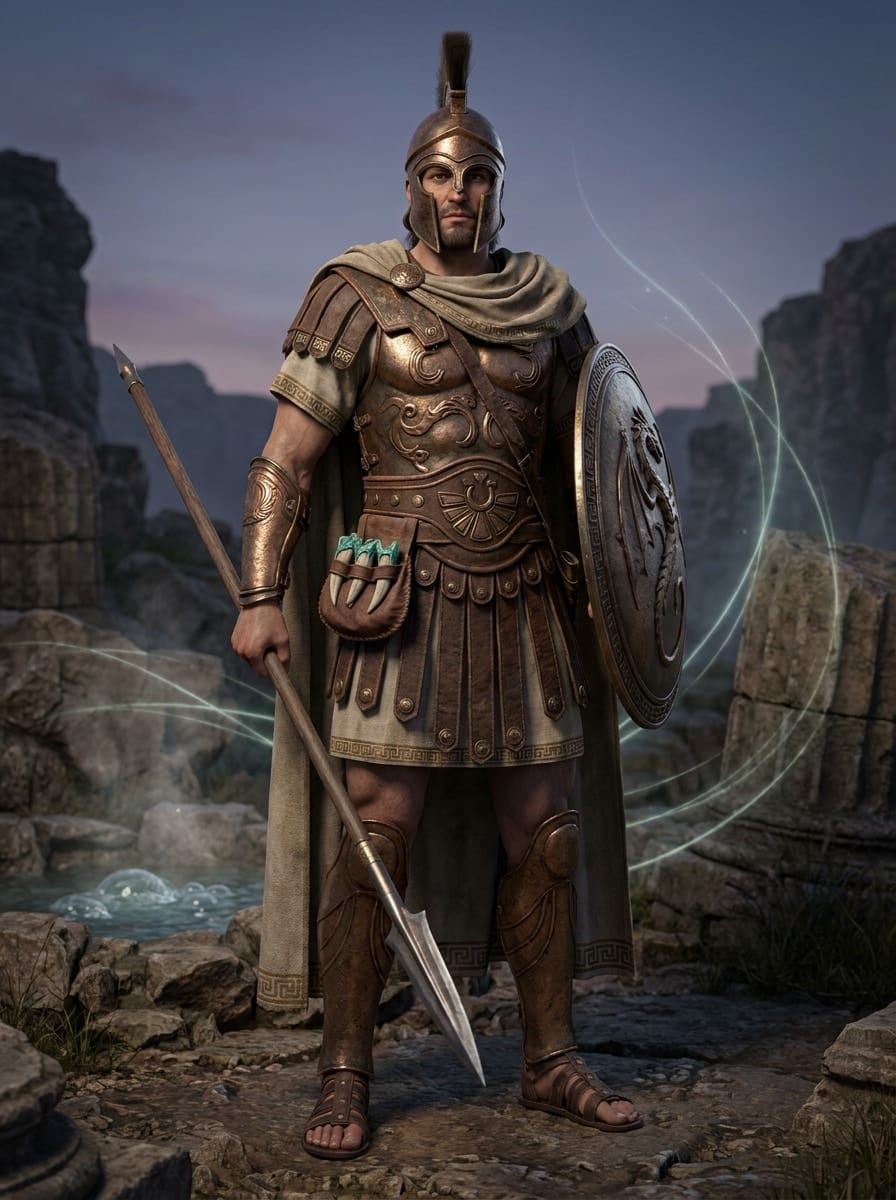
Cadmus is a Phoenician prince and the founder of Thebes. In search of Europa, he travels into foreign lands, follows a cow in obedience to the Delphic oracle, kills the venomous dragon by a spring, sows warriors from dragon’s teeth, and must serve Ares in atonement for slaying the dragon. His story binds wandering, city-founding, and cost tightly together.
Domain
City-founding, Kingship, Migration, Search for kin, Atonement
Symbols
Cow, Dragon’s teeth, Venomous dragon, City walls, Spring water
Article
Origin and Lineage
Cadmus comes from the house of Agenor, king of Phoenicia, and is the brother of Europa. After Zeus carries Europa away in the form of a bull, his father orders his sons to sail out in search of her and forbids them to return home without their sister. Cadmus therefore leaves his wealthy homeland by the sea, searching along coasts and through inland country, until the man looking for someone lost becomes an exile driven by divine will onto unfamiliar ground.
Divine Role and Attributes
Cadmus is not a god, yet in Greek mythology he carries a role almost like that of a founder. His most important quality is not martial strength itself, but obedience to prophecy, endurance of consequences, and the creation of order between ruins and foreign soil. He can hesitate, and he can grow weary; he can lose kin, and still keep moving. For him, founding a city is not an ornament of glory, but the hard work of forcing fate down onto the earth.
Major Myths
Cadmus asks Apollo at Delphi where Europa has gone. The oracle does not give his sister back to him, but commands him to follow a cow that has never borne the yoke and to build a city wherever the cow lies down. He obeys, and the cow finally stops in the land of Boeotia. Cadmus prepares a sacrifice there, but the attendants he sends to fetch water are killed by a venomous dragon guarding the spring; he then fights the dragon and kills it. Afterward, by divine instruction, he sows the dragon’s teeth, and fully armed warriors rise from the earth. In the end only a few survive, and together with Cadmus they raise the walls that become the beginning of Thebes.
Because he has killed the dragon of Ares, Cadmus must also serve the war god in atonement. This gives his city-founding story a heavy cost: the city stands not only through divine favor, but also through blood-debt, obedience, and compensation. Years later, he marries Harmonia, and the gods attend the wedding, turning his story from the search for his sister, the killing of the dragon, and the founding of a city toward another fate where gods and mortals are entangled.
Worship and Influence
Cadmus does not have widespread temple worship like the Olympian gods, but in Theban tradition he holds immense foundational importance. He is the city’s first memory and the starting point of the later heroic families’ glory and disaster. Thebes would later pass through repeated rises and falls, and its related myths often trace everything back to Cadmus’s arrival: a cow, an oracle, a venomous dragon, and a band of warriors grown from the ground form the earliest narrative frame of the city.
Character Overview
Cadmus is often portrayed as steady, cautious, and able to endure a long road. He does not triumph through extravagant divine power, but through waiting, judgment, and persistence, turning strange land into a city. Yet there is nothing light about his image: he travels far for his family, kills because of a command, and atones in order to found a city. For that reason, he resembles both a founder of a kingdom and a survivor repeatedly driven onward by his age and by divine will. To understand him, one cannot look only at the result—“the founding of Thebes”—but must also look at the long, weary, blood-marked road that led there.