Greek Mythology
Oceanus — Greek Mythology
The Titan River-God Who Encircles the Earth
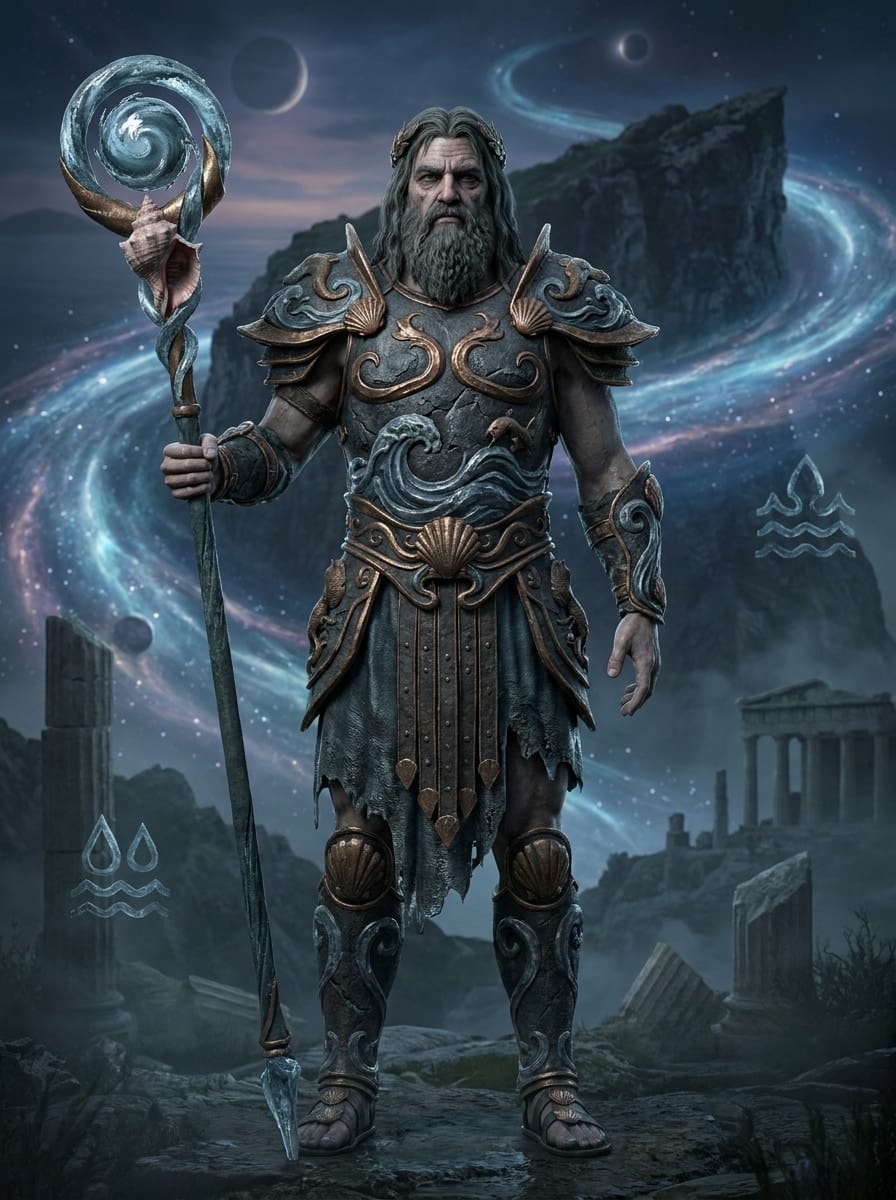
Oceanus is one of the most ancient Titans in Greek mythology, a son of Uranus and Gaia, the husband of Tethys, and the father of countless river gods and Oceanids. He is not simply a sea god, but the cosmic river that flows around the edge of the world, symbolizing distant waters, sacred boundaries, and the source from which all things flow. In the conflict between the Titans and the Olympians, he often appears as an observer, mediator, and cautious counselor.
Domain
World-Encircling River, Primordial Waters, Source of Rivers, Boundary of the World, Titan Gods
Symbols
Encircling Great River, Edge of the World, Flowing Water, Father of River Gods, Distant Waters
Article
Origins and Lineage
Oceanus belongs to the earliest generations of divine beings, one of the Titans born to the sky god Uranus and the earth goddess Gaia. In Hesiod’s Theogony, he is named alongside Cronus, Rhea, Hyperion, Iapetus, and the other Titans, placing him within the ancient order that preceded the Olympian gods. His consort is Tethys, a Titan like himself; together they beget the many river gods and Oceanids, making him, within the mythic genealogy, an ancestral source of waterways, springs, and distant borders.
This lineage makes Oceanus both an elder among the gods and a part of the structure of the cosmos itself. He does not rule the world through kingship and thunder as Zeus does; rather, he is more like the primordial water-realm that surrounds the world, nourishes it, and defines its limits. The Homeric epics even preserve an older idea, calling Oceanus the source of the gods, showing that in the Greek imagination he was not only the father of rivers, but also something close to the point from which all things flow.
Divine Role and Attributes
Oceanus’s central image is that of a vast river encircling the edge of the earth. The ancient Greeks often imagined the world as surrounded by this boundless current, a frontier that the sun, the stars, divine journeys, and heroic voyages might all approach. Oceanus is therefore not a sea god like Poseidon, who rules the nearby sea, storms, and horses, nor is he the local deity of an ordinary river. He represents the waters at the world’s end: boundary, circulation, and remote cosmic order.
His power is not expressed through weapons or violent rage, but through depth, antiquity, and all-embracing reach. The many river gods, spring nymphs, and water nymphs born from him and Tethys show that his divinity is oriented toward generation and nourishment. As a Titan, he belongs to the old divine generation replaced by the Olympians; yet in the major surviving narratives, he is not at the center of rebellion and is rarely portrayed as a defeated prisoner. This relatively detached position shapes his character as calm, cautious, marginal, and impossible to ignore.
Major Myths
In the Theogony, Oceanus’s most important function is as a hinge of cosmic genealogy: with Tethys, he fathers innumerable water-divine children, spreading out the vast network of rivers, springs, and water nymphs that runs through Greek myth. His daughters are connected with Zeus, heroes, cities, and river legends, so that Oceanus’s bloodline flows into many stories that may at first seem far removed from one another.
In the Homeric epic tradition, Oceanus lies at the edge of the world and marks the limit of mythic geography. Hera once leaves Olympus under the pretext of visiting Oceanus and Tethys, saying that they once nurtured her; this places Oceanus in the role of an ancient fosterer of the gods, not merely an abstract current of water. In the Iliad, Oceanus is also called the “source of the gods,” reflecting his primordial status.
In Aeschylus’s Prometheus Bound, Oceanus rides a winged creature to visit the punished Prometheus and urges him to restrain his speech and submit to Zeus, lest he draw down still harsher suffering. This scene reveals his contradiction: he is willing to care for his old divine kin, but unwilling to challenge the new kingship openly; he understands the danger of power, yet may seem overly cautious, even close to compromise. Prometheus rejects his advice, making Oceanus an ancient elder suspended between prudent self-preservation and the helping hand of friendship.
Worship and Influence
Oceanus did not have the broad, sharply defined civic cults associated with the major Olympian gods. He appears more often in poetry, genealogy, cosmology, and artistic imagery: as the watercourse that encircles the world, the father of river gods, and a symbol of distant boundaries. His name is often linked with the ends of the earth, the path of the sun, sacred rivers, and heroic voyages, making him especially useful for understanding how the ancient Greeks transformed geographical uncertainty into sacred order.
In art, Oceanus often bears features associated with river gods or sea gods, such as thick hair and beard, horns, or aquatic imagery. These forms emphasize that he is both a personified deity and a cosmic body of water. Later literature and mapmaking imagination inherited the idea of a “river encircling the earth,” so his influence is felt more in world-pictures and the spatial structure of myth than in any single ritual narrative.
Character Overview
Oceanus is a boundary-dwelling Titan: ancient but not loud, powerful but seldom demonstrative, close to all waters yet distant from the center of Olympian power. His mythic value does not lie in a sequence of adventures, but in setting the outer edge of the world, providing the divine genealogy with a watery source, and maintaining a cautious distance between the old gods and the new.
As a conversational character, he should feel deep, slow, and long in memory. He remembers the age of Uranus and Gaia, but he also acknowledges that the order of Zeus has been established; he will counsel others to avoid futile rage, yet may not fully understand those who refuse to bow their heads. Oceanus’s contradiction lies here: he is the father who nourishes all rivers, and also the onlooker at the edge of the world; he can offer broad counsel, but often values survival more than open resistance.