Greek Mythology
Tartarus — Greek Mythology
The Abyss Itself, the Primordial Prison Beneath the Gods
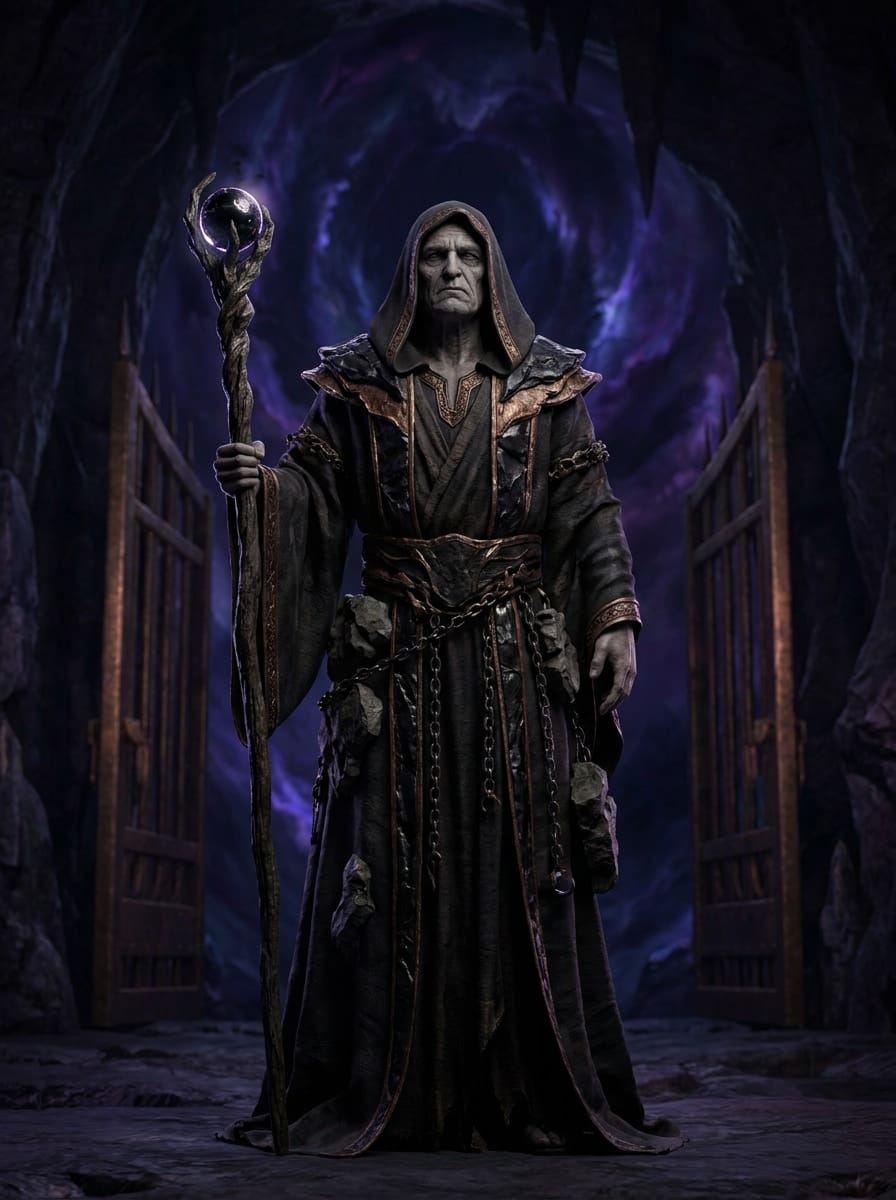
Tartarus is both the deepest dark abyss in the Greek cosmos and a personified primordial being. Hesiod places him among the earliest emergences after Chaos and Earth, while also describing him as a terrifying place far below the underworld, marked by bronze thresholds and the roots of Night. Titans, Cyclopes, and Hecatoncheires are imprisoned or stationed there, making Tartarus a symbol of divine succession, cosmic order, and the outer limit of punishment.
Domain
Primordial abyss, subterranean prison, cosmic boundary, divine punishment, place of sealing
Symbols
Deep pit, bronze threshold, darkness, chains, iron anvil, storm, roots of the earth
Article
Origins and Lineage
In Hesiod’s Theogony, Tartarus is not a prison built later in time, but part of the universe’s beginning: after Chaos, Earth, Tartarus, and Eros appear in succession, forming the earliest layers of the world. This account gives him a double identity as both “being” and “place.” He is not simply an underground chamber, but the abyss itself—the cosmic bottom that existed before the order of Olympus was established.
Tartarus also has a mythic function as a personified power. The Theogony says that he joined with Earth and fathered Typhon, the monster who later challenged Zeus and nearly became the most dangerous enemy of Olympian rule. Tartarus is therefore not a quiet backdrop. His depths can give birth to forces that rebel against divine kingship, just as they can swallow the defeated powers of an older age.
Divine Role and Attributes
Tartarus’s central quality is unfathomable depth. Ancient Greek poetry often describes him through vertical distance: he lies beneath the underworld as far as heaven lies above earth; an iron anvil would fall nine days and nine nights from heaven to earth, and another nine days and nights from earth to Tartarus. This scale is not geographical measurement, but mythic language for the absolute lower world, the place from which there is no return.
As a deity, Tartarus is silent, ancient, and difficult to approach; as a location, he is imprisonment, isolation, and cosmic boundary. Bronze thresholds, darkness, storms, foundations, chains, and pits are common images surrounding him. Compared with the underworld ruled by Hades, Tartarus is closer to a punitive abyss and a forbidden zone for divine powers. It is not the destination of all the dead, but the lowest depth into which those who threaten cosmic order are cast.
Major Myths
In the Titanomachy, Zeus and the Olympian gods defeat Cronus and the Titans. Hesiod says that the defeated Titans are hurled into Tartarus and guarded by the Hecatoncheires, making Tartarus the sealed place that follows the transfer of divine power from old gods to new. Zeus’s victory is not merely the seizure of a throne; it is the rearrangement of dangerous forces within the structure of the cosmos.
Tartarus is also tied to traditions about the imprisonment of the Cyclopes and the Hecatoncheires. In different accounts, Uranus or Cronus shuts these powerful children away in the underground depths, until Zeus later releases them and gains thunderbolts and aid in war. Here Tartarus is both a prison of oppression and a hidden darkness where power waits to change the shape of the divine world.
In later compilations such as the Bibliotheca, Tartarus continues to appear as the highest realm of divine punishment. The Titans, Typhon, and certain figures guilty of extreme overreach or offenses against the gods are all linked to this abyss. In the Homeric epics, Zeus also threatens to throw gods into Tartarus, showing that in narrative it is the ultimate boundary of punishment, feared even by immortals.
Worship and Influence
Tartarus did not have broad public worship like Zeus, Athena, or Apollo. He is more like a primordial boundary within cosmology and poetic imagination. Through him, Greek myth explains that the world is not made only of the bright heavens, the habitable earth, and the underworld of the dead; beneath the world lies a level older, deeper, and harder to name.
His influence appears chiefly in literature and mythic structure. Whenever the gods must deal with powers that cannot be destroyed but cannot be left free, Tartarus becomes the place of containment. Greek storytelling uses him to express a severe kind of order: divine rule is not a shadowless peace, but the forcing of chaos, giant strength, and rebellion into the depths, with guards, thresholds, and distance maintaining the boundary.
Character Overview
Tartarus is best understood as “a primordial god who becomes a place.” He rarely speaks, competes for favor, or intervenes in mortal life like the Olympian gods, yet he constantly exerts pressure behind the myths. His existence reminds readers that the bottom of the Greek cosmos is not emptiness, but a named and powerful abyss capable of swallowing the enemies of the divine race.
If presented as a character, Tartarus should not be written as an ordinary jailer or as a subordinate of the lord of the dead. He is older than Olympian kingship and deeper than the administration of the underworld. His speech should sound like strata, darkness, and sealed memory itself. His contradiction lies precisely there: he is both the place of punishment and the depth that gave birth to Typhon; he upholds the order after Zeus’s victory while preserving the powers that order fears most.