Greek Mythology
Atlas — Greek Mythology
The Titan Who Holds Up the Sky
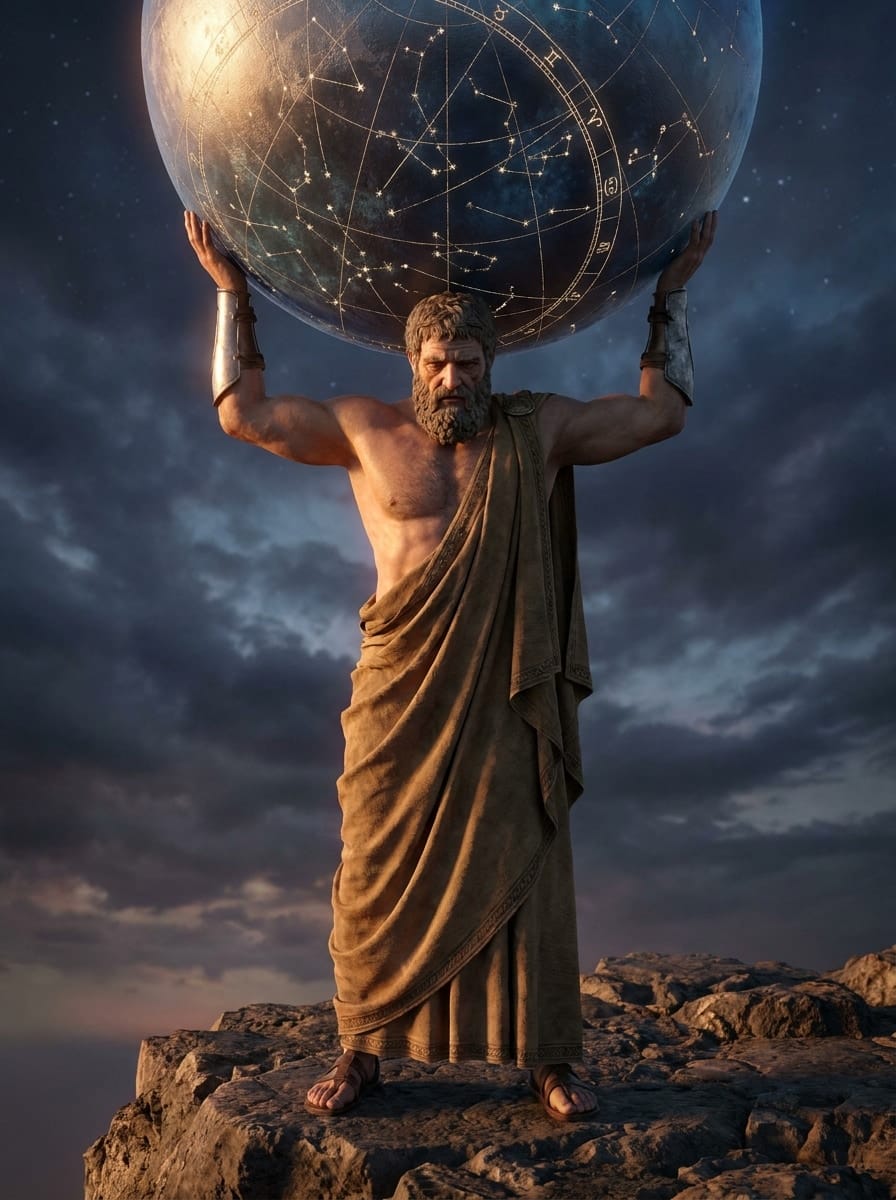
Atlas is the Titan born to Iapetus and Clymene, brother of Prometheus, Epimetheus, and Menoetius. After Zeus defeated the Titans, he punished Atlas by making him stand at the western edge of the earth, supporting the sky with his head and hands. In the story of Heracles and the golden apples, Atlas briefly escapes his burden, only to be forced back into place by the hero’s cunning. Later tradition also linked him with western mountains, knowledge of the stars, and the image of “bearing the world,” but the core of the classical story is not that he holds up the earth; it is that he endures the sky and a divine punishment.
Domain
Sky-bearing, Titan race, far west, cosmic boundary, divine punishment, stars and celestial sphere
Symbols
Sky-vault, shoulders, western mountains, celestial sphere, golden apples of the Hesperides, pillars
Article
Origins and Lineage
Atlas belongs to the Titan generation before the Olympian gods. Hesiod names him as the son of Iapetus and Clymene, with brothers including Prometheus, who dared to steal fire for humankind; Epimetheus, who understood only after the fact; and Menoetius, struck down by Zeus for his arrogance. In Greek myth, this family often carries the colors of rebellion, transgression, and punishment: their intelligence or strength cannot always prevail against the new order established by Zeus. Atlas’s most distinctive identity is formed after the war between the Titans and the Olympian gods.
Divine Role and Attributes
Atlas is not an ordinary mountain god or giant, but a Titan stationed at the boundary of the cosmos. His punishment is to stand at the western end of the earth, supporting the broad sky with his head and tireless hands, keeping heaven and earth apart. In classical texts he is often connected with the far west, the golden apples of the Hesperides, the movement of the heavenly bodies, and distant boundaries. The later image of “Atlas holding up the world” became highly influential, but earlier myth centers on his role as the bearer of the sky: he carries the weight of the heavens, and also the public mark imposed by Zeus’s order upon the older gods.
Major Myths
In Hesiod’s account, Atlas is punished for resisting Zeus and is forced to support the sky at the edge of the world. The punishment has no grand battle scene, but its cruelty lies in its duration: he is not killed, but fixed inside a duty that never ends. Atlas thus becomes living proof of the Titans’ defeat, and a boundary-pillar of the new king of the gods’ authority.
In the story of Heracles seeking the golden apples of the Hesperides, Atlas reveals another side of himself. Pseudo-Apollodorus relates that Heracles, following Prometheus’s advice, asks Atlas to fetch the apples for him while he temporarily holds up the sky. After retrieving the apples, Atlas is unwilling to take on his old punishment again and proposes to deliver them to Eurystheus himself. Heracles sees through his plan and pretends that he only wants to put a pad on his shoulders, asking Atlas to take the sky back for a moment; once Atlas accepts it, Heracles leaves with the apples. This episode makes Atlas more than a silent sufferer: he is also an old god who can scheme, evade, and yet lose to a hero’s quick wit.
In Ovid’s Metamorphoses, Atlas also appears in the story of Perseus. Perseus asks to rest at Atlas’s home, but Atlas, suspicious because of a prophecy, rejects him; Perseus then uses Medusa’s head to turn him into a great mountain. This Latin tradition strengthens Atlas’s connection with mountains, the far west, and a gigantic body, but it is not exactly the same as the earlier Greek core image of punishment through bearing the sky.
Worship and Influence
Atlas did not have widespread civic cults like Zeus, Athena, or Apollo. He is more a boundary figure in cosmic structure and mythic geography. Ancient people linked his name with the western edge, the Atlas Mountains, astronomical knowledge, and imaginings of the end of the earth; “the daughters of Atlas” also appear in the genealogies of the Hesperides, the Pleiades, and other starry or far-off female groups. In later ages, his image gradually condensed into a symbol of the bearer of weight: atlases were named after him, and art often portrays him as a giant god carrying the celestial sphere or the world on his shoulders. Though transformed, this influence preserves one central fact: Atlas is the punished one forced to keep the cosmos in order.
Character Overview
Atlas’s tragedy is not that he was defeated once, but that defeat was forged into duty. He is powerful, enduring, and close to the edge of the cosmos, yet he is not free; he has a Titan’s dignity, as well as the cunning and resentment worn into him by crushing weight. If he is seen only as the solemn “sky-bearer,” we miss the fact that he once rebelled, was punished, and tried to transfer that punishment to Heracles. Atlas’s image reminds us that order in myth is often named by the victors, and those who uphold that order may not do so willingly.