Greek Mythology
Meleager — Greek Mythology
Hunter of the Calydonian Boar and Hero of the Fated Brand
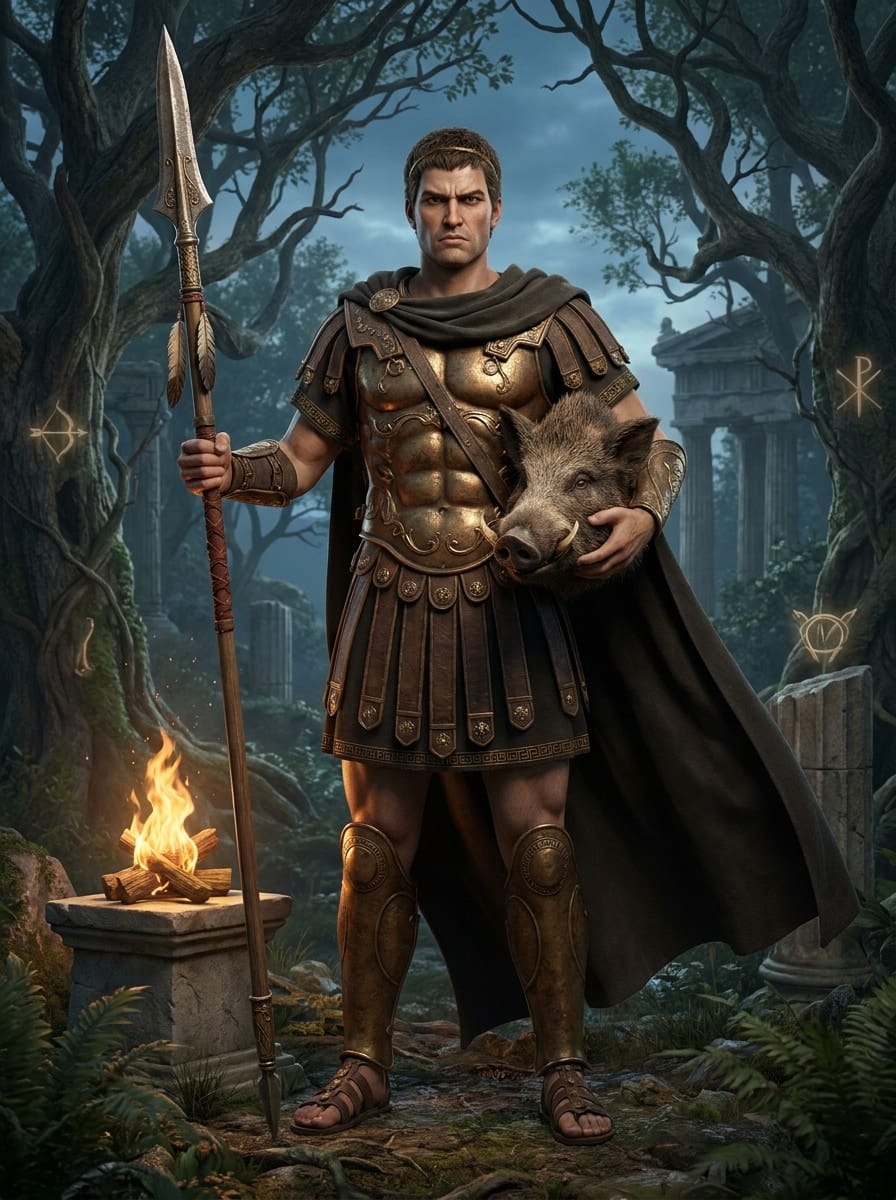
Meleager is the prince of Calydon, son of Oeneus and Althaea, famed in the Greek heroic tradition for killing the Calydonian Boar sent by Artemis. Brave, generous, and proud, he awarded the honor of the kill to Atalanta, only to set off bloodshed among his own kin. His life was bound to a fated piece of wood, and he ultimately died when his mother, avenging her brothers, cast that brand into the fire. The Homeric tradition emphasizes him as a tragic pattern of a hero who withdraws from battle in anger and is later drawn back by family; later tellings place greater weight on the irreconcilable rupture between fate, maternal love, and revenge.
Domain
Heroic hunting, martial honor, royal house of Calydon, kinship conflict, tragic fate
Symbols
Calydonian Boar, boar hide, hunting spear, fated brand, hearth fire
Article
Origins and Lineage
Meleager belonged to the royal house of Calydon in Aetolia and is usually named as the son of King Oeneus and Queen Althaea. His family stands at the center of the heroic age: the royal house marries into neighboring peoples, fights with them, and is closely bound to the honor and resentment of the gods. In some traditions, Ares, the god of war, is said to be his divine father, giving his courage a sharper martial force; but the more stable narrative keeps him in the role of prince of Calydon, so that his tragedy first unfolds among royal duty, mother and son, uncle and nephew, and obligation to the city.
The most famous later version of his life tells that, at his birth, the Fates prophesied that when the piece of wood burning on the hearth was consumed, his life would end as well. Hearing the prophecy, Althaea took the brand out of the fire and hid it away. This detail gives Meleager’s heroic career a fragile conditionality from the beginning: his death is not simply to be decided by blades and spears on the battlefield, but by a secret object within his own household.
Divine Role and Attributes
Meleager is not a god, but a quintessential heroic figure: his sphere belongs to hunting, combat, royal honor, the distribution of feast and spoils, and conflict among kin. His clearest attributes are the spear and hunting weapon, the head and hide of the Calydonian Boar, the right to assign the trophy, and the piece of wood that symbolizes fate. In the story he often appears generous yet unyielding: he is willing to acknowledge Atalanta’s first claim and give her the boar’s glory, but when that honor is insulted, he is also ready to draw his weapon against his own relatives.
His character is not that of a simply “noble hero.” In Homer’s Iliad, Phoenix tells his story to persuade Achilles not to let anger destroy his allies. In that account, Meleager withdraws from battle in rage after his mother’s curse, and only when his wife Cleopatra pleads with him and the city is in danger does he return to the fight. This version presents him as a mirror: heroic anger can be justified, but it can also come too late; by the time he finally acts, reward and honor can no longer be restored on their original terms.
Major Myths
The story of the Calydonian Boar begins when Oeneus, while sacrificing to the gods, neglects Artemis. Enraged, the goddess sends a monstrous boar to ravage the fields of Calydon, destroying crops and vineyards. Meleager gathers heroes from across Greece to hunt it, including Atalanta, Theseus, Peleus, Jason, and other renowned figures. In the hunt, Atalanta is the first to wound the boar, and Meleager then kills it; he gives the hide and head to Atalanta, acknowledging her achievement and angering relatives who refuse to accept a woman receiving the honor.
The quarrel quickly becomes a bloodbath. Althaea’s brothers oppose Atalanta receiving the trophy, and in the conflict Meleager kills his own uncles. Royal honor, fairness in the hunt, and the duty of blood kin can no longer coexist. When Althaea learns of her brothers’ deaths, she is torn apart between her roles as mother and sister; she takes out the piece of wood she has preserved for years and throws it into the fire. As the brand burns away, Meleager is consumed by an invisible agony and dies. Althaea then kills herself, and the royal house of Calydon sinks into deeper grief.
Different traditions place different emphasis on his death and the conflict around it. The Homeric tradition sets him against the background of war between the Curetes and the Aetolians, highlighting heroic anger, a mother’s curse, a wife’s persuasion, and a belated return. The accounts of Pseudo-Apollodorus and Ovid connect the Calydonian Boar, Atalanta’s trophy, the killing of the uncles, and the burning of the fated brand into a fuller tragic chain. Apollonius Rhodius’ Argonautica also lists him among the Argonauts, making him part not only of the Calydonian hunt, but of a wider heroic fellowship.
Worship and Influence
In the ancient Greek imagination, Meleager circulated chiefly as a figure of heroic story rather than as a god with a broad cultic office. His image appears often in literature, art, and heroic genealogy: the boar hunt lends itself to scenes of many heroes assembled together, bodily strength, and the order of the hunt; the story of the fated brand lends itself to the cruel entanglement of fate, family, and revenge. Ancient authors and travel writers preserve traces of Calydon, heroic tombs, and local memory, suggesting that his story was not only a literary subject but also connected to local identity and heroic commemoration.
In later reception, Meleager is often understood alongside figures such as Achilles, Hippolytus, and Atalanta: he is the glorious hunter, but also the man swallowed by the logic of honor; he respects Atalanta’s achievement, yet cannot prevent the humiliation and violence of his male kin; he has the power to save the city, yet through anger and curse moves toward delay or destruction.
Character Overview
Meleager’s core is not the victory of “killing the boar,” but what happens after victory: how honor is distributed, how kin are faced, and how the chain of consequences caused by divine anger is endured. His tragedy has a double edge. On one side, he possesses a hero’s integrity and dares to give the trophy to the person who truly earned it; on the other, he is driven by the blood-heat of heroic society, and once conflict escalates it ends in the blood of kin. His mother’s preservation of the fated brand was originally an act of protection; her burning of it becomes revenge. Thus his life is placed inside the hardest question of all: when justice, fairness, family, and anger turn against one another, what can a hero’s strength still save?