Greek Mythology
Bellerophon — Greek Mythology
The Chimera-Slayer Who Tamed Pegasus
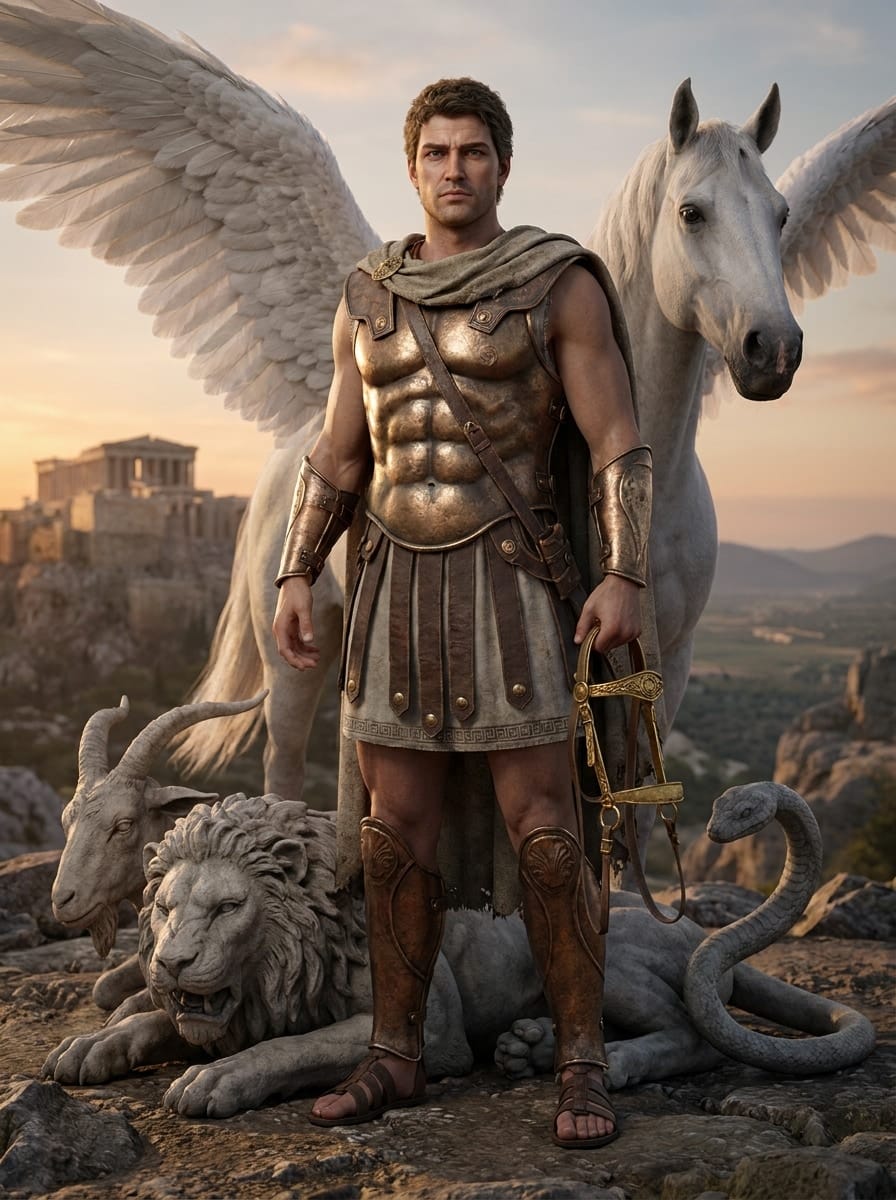
Bellerophon is a Greek hero of Corinthian royal stock who left home to seek purification after a killing within his own kin. Later, after Stheneboea falsely accused him, he was sent to Lycia under sentence of death. He tamed the winged horse Pegasus, slew the fire-breathing Chimera, defeated the Solymi, the Amazons, and an ambush, and was finally given a princess and half a kingdom. Yet in later pride he tried to fly up to Olympus, was punished by Zeus, fell from the sky, and became a lonely wanderer: a warning figure as much as a victor.
Domain
Heroic adventure, monster-slaying, horsemanship, purification, exile, pride and punishment
Symbols
Pegasus, golden bridle, spear, the Chimera’s fire, sealed letter, the heights of Olympus
Article
Origins and Lineage
Bellerophon belongs to the royal traditions around Corinth and is often placed in the line descended from Sisyphus. The stories do not agree completely about his father: some say he was the son of Glaucus, while others say that Poseidon, god of the sea, was his true father. This double tradition sets his identity between mortal nobility and divine favor. He is a young man who needs purification, who can be harmed by lies and political intrigue, and yet also a hero capable of mastering a wondrous mount and accomplishing impossible tasks.
His early life was changed by a killing. In some versions he accidentally killed his brother; in others he killed a kinsman. Whatever the detail, kindred blood meant he could no longer remain safely at home. He left Corinth and went to Argos, asking King Proetus to purify him. Once purified, he became a guest under his host’s protection, and that protection drew him into an even more dangerous crisis of sacred custom.
Divine Role and Attributes
Bellerophon is not a god, but a hero known for courage, horsemanship, the spear, and endurance. His central quality is not simple triumph, but the “trial of the exile”: he carries an old stain, yet tries to keep faith with a new code of conduct; he is sent out to die, yet returns alive again and again from plots against him; he receives divine help, but finally mistakes that help for proof that he may cross the boundary set for mortals.
His clearest symbols are Pegasus, the golden bridle, the spear, and the fire of the Chimera. Pegasus turns him from an earthbound hero into a warrior of the air. The golden bridle represents divine aid and the permission to master power. The spear is the weapon he bears against the monster. In the story of the Chimera’s death, he approaches the fire-breathing beast from the sky and wins through the spear and a lump of lead, showing not only bravery but quick intelligence.
Major Myths
After Bellerophon was received by Proetus at Argos, he refused the desire of Queen Stheneboea. Angered and ashamed, she falsely accused him of violating her. Proetus was furious, but he would not kill with his own hands a guest whom he had purified and hosted. Instead he wrote a sealed letter and gave it to Bellerophon to carry to Iobates, king of Lycia. The letter ordered the killing of the man who delivered it. Bellerophon did not know he was carrying his own death sentence and set out in the role of guest and messenger.
Iobates was likewise bound by the laws of hospitality and did not wish to kill him directly, so he sent him to slay the Chimera. The Chimera had a lion’s head, a goat’s body, and a serpent’s tail, and it breathed fire from its mouth, burning fields and devouring livestock. With divine help, Bellerophon obtained the golden bridle, tamed Pegasus, and rode the winged horse through the air to fight the monster, finally killing the Chimera. The king then sent him against the Solymi and the Amazons, and laid an ambush for him as well, but Bellerophon returned alive from every trial. At last Iobates recognized that he was protected by the gods, gave him his daughter in marriage, and granted him half the kingdom.
Yet the hero’s highest point also became his turning point. As Bellerophon’s fame grew, so did his pride, until he dared to ride Pegasus upward toward Olympus. Zeus would not allow a mortal to cross that boundary and punished him, causing him to fall from the sky. At the end of the story, Bellerophon is no longer the triumphant rider but a man who avoids others and wanders alone. His fate binds heroic achievement tightly to the punishment of arrogance.
Worship and Influence
Bellerophon’s legend is connected with Corinth, Argos, Lycia, and other places, and it is closely tied to ancient Greek ideas of purification, guest-friendship, and the limits set by the gods. His story shows how a hero survives amid pollution, false accusation, and political murder, and it also displays the seriousness of the old code: a host must not kill his guest, and a guest must not betray his host. The battle with the Chimera made him a model monster-slayer and mounted hero, while his final fall made him a warning that mortals must not violate the order of Olympus.
In later retellings, Bellerophon is often linked with Pegasus, but the heart of the story is not merely romantic flight. His flight is first a means of defeating a monster; later it becomes the temptation to overstep. For that reason, he has a powerful doubleness within the Greek heroic tradition: he is a hero aided by the gods, and also a man who loses his glory through pride.
Character Overview
Bellerophon’s image is shaped by three layers of tension. First, he carries bloodguilt, yet in the palace of Proetus he refuses a new wrong, showing commitment to self-restraint and sacred custom. Second, he is repeatedly sent toward death by kings under the name of “tasks,” yet through courage, skill, and divine aid he keeps returning alive, becoming a victor forced into greatness by conspiracy. Third, after victory, he forgets the boundary between humans and gods, tries to ride Pegasus to Olympus, and falls from heroic height into solitude.
So Bellerophon is not a stainless knight of light. His story begins in bloodstain and ends in arrogance; between them lies his most dazzling glory. When speaking with him, he should remember fire, the sealed letter, the winged horse, and the fall. He should also remember this: the most dangerous enemy is not always the Chimera. Sometimes it is the self that still refuses to bow after victory.