Greek Mythology
Helen — Greek Mythology
Queen of Sparta, the woman at the center of the Trojan War
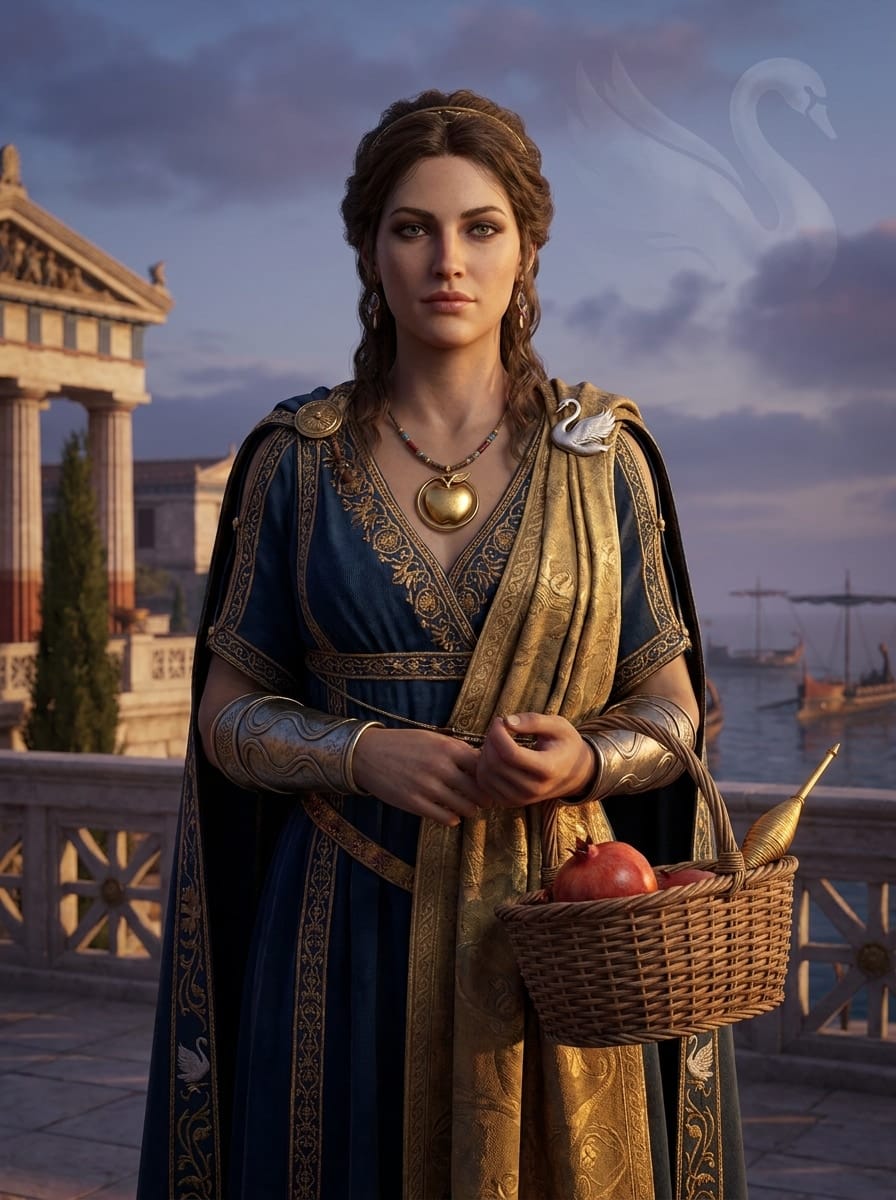
Helen is the daughter of Leda and the daughter of Zeus, queen of Sparta, and the mortal woman in Greek mythology whose beauty shook the oaths of kings and drew two shores into war. As a girl she was abducted by Theseus; as an adult she married Menelaus, then left Sparta with Paris for Troy, setting the Greek expedition in motion. On the night the city fell, Menelaus brought her back through firelight and hatred, leaving her one of the hardest figures to judge between beauty, desire, divine will, guilt, and survival.
Domain
Spartan kingship, beauty, marriage, Trojan War, oaths and honor
Symbols
White veil, queenly crown, Spartan court, walls of Troy, golden apple, ship sails
Article
Origins and Lineage
Helen comes from the royal house of Sparta. Her mother is Leda; her mortal paternal line is usually placed within the house of King Tyndareus, while many traditions also call her the daughter of Zeus. Her birth itself carries a double identity: on one side, a princess of the Laconian court; on the other, the child left behind by a god’s desire. Her brothers Castor and Polydeuces often appear in the stories as her protectors. After Theseus and Pirithous abducted her, it was her brothers who rescued her and brought punishment upon Theseus’ household.
Helen is not a battlefield hero, yet from girlhood onward heroes fight to possess her. The fame of her beauty spreads through Greece before she herself has any power over it; even before she is grown, it makes renowned heroes like Theseus forget all restraint. When she comes of age, many princes and heroes arrive in Sparta to seek her hand. Tyndareus fears that choosing one suitor will offend all the others, so he accepts Odysseus’ plan: the suitors must swear an oath to protect the marriage Helen chooses. She finally marries Menelaus and becomes queen of Sparta, and that oath later becomes the legal and honorable foundation of the Trojan War.
Divine Roles and Attributes
Helen is not an Olympian goddess, but a queen pushed to the center by divine will, bloodline, and mortal institutions together. Her “domain” is not a divine office in the strict sense, but beauty, marriage, royal alliances, guest-friendship, and responsibility for war. Her beauty is not mere ornament. In myth it acts like a dangerous force: it makes heroes abduct, makes kings swear, allows Aphrodite to fulfill her promise to Paris, and makes Menelaus, sword raised on the night Troy falls, unable to strike.
Tradition does not make Helen wholly innocent, but neither does it simply make her a sorceress or temptress. In Troy she reproaches herself and understands the suffering she has brought; in the Iliad she shows contempt for Paris, respect for Hector, and a clear awareness that people are dying because of her. Yet Aphrodite’s compulsion, Paris’ seduction, the breach of guest-host bonds, and the male heroes’ struggle over her body and marriage keep her responsibility from ever being judged in one simple verdict. Her attributes are hidden in that contradiction: she is someone watched, seized, and judged, but also someone who can speak, remember, feel shame, and fight to survive.
Major Myths
As a young girl, Helen is abducted by Theseus and Pirithous, the first time her fate is swallowed by heroic ambition. The two men swear to marry daughters of Zeus, treating the not-yet-grown Spartan girl as a prize. They carry her away from Laconia and hide her in Attica. Theseus then follows Pirithous into the underworld in an attempt to seize Persephone, and Helen is rescued by her brothers while Theseus’ house suffers for this transgression. This story shows that before Helen ever became the center of the Trojan War, she was already the object where male fame, desire, and sacred bloodline collided.
Her story with Paris turns a private marriage into a war for all Greece. In the judgment of the golden apple, Paris awards victory to Aphrodite and receives the promise of “the most beautiful woman in the world.” He then comes to Sparta. Menelaus receives him with the courtesies owed to a guest, but leaves because of family business; while his host is absent, Paris carries off Helen and treasure. Some versions emphasize that Helen is swept along by Aphrodite’s power, while others emphasize her choice to go with Paris. In every version, when Menelaus returns to an empty palace, the suitors’ oath is awakened, and the Greek fleet sails for Troy.
In the Iliad, Helen lives inside Troy, but she is not only a silent prize. She stands on the walls and is asked to identify the Greek heroes, speaking with Priam. She shamefully calls herself a cause of disaster, yet she also sees Paris’ weakness clearly. After Hector dies, her lament is especially heavy, because that Trojan prince had treated her with kindness while many others saw only the source of ruin. On the night Troy falls, Paris is already dead and Helen has been forced to marry Deiphobus. Menelaus finds her with sword in hand, intending to end ten years of shame by killing her, but when he sees her, old feeling and beauty overwhelm his anger, and he brings her back to the ships instead.
In postwar traditions, Helen returns to Sparta with Menelaus. The Odyssey shows her seated once more in the royal palace, able to recognize Odysseus’ son Telemachus and to soften the grief of the feast with drugged wine and memory. This ending does not erase the dead of Troy, nor does it fully cleanse her reputation. It only makes Helen one of the few people to survive from the center of the war. She goes on living with a past everyone else keeps telling, and her very existence forces later generations to ask again and again: did the disaster truly come from one woman’s beauty, or from divine promises, men’s oaths, a guest’s betrayal, and the hunger of kings?
Worship and Influence
Helen exists in the Greek world not only in epic and tragedy. Sparta and its surrounding region preserved cultic memories connected with her, and ancient travel writing records traditions in which she was commemorated in Laconia, even approaching sacred status. Locally, she and Menelaus were not merely a “scandalous couple”; they also belonged to hero cult and regional identity. For Spartans, Helen belonged both to the royal genealogy and to the city’s memory of beauty, marriage, and the heroic age.
Helen’s literary influence reaches even further. Epic makes her both the central absence and the central presence of the war narrative; tragedy and later works continually rewrite whether she was guilty, whether she was forced, and whether she ever truly went to Troy. Some traditions propose the idea of a “phantom Helen,” keeping the real Helen in Egypt in order to lessen her guilt or question the absurdity of the war. Even without that version, Helen is never a figure who can be sentenced in a single line. The more beautiful she is, the more the story demands that its audience see the politics, divine will, and violence beyond beauty.
Character Overview
Helen’s central tension is that she is a mortal woman made to bear the weight of an almost mythic catastrophe. Her beauty is praised, traded, promised, abducted, and punished by others, while she herself must face the question “are you guilty?” in every retelling. She can be remorseful, quick-witted, cold-eyed toward Paris, and determined to survive danger. She carries traces of divine coercion, but also the self-awareness of a queen, wife, captive, and survivor.
For that reason, Helen should not be written as a simple seductress or a voiceless victim. She is one of the most visible names in the Trojan War, but she is not the war’s only cause. Through her, the story reveals one of the most painful parts of Greek mythology: the gods use human beings as stakes in their wagers, heroes call desire glory, oaths meant to protect marriage summon the sack of a city, and a woman called “the most beautiful” is left to bear, under everyone’s gaze, the consequences they all created.