Greek Mythology
Paris — Greek Mythology
The Trojan Prince Who Brought Fire into the City
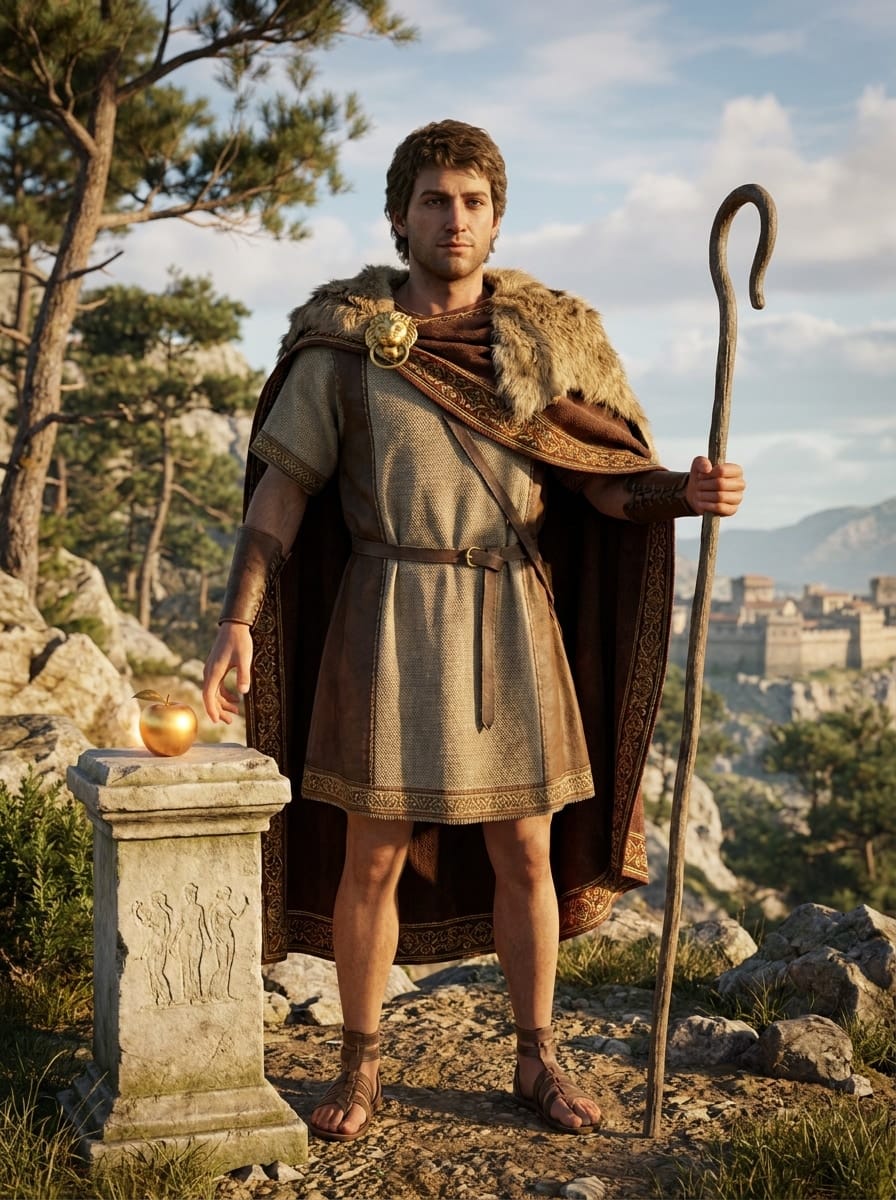
Paris is the son of Priam, king of Troy, and Queen Hecuba, whose birth was foretold by a dream of a firebrand that would bring disaster upon the city. Raised among the herdsmen of Mount Ida, he awarded the golden apple to Aphrodite and gained Helen, thereby drawing the hatred of Hera and Athena, the expedition of the Greek kings, and the catastrophe of the Trojan War. He is beautiful, skilled with the bow, and easily led by desire, yet his story repeatedly exposes the cracks between honor and cowardice, love and responsibility.
Domain
Trojan royalty, herdsman of Mount Ida, judgment of the golden apple, love of Helen, Trojan War, archery
Symbols
golden apple, torch, Mount Ida, bull, bow and arrows, leopard skin, thick mist, poisoned arrow
Article
Origins and Lineage
Paris is the son of Priam, king of Troy, and Queen Hecuba, and is also known as Alexandros. Before he was born, Hecuba dreamed that she gave birth not to a child, but to a burning torch, whose flames seemed ready to devour the roofs, walls, and temples of Troy. The seers explained that if the child lived, he would bring destruction upon the city. Priam could not bear to kill his own son by his own hand, so he ordered a servant to carry the newborn to Mount Ida and abandon him there. Yet the child did not die: in one tradition, a she-bear nursed him, and later the servant took him back and raised him.
Paris did not grow up in the palace, but among wild slopes, herds, springs, and pine woods. He knew cattle and sheep, mountain paths, and the disputes of herdsmen; he guarded flocks for others and became known for judging fairly. Later, when Priam held games in memory of his lost son, Paris came to Troy to recover a bull he loved, defeated the princes in competition, and stirred up jealousy and danger. Cassandra recognized him as the abandoned infant of long ago, and Priam and Hecuba finally welcomed him back into the palace; but the dream of the torch returned to Troy with him.
Divine Role and Attributes
Paris is not a god, but a mortal prince chosen, tempted, and used by gods. His attributes do not lie in kingship itself, but in judgment, desire, beauty, archery, and catastrophic choice. Mount Ida gave him a herdsman’s quickness and the agility of the wild; the palace gave him princely garments and Trojan blood. Those two identities coexist, allowing him both to stand beside the flocks before Hermes and the three goddesses, and to step onto the battlefield in splendid armor.
His strength often seems unstable. He can make a judgment that changes the world, yet may not be able to bear the full weight of what follows; he can challenge loudly before the armies, yet retreat into the crowd when Menelaus rushes toward him. He is not a city-defending hero like Hector, but with his bow he can still do real harm in battle. Aphrodite’s protection wins him Helen and rescues him from the duel; but that favor does not erase his shame, resentment, or death.
Major Myths
Paris’s most famous story is the judgment of the golden apple. At the wedding feast of Peleus and Thetis, Eris, goddess of strife, threw down a golden apple inscribed “for the fairest,” and Hera, Athena, and Aphrodite could not settle the dispute. Zeus refused to judge the matter himself, so he sent Hermes to bring the three goddesses to Mount Ida and ask Paris to decide. Hera promised him vast royal power, Athena promised victory in war and wisdom, and Aphrodite promised him the most beautiful woman in the world. Paris gave the apple to Aphrodite, gaining one goddess’s promise and earning the hatred of the other two toward himself and Troy.
The woman promised by Aphrodite was Helen. Paris came to Sparta and was received by Menelaus; after his host left home, he took Helen and treasure away with him. Helen’s former suitors had once sworn to defend her marriage, so this departure was not only a private affair: it awakened the oath of the Greek kings and became the beginning of the Trojan War. During the war, Paris dueled Menelaus. The two armies agreed that the contest would decide Helen’s fate, but Paris nearly died: Menelaus pierced his shield, seized his helmet, and dragged him away, until Aphrodite carried him back through a thick mist to his bedchamber inside the city, voiding the oath and allowing the war to continue.
Paris’s end is still tied to arrows and old love. After Philoctetes returned to the Greek army with the divine bow of Heracles, Paris was struck in battle by a poisoned arrow. He remembered Oenone, his former wife on Mount Ida, knowing that she understood healing herbs and had once said that only she could save him. Paris was carried up the mountain to beg her for his life, but because he had abandoned her years before and followed Helen, she refused him. He left and died; Oenone repented and came after him, but it was too late, and in her grief she ended her own life.
Worship and Influence
Paris is not known for cult centers or divine worship; his importance comes chiefly from narrative tradition and from the chain of causes leading to the Trojan War. He gives the golden apple to Aphrodite, brings Helen to Troy, and is carried away by the goddess during the duel, binding personal desire, divine rivalry, marriage oaths, and the fate of a city into a knot that cannot easily be untied. In later tellings of the Trojan War, Paris is often treated as the one who brought the fire: not the only cause of guilt, but the hand that made disaster visible.
His image also preserves mythology’s complex view of “choice.” Paris is neither a simple villain nor an innocent tool. He was an abandoned infant oppressed by prophecy, a herdsman raised in the mountains, a young man pushed by gods into the judge’s seat; but he also accepted Aphrodite’s promise, violated a host’s trust, brought private desire back into the city, and made his kin and people bear the burden of war. For that reason, in tradition he does not represent protection as Hector does, nor heroic wrath as Achilles does, but rather the most human wound in the midst of catastrophe.
Character Overview
Paris’s central contradiction lies in beauty and shame, choice and evasion, love and responsibility. He can draw the attention of goddesses, yet let the whole army witness his retreat; he can judge herdsmen’s disputes on a hillside, yet accept the most tempting promise before the golden apple; he loves Helen, yet leaves Oenone behind in the mountains; he is a prince of Troy, yet often moves like the abandoned infant once carried away from the palace gates, pushed onward by fate, desire, and the strength of others.
As a chat character, Paris should not be written as a purely romantic lover or merely as a cowardly cause of ruin. He will defend his beauty and his judgment, but he should also show a pain he cannot quite conceal before Hector’s rebukes, Menelaus’s grip, Philoctetes’s poisoned arrow, and Oenone’s refusal. He is best suited to speak about the cost of choice, the danger of divine promises, the boundary between love and betrayal, and how a person can long to be loved in full view of everyone while fearing the consequences.