Cthulhu Mythos
The Statement of Randolph Carter — Cthulhu Mythos
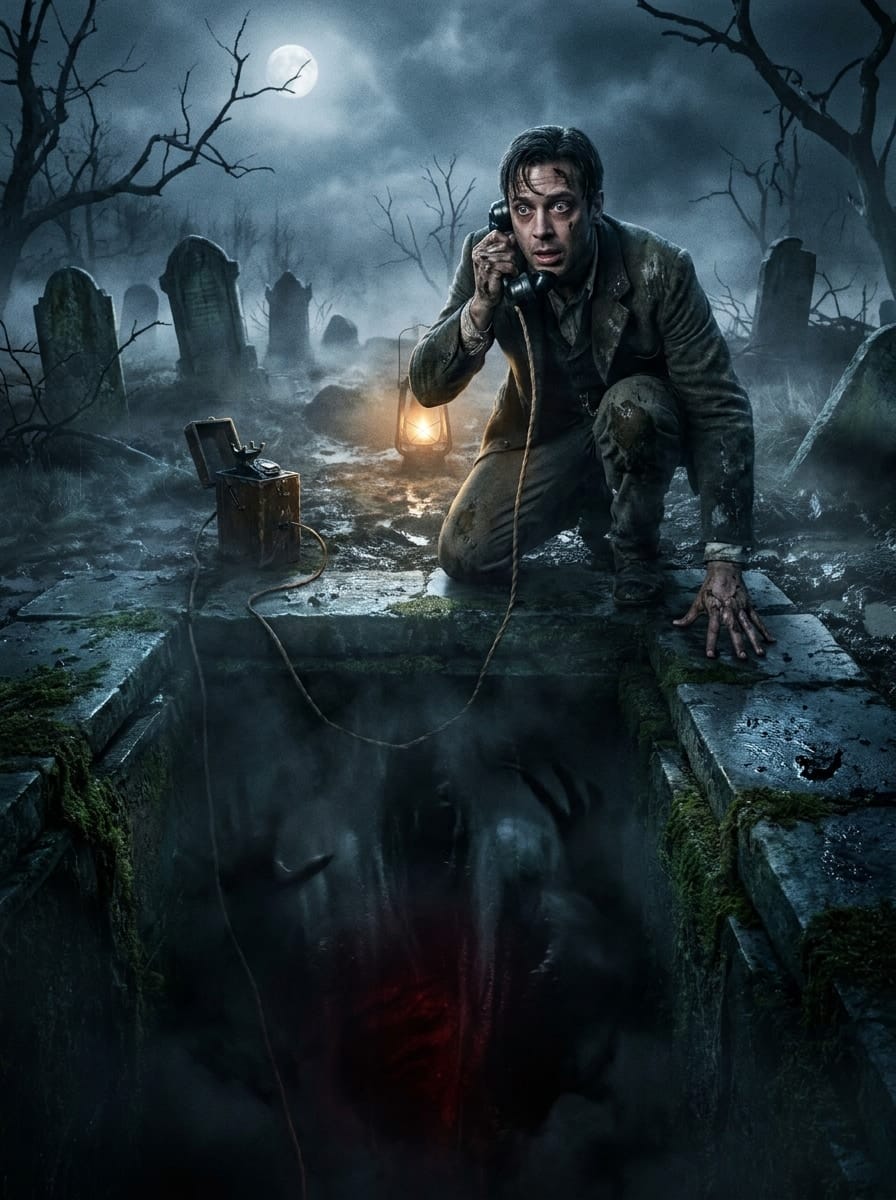
When Randolph Carter comes to beside a swamp, his friend Harley Warren has vanished, and only a telephone line still running down into the earth remains in his hand. Questioned by the police, he can only repeat the same terrible account: Warren went into the tomb and never came back.
Article
Summary
Randolph Carter awakens in a dazed state on the edge of a swamp. Harley Warren is gone, and the only thing left is a telephone set still linked by wire to something below ground. The police take Carter in and question him about the night before, suspecting him of murder. Carter insists he has killed no one and does not know where Warren’s body may be. All he can do is describe how the two of them came in the night to an ancient tomb in the marsh, with Warren descending and Carter remaining above to keep the line. Once below, Warren keeps speaking to Carter by telephone, at first describing what he sees underground. Soon, however, his voice grows more and more frightened. He orders Carter to seal the tomb and stop waiting for him. Carter refuses to abandon his friend and calls to him again and again, but the line soon carries only confusion and horror. In the end, a voice that is not Warren’s tells Carter that Warren is dead. Carter loses consciousness, and when he wakes he is standing by the swamp, facing the police and clinging to the only explanation he can give for Warren’s disappearance.
Before the Police
When Randolph Carter was found, dawn had already broken. He stood by a lonely swamp, his clothes wet and streaked with mud, his eyes vacant, as though he had not yet come back from the night. When people asked where Harley Warren was, he could not answer. When they pressed him, he only said that he had hidden nothing. Yet some things sounded so strange that even he could scarcely believe them.
Later, the police took him in for questioning. He sat in a room with a recorder before him and a closed door behind him. They suspected him because Warren had vanished, and Carter had been the last man seen with him. So Carter began at the beginning. If his friend was dead, he said, then he had not died by Carter’s hand. They had gone to a place that night where no sensible man would have chosen to go.
Warren’s Book
Harley Warren was not a man who trembled easily. He was lean, pale almost to the bone, with eyes that seemed to burn from within. Carter had known him for years and knew his appetite for dark researches. They had read many old books together—yellowed pages, broken bindings, some lines scarred as though by fire, some illustrations cold enough to make the flesh creep.
Carter remembered one book in particular, stranger than the rest. It was written in a tongue he could not understand, though Warren seemed able to read it with ease. Whenever Warren turned to certain pages, his face would tighten with unease. He would not reveal all that the book contained, but now and then he spoke of tombs, underground passages, and the secrets of the dead.
At last Carter asked him, “What is it you are looking for?”
Warren did not answer at once. He shut the book and laid his hand on the cover, as though he feared the words inside might escape. After a long silence, he said only that there were things beneath the earth which were no legend. And he added that what a man leaves behind after death is not always only bones.
Those words unsettled Carter. Yet Warren had already made up his mind. A few days later he told Carter that they were to go out that night to a place far from the roads, among swamp and scrub, where an old burial ground lay half forgotten.
The Graveyard at Night
They set out deep in the night. The moon was dim, and the wetlands around them lay black and gray. Wind slid through the grass with the smell of stagnant water and mud. Each carried a lamp and tools, and the ground underfoot shifted from soft to hard so that every step answered with a wet sound beneath the boots.
Warren led the way and said little. Carter followed him and more than once meant to urge him back, but each time he saw the set of Warren’s shoulders and held his tongue.
At last they reached the graveyard. There was no neat wall there, only leaning headstones and twisted trees. Some of the stones were cracked, their names worn smooth by rain. Warren did not linger among them. As if he already knew where to go, he led Carter to a slab half buried in the grass.
They knelt and clawed away roots and soil. When the shovel struck stone, it rang dully. The sound seemed too loud to Carter, as though it might wake something below. He looked around uneasily. In the distance there was only the low mist of the swamp—no people, no lights.
Warren only grew more urgent. He cleared the earth from around the slab and pried at it until a gap opened. Cold, damp air rose from below, carrying the smell of long-sealed places. Carter shone his lamp into the opening and saw that beneath the slab there was no ordinary grave pit, but a stairway leading downward, black as if it had no end.
The Telephone Line
Warren drew out a portable telephone and a long coil of wire. He had come prepared. He handed Carter one end and attached the other to the instrument he meant to carry below.
Carter understood at once and felt his stomach sink. “I’m going with you.”
“No,” Warren said at once.
Carter told him he was not afraid. Warren looked at him with an unusual severity. He said the things below were too dangerous, that Carter could not bear what he might encounter. And if both of them went down, he said, then no one would remain above to call for help if the need arose.
Carter would not agree. The two argued in low voices beside the slab. The silence all around them was so deep that even their quarrel seemed dangerous. At last Warren almost pleaded with him, gripping his shoulder and urging him to stay. He said he was only going to confirm one thing, and would soon return; if help were needed, he would speak by telephone.
Carter looked into the black stairwell and felt the chill of it in his bones. He knew Warren would not be turned aside. So he helped lay the line, and set the telephone on the ground beside the slab.
Warren took up his lamp, gathered his tools and the telephone, and stepped onto the first stair. The light wavered over the stone walls. He looked back at Carter as if he still had something to say, but in the end he only said, “Whatever you hear, wait for my message first.”
Then he went down, step by step. The lamp grew lower and lower, until it was only a yellow point shrinking in the dark, and then gone.
The Voice from Below
Carter remained alone in the graveyard. He crouched by the entrance with the receiver in his hand. The wire slid away into darkness beside him like a thin serpent. Wind moved through the grass, and the crooked shadows of the headstones leaned across the ground. He had no idea how far Warren had gone. All he could hear at times was the faint rustle of the line.
At last Warren’s voice came through the telephone. It was low, but still steady. He said he had reached the lower levels, and that the passage was deeper and older than he had expected. Carter asked quickly what he saw.
Warren did not answer at once. Heavy breathing came down the line, along with the sound of stone being touched or shifted. Then he said there was an opening there, and beyond it something even deeper. Carter could hear the change in his voice—an excitement now shadowed by fear.
“Come back,” Carter said. “You’ve seen enough.”
But Warren seemed not to hear him. He went farther on. The wire trembled faintly, and Carter’s palms were drenched with sweat.
Soon a stifled cry came over the receiver. Carter sprang up so suddenly he nearly overturned the telephone. He shouted Warren’s name. After a while Warren answered, his voice shaking. He said there were things below that were nothing like what he had believed.
“What is it?” Carter demanded.
Warren did not say. He only ordered Carter, in a voice that kept rising with urgency, to put the slab back at once and leave. Carter thought he must have misheard him and kept asking questions, but Warren only grew more frantic. He nearly shouted at him not to ask again, not to come down, but to go.
Carter refused. He said he could not leave his friend below. Then Warren’s voice changed into something anguished, as though he were looking upon a disaster that could not be undone. He told Carter that coming down now would serve no purpose; if Carter still had any reason left, he should flee at once.
The Answer That Was Not Warren’s
Carter’s hands shook. He bent over the stair and called down into the dark for Warren, but there was no answer from below, only the broken sounds carried through the telephone. Warren seemed very near the mouthpiece, and yet terribly far away. Again and again he told Carter to go, each time more faintly than before.
Then the line went silent.
That silence was worse than any cry. Carter held his breath and pressed the receiver to his ear. He could hear his own heart and, far off in the swamp, the night insects. After a while, something moved on the other end—like a body dragging across stone, or someone breathing very close to the receiver.
Carter called, “Warren! Are you there?”
No answer.
He called again. Then suddenly a voice came through the telephone.
It was not Warren’s voice.
Carter later told the police that he could never explain what it was. It seemed to rise from some immense depth underground—low, cold, and burdened with a wet heaviness that made the stomach tighten. It did not speak at once. It paused in the darkness as though it were studying Carter the way one studies a small object.
Carter froze there, forgetting even to run.
At last the voice spoke, and told him that Warren was finished.
When Carter heard those words, everything went black. He never knew how he dropped the telephone or how he fled from the graveyard into the swamp. Headstones, scrub, mud, and mist all blurred together. He only remembered running with all his strength, as though an entire tomb lay behind him in pursuit.
After Dawn
When memory returned clearly, morning had already come. The light was pale, and a thin mist still hung over the swamp. Someone found him and brought him back. Warren never returned. Even afterward, the graveyard gave up no easy answer. Carter could not say whether the slab was still open, whether the wire still trailed into the earth, or whether there might still be a voice at the far end of that receiver.
The police did not entirely believe his statement. They wanted a simpler explanation, a crime committed by one man, a body, a weapon, footprints, motive. But Carter could only repeat what he knew: Warren had gone down of his own will; Carter had remained above; Warren had first begged him to flee, and then the voice in the telephone had become another voice entirely.
He could not prove where that voice came from, nor what truly waited in the dark. He only knew that Harley Warren never came back to the surface.
From that day on, Randolph Carter’s name was bound to this statement. It was no victory, and no complete adventure. It left only one dreadful night, one wire leading into the earth, one missing man, and one answer that the survivor would never again wish to remember.