Cthulhu Mythos
The Nameless City — Cthulhu Mythos
A lone explorer ventures deep into the Arabian desert and descends into a nameless city, where ruins, subterranean temples, and ancient wall carvings reveal a civilization older than humankind. When he learns that the city is not truly dead, the wind from below and its former inhabitants close in on him.
Article
Summary
A lone explorer journeys into the heart of the Arabian desert and finds the legendary nameless city in a moonlit valley. Nothing remains but desolate ruins, yet the shape and age of the buildings suggest an impossibly ancient civilization, one that seems to predate human history itself. He presses on into the underground temples, where, in the darkness, he studies the old carvings and slowly realizes that the builders of this city were not human at all, but one of the elder races that ruled the world before mankind. The murals record the rise and fall of that civilization and make clear that the nameless city is no ordinary ruin. When the explorer finally understands that the city is not dead, a strange wind rises from the depths, as though something below is still stirring. The old inhabitants draw near, and he finds himself trapped before the city’s terrible truth, at last swallowed by an ancient shadow from beneath the earth.
The Valley by Moonlight
The explorer had heard of the nameless city long before he ever saw it.
Deep in the Arabian Peninsula, caravans avoided a certain dry river valley. Camel drivers would not speak of it except in whispers by the fire, telling of an ancient city without a name, one that had fallen before the oldest kingdoms rose and been forgotten before the desert took its present shape. No one knew who built it, and no one knew why it had been abandoned. It lay there like a poorly buried corpse, half-exposed in the sand, waiting for some foolhardy soul to look upon it.
The explorer went anyway.
He crossed the parched riverbed by moonlight. The ground beneath him was hard as broken tiles, its cracks packed with fine sand. There were no trees, no water, no distant cry of birds—only the wind skimming low across the earth and lifting a pale dusting of sand. In the second half of the night, he at last saw the low stone walls.
They crouched between the dunes, ruined and silent, their color not far from moonlit bone. Some stood only in fragments; some doorways were half-buried, like mouths that could no longer open. As he stood at the edge of the valley, the explorer had the uncanny feeling that the city had not been found at all, but had merely been waiting for him.
He remembered a strange verse left by Abdul Alhazred, the author of the Necronomicon: that some things lie long and yet are not truly dead, and that in immensities of time even death itself becomes uncertain. Read in ordinary days, the line had the ring of a madman’s muttering. Yet before the nameless city, he felt for the first time that it was a cold key, poised to open a door that should have remained shut.
Temples in the Sand
By daylight, fear loosened its grip a little, and he began to walk among the ruins.
The buildings in the city were astonishingly low, as though never meant for human stature. Many doorways were narrow and stunted; he had to bend down, and at times even kneel, to peer inside. Wind and sand had worn the stone smooth, but certain ancient patterns still remained—curving lines, rows of small figures, motifs that looked at once like scales and like flames. They bore no resemblance to anything left by the peoples he knew.
At noon the desert burned white. He sheltered in the shade of a broken wall, drank a little water, and gazed across the rolling dunes. The city held no towers, no palaces, no recognizable streets. It seemed more like the exposed shell of something ancient forced up from below, with only a fragment showing above ground. The true secret, he felt, must be buried underneath.
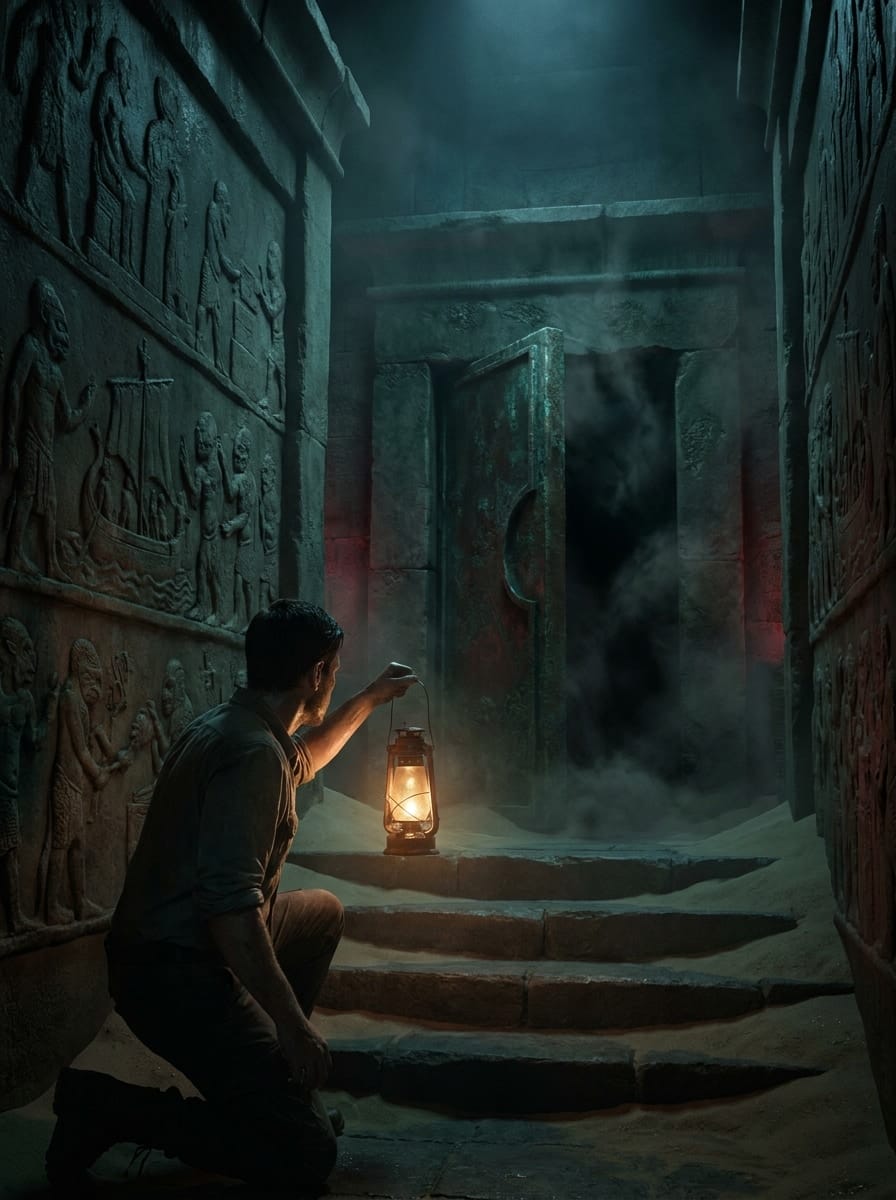
By evening he found three temples half-sunk in the sand. They were low and massive, with entrances like cave mouths. The first held only rubble and drifted sand. The second had largely collapsed. The third, however, revealed a dark opening descending inward. He lit a lamp, dropped to the ground, and forced himself inside inch by inch.
The passage was so narrow he could scarcely breathe. His clothes caught on sharp edges of stone, and the flame shook in the cramped air. After a short crawl, the corridor suddenly sloped downward, and stair after stair sank into blackness. Here there was none of the desert heat, only a cold rising from below, as though some vast cellar were breathing.
He ought to have turned back. But he had already come this far; how could he leave without seeing what lay beneath? He raised the lamp, braced himself against the wall, and descended.
The History Carved in Stone
The stairway was long enough to seem to carry him away from the world of daylight altogether.
At last the explorer reached a broad underground hall. The walls on both sides were covered in carvings, preserved with uncanny clarity. As the lamplight touched them, the lines awoke in sections, like a story long asleep opening its eyes.
At first the images showed marshland and a city of low buildings. The beings walking through it were not men. They were short and elongated, with narrow heads, limbs bent in a way that was not human, and skin that seemed almost scaly. The artist had rendered them with solemn care: they raised tools, hauled stone, and raised temples; they knelt before altars and placed the dead into stone coffins; they sailed along rivers and bays in strange vessels; they fought enemies, and after victory they carried the slain back into the city.
At first the explorer thought these must be some strange mythological gods. But the farther he went, the more wrong that seemed. The carvings were too continuous—from founding to prosperity, from war to migration, from feast to burial, scene after scene, like true history. The inhuman shapes were not chance monsters at all; they were the masters of this city.
Deeper in the hall, the murals grew darker. Rivers ran dry, the land split open, and the sun hung in the sky like a watchful eye. The city’s inhabitants began carrying their possessions underground, and deeper passages appeared beneath the temples. Later, there were no broad waters in the images at all—only sand, stone, caves, and doors opening into darkness.
The explorer stood sweating, his hand tight around the lamp. He came at last to a low burial chamber. In its center lay a stone coffin, the lid not quite sealed. After a moment’s hesitation, he pushed it open.
Inside was a desiccated body.
It had been preserved almost too well. It was not human, yet it was disturbingly human in outline—long-jawed, flat-browed, with curled limbs and hard, weathered skin that recalled the beings in the carvings. It wore ancient ornaments, like some noble or priest laid in an ancestral place. In that instant, the murals, the low doorways, and the underground passages all came together.
The nameless city was not the ruin of some forgotten human kingdom. It belonged to a race older than human memory. The walls above were only its dead shell; below lay its final nest.
The Wind Behind the Bronze Door
The explorer did not flee at once.
Fear had seized him, yes—but something stronger had seized him too: he wanted to know where the corridor led, and where those inhabitants had gone at last. So he left the tomb and kept on along the stairs downward.
The deeper he went, the colder the air became. The carvings grew fewer, replaced by rows of doorways and low chambers. Some places seemed to be quarters, others shrines; in others, broken vessels and unrecognizable fragments of bone lay strewn about. He dared not examine them closely, and kept the lamp close to his chest while his footsteps echoed through the depths.
At length he came to the edge of a vast black void.
Before him stood a bronze door of extraordinary height, utterly unlike the low entrances he had passed through. Rust and strange reliefs covered it, as though it were the last barrier to still deeper places. No light showed through its seam—but wind did.
It came up from below, cold and damp, carrying a smell that did not belong in the desert. It seemed to rise from an abyss, from a buried sea, or from something even farther below than a buried sea. The flame of his lamp sank almost to extinction, and within the wind he heard faint sounds.
At first they were like stones rolling. Then like countless claws scratching over the floor in the distance. And then, unmistakably, there came a harsh, broken chant, as though many throats were calling out in a language long dead.
He turned and ran.
But in terror the way back became long and strange. He struck walls, fell, rose again. The lamp shook violently, throwing the ancient inhabitants in the carvings into the look of running figures. The eyes cut into the stone seemed all to turn upon him, as if questioning an intruder in an ancestral tomb.
Behind him the wind grew fiercer. It rushed through the hall with a shrill howl. The explorer glanced back once and nearly lost the strength to move.
Out of the darkness where the bronze door stood came shapes.
They were low and long, swift in movement, and their outlines matched the old race in the carvings exactly. They seemed to be lifted by the wind like smoke, yet they crossed the floor as if they had solid bodies. The explorer could not tell whether they were ghosts, nightmares, or some of the old inhabitants still surviving below. He only knew that they were coming from the black depths—from the true heart of the nameless city.
The City Still Beneath the Sand
How he escaped the underground he could never fully say.
He remembered the narrow stairs, his knees and palms bleeding raw, and the lamp at last going out as he groped upward in darkness. Behind him there had always been wind, and shrieks, and many quick, light sounds. By the time he rolled out of the temple entrance and onto the sand, the sky at the horizon was already paling to dawn.
The nameless city still lay there in the desert.
Low walls, broken doorways, half-buried temples—all were as silent as when he had arrived. Once the sun was up, the dunes shone, and the wind smoothed away the tracks he had left in the night. Anyone passing at a distance would see only a dead city, a heap of stone crushed by time.
But the explorer knew that its silence was only skin-deep.
Beneath that city lay halls, tombs, walls carved with the history of a race, and a bronze door leading into deeper darkness still. Those ancient inhabitants may have died long ago—or perhaps they had only withdrawn to places human beings could not see. The city had no name, because humankind had never truly possessed the right to name it.
Afterward, whenever he thought of moonlight in the desert, he remembered the cold wind that had risen from below. The nameless city was still there, half-buried in the sand, like an ancient corpse that had not yet quite rotted away. And in its buried heart, something older than mankind might still be waiting for the next wind to open the door.