Cthulhu Mythos
The Silver Key — Cthulhu Mythos
After reaching adulthood, Randolph Carter lost the power to enter the realm of dreams. Neither reality, learning, nor occult study could restore to him the strange countries he had known in childhood. Only when he found a silver key in an ancestral oaken box did he follow the old road back into the hills near Arkham, and vanish from the human world as though he had passed through time itself.
Article
Summary
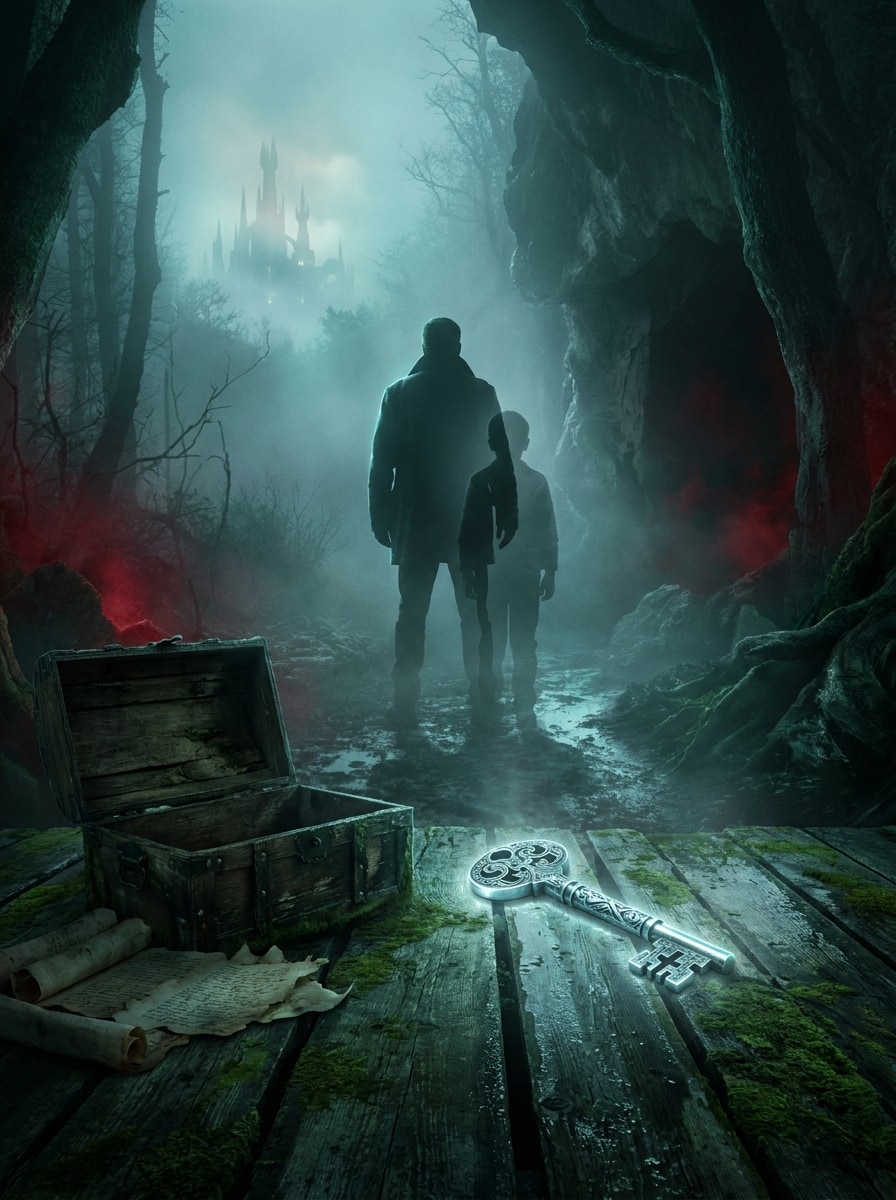
After the age of thirty, Randolph Carter could no longer enter the cities and gardens of his dreams. In boyhood, night had been a road into marvelous countries; as a grown man, he tried to accept the answers offered by the waking world, and sought comfort in religion, science, philosophy, and occult lore. Yet every path led him farther from the wonders he had once known as a child. In time, he withdrew among the traces of his former life, arranging his house as it had been in childhood. In dreams he heard his grandfather telling him to seek an heirloom box. Inside it lay a silver key engraved with strange patterns, along with ancient writing he could not read. Carter did not know what door the key was meant to open, but he understood that dreams were drawing him back toward the land of his ancestors. Carrying the key, Carter returned to the ruins of the old family place near Arkham. At dusk he left his motorcar behind and entered the woods and caves he had known as a boy, while memory and reality began to overlap. When an old servant's voice called to him among the trees, he was no longer merely a wanderer of fifty, but seemed to have returned to the year when he was ten. Later, his relatives found only his car beside the hill road, together with the oaken box and an undeciphered parchment. Carter himself was gone. The surviving account suggests he did not die, but used the key to pass through the maze of time, space, and dream, returning to the realm he had always longed for. The rumor, in a far dream-city, of a new king may be the sign that he found his way home.
The Man Who Lost the Gate of Dreams
After Randolph Carter turned thirty, he discovered that he could no longer find the gate of dreams.
Once, every night, he had been able to leave the dull and level world of humankind and travel to distant cities, gardens, and shores. Those places belonged to no daytime map, yet he knew them better than many real streets. He remembered ships on foreign rivers, towers shining beneath moonlight, and far horizons that still glowed in his heart after waking.
But as the years passed, the gate slowly closed. First the roads in dream grew dim; then even the walls and rivers disappeared. By day Carter heard men speak of reality, learning, duty, and success. By night, when he shut his eyes, he found only scraps of the waking hours.
He would not accept such a loss. When others urged him to acknowledge the real world, he tried to look at reality. When they told him to seek wonder in science, philosophy, faith, or occultism, he tried each in turn. Yet these doctrines seemed either too barren or too shallow. They could explain many things, but they could not open the old door.
The Ancestral Box
In time, Carter retreated into his own memories.
He rearranged his house until it resembled the rooms of his childhood, hoping that the vanished days might draw a little nearer. In those half-waking, half-dreaming days, he began to dream of his dead grandfather. The old man spoke of the strange and sensitive forebears of the Carter family, and of an oaken box that had not been opened for a very long time.
When Carter woke, he truly found the box in the depths of an old cabinet in the attic. It was bound with iron, and uneasy faces were carved into its wood. The marks of age upon it suggested that many generations had neither wished nor dared to touch it. Even the servant who helped pry up the lid trembled as he worked.
There was no treasure inside, only a yellowed parchment and a heavy silver key. The key's surface was covered with fine markings, like writing, yet like no script any scholar could readily name. The parchment, too, was covered with strange signs that reminded Carter of things he had glimpsed during certain perilous studies.
He did not know what door the key was meant to open, but he knew it was no common key. After that, his dreams grew clearer. They did not carry him back to the cities of old dreaming, but drew him step by step into childhood, toward Arkham, the Miskatonic River, and the hill country where the ancestral house had stood.
Back to the Old Hills and Woods
One autumn day, Carter set out with the silver key.
He drove along country roads that were both familiar and strange, toward the land of his forefathers. There were stone walls by the road, pastures, bends of the river, and woods; far off, the hills receded layer by layer in the evening light. The nearer he came to the old place, the more he felt that a motorcar had no right to enter what he sought. So he left it at the edge of the woods and climbed the slope alone.
The old house had long since fallen into ruin, but the woods still swallowed the path as they had in childhood. As dusk deepened, he saw a church spire shining far away in the sunset; then he remembered that the church had been torn down many years before. Memory and the scene before him began to fold together, as though an unseen hand were gently bending time back upon itself.
Suddenly, someone in the woods called him by his childhood name.
The voice belonged to old Benijah. By all reason, the man should have been too old to run about like that, if indeed he were alive at all. Yet Carter heard him scolding a child who had played too long and stayed out too late, telling him to hurry home before Aunt Martha grew anxious.
Carter felt in his pocket. The silver key was still there. But all at once he could no longer tell clearly where he had come from. The houses in Boston, the books of adulthood, the wars and travels all seemed to lie behind a heavy mist. The old servant led him back into the lamplit house, where Carter ate supper like a boy of ten and waited for the next day, when he would go into the woods to seek the true door.
In the Depths of the Snake-Den
The next day, while no one was watching, Carter took the key and ran into the woods.
He came to a cave he had often visited in childhood. Country people called it the snake-den and kept away from it, but Carter knew that at its deepest point a narrow cleft led into a farther chamber of stone. The place was cold and still. Its walls seemed natural, yet also as if, very long ago, some hand had deliberately left its mark there.
He lit stolen matches, crawled through the fissure, and went deeper into the cave. The farther he went, the more certain he became that the key was meant to be used there. Where the key was inserted, and how the door opened, no one outside could ever say.
Only this is known: after that day, Carter was no longer quite the same Carter.
Years later, his relatives would say that after his tenth year he became stranger than before. From time to time he seemed to speak of the future, though he himself did not understand the meaning of his words. Later still, when the grown Randolph Carter disappeared, people found his motorcar beside the hill road leading to the old place. Inside it were the dreadful wooden box and the parchment, but not Carter himself.
Some were ready to divide his property. But the narrator does not believe that he is dead.
For to a true dreamer, time, space, memory, and reality may not be as firm as ordinary people suppose. What Carter sought was the dreamland of childhood, and also the self he had long ago lost. Perhaps the silver key was the thing that opened the labyrinth. The human world saw only an empty car and a missing man; but deep in dream, perhaps a new king has already taken the throne of a far city, waiting to meet old companions once again.