Cthulhu Mythos
The Lurking Fear — Cthulhu Mythos
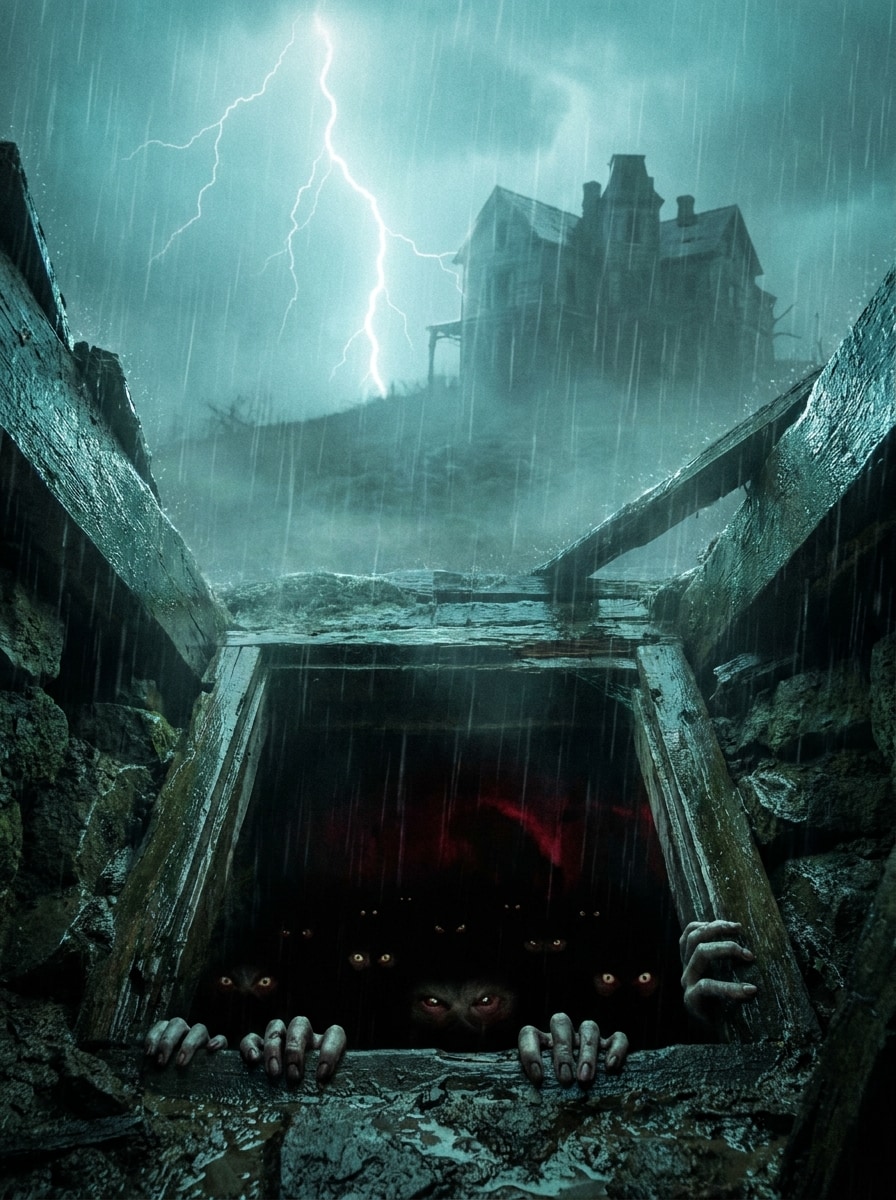
On a desolate mountain after a storm, people are found slaughtered near an abandoned mansion. An investigator goes there with companions, only to discover that the terror is not the ghost of local legend, but the monstrous offspring of a family that has degenerated in darkness.
Article
Summary
Around Tempest Mountain, the hill folk spoke of the old Martense mansion whenever thunder rolled. The house had long stood in ruin, and poor scattered families lived nearby. After one violent storm, nearly everyone in a nearby settlement was found torn apart, their bodies marked by wounds that seemed neither animal nor human. Obsessed with the horror, the investigator takes two companions into the abandoned Martense house, hoping to witness the truth when the thunder returns. In the night, while the storm breaks over the roof, one companion vanishes, leaving only confused traces behind. Later, he keeps watch in the hills with a reporter named Munroe, but something creeps closer from the dark and from beneath the earth, and Munroe too dies by the window. Searching for the root of the terror, the investigator turns to the history of the Martense family. The Dutch-descended line had once been secluded and gloomy, avoiding all contact with outsiders and marrying among its own kin for generations. One young man left home to serve as a soldier, then returned unable to endure the family's decay. His relatives murdered him, and the hill people blamed every later horror on his restless ghost. The investigator opens the grave and proves that the young man was indeed murdered, but he also realizes that the true fear does not come from the tomb. At last he discovers that the ground beneath the ruined house is riddled with passages, where a brood of creatures, degenerate descendants of the Martense bloodline, lurks in darkness. Thunderstorms rouse them, and they crawl out through the mountain to attack the living. After the truth is uncovered, the house and its underground lair are destroyed, but he can never forget the eyes in the dark, still bearing the family's mark.
The Mountain Village After the Storm
Tempest Mountain was never a place that invited affection.
It crouched over the lonely countryside, its slopes tangled with twisted trees, its stones jutting from the soil like the backs of old graves. Near the summit stood a great abandoned house, its boards blackened, its windows hollow, its roof fallen in at several places. Few people nearby cared to pass it after dark, and fewer still would go near it in a thunderstorm.
Yet poverty leaves little room for fear. Some families with nowhere else to go had built shacks at the foot of the mountain and among the trees, living on odd work, gathered firewood, and scraps of poor soil. They knew the stories about the old house, but treated them as tales to frighten children. Then came the storm.
That night, clouds rolled down from beyond the mountain, and flash after flash of lightning turned the ridge a ghastly white. Thunder crashed through the woods like enormous wheels grinding across the sky. When people went up the next day to see what had happened, they found several shacks battered by wind and rain, and the ground within and around them strewn with the dead.
They had not been crushed by falling beams, nor drowned in floodwater. Many bodies were torn by bites and raking wounds; bones had been snapped by a terrible strength. Some seemed to have been dragged from their straw beds in sleep. Others had died crawling toward the door, their fingers still clawed into the mud.
When the news spread, the hill folk began to speak an old name: Martense.
They said the ruined house on the summit had once belonged to the Martense family. Long ago, that family had lived apart on the mountain, disliking the company of outsiders, and each generation had grown stranger than the last. In time the family vanished from notice and the house fell into decay, yet on nights of thunder, people said, something still woke upon the mountain.
When I heard these things, I was not satisfied with vague talk of "something." Fear can turn a wild dog into a demon, and a criminal into a ghost. But the marks on those bodies were too strange, and the dead too numerous. Somewhere in the dark, there had to be a cause. So I resolved to go up the mountain.
Watchers in the Ruined House
I did not go alone.
George Bennett and William Tobey came with me. They had heard of the massacre and were willing to spend a night with me in the old Martense house. We carried lamps, pistols, food, and clothes enough to keep off the rain, and climbed the slope before dusk.
The house was worse than it had seemed from below. The door hung crooked, and its hinges gave a long groan when pushed. Dampness filled the rooms. Wallpaper peeled from the walls, and the floors were layered with dust and splinters. In the hall stood a great chimney; the hearth was cold, and the flue yawned upward like a black mouth into unseen heights.
We chose a room that could still keep out the rain and settled there to watch. Outside, the wind rose, and branches struck the siding as though someone were testing the walls. Bennett said, half in jest, that if the legend were true, we might at least learn whether it entered by the door or came down the chimney. Tobey did not laugh. He kept staring at the chimney, his fingers tight around the butt of his pistol.
Late in the night, the thunderstorm arrived.
When the first bolt of lightning lit the room, every crack in the wall seemed suddenly to open like an eye. Then thunder burst over the roof, and dust sifted down from the beams. We raised the lamp flame and kept close to the center of the room, unwilling to let any corner sink back into darkness.
At the height of the thunder, something stirred in the chimney.
It was not the fall of loose stone, nor the howl of wind through the flue. It was a low, hurried scraping, as if something wet were rubbing along the bricks. Bennett sprang up and took a step toward the hearth. Tobey shouted for him to come back, but another clap of thunder swallowed his voice.
For one white instant of lightning, I saw a shadow pass across the wall beside the chimney.
It was low and misshapen, its limbs pressed close to the surface, moving too swiftly for any ordinary man. Bennett turned, astonishment just beginning to cross his face. Then a cold rush of air dulled the lamp.
By the time we reached him, he was gone.
A few confused gouges scarred the floor, and a wet black smear of blood lay beside them. From inside the chimney came a rapid scraping sound, already retreating. Then the storm covered everything.
Tobey and I did not follow. It was not that we did not wish to, but in that moment courage seemed to have been hollowed out of our chests. We stood back to back until dawn, neither of us closing our eyes. At daybreak we searched the ruined house and the surrounding woods, but found only a small torn piece of Bennett's clothing.
The Second Death at the Window
After Bennett disappeared, many urged me to leave Tempest Mountain.
But I could not go. Fear did not drive me from the place; it bound me there. Whatever had entered the old house on a night of thunder, whatever could carry off a grown man through chimney or wall, might explain the slaughter at the foot of the mountain. It had a lair, a path, and a habit of waiting for thunder.
Not long afterward, I met Arthur Munroe. He was a bold reporter, and when he heard my account, he decided to investigate with me. We did not return at once to the mansion. Instead we searched the mountain for fissures, cave mouths, old wells, and any opening that might lead underground.
The earth and stone there were in confusion. Black holes showed beneath tree roots, and in gullies washed out by rain we sometimes saw marks like the work of claws. We searched by day and slept at night in deserted shacks. Whenever clouds gathered on the horizon, Munroe cleaned his pistol and set the lamp near the window.
On another night of thunder, we took shelter in a broken wooden hut. Rain hammered the roof, water leaked from one corner, and mud began to pool on the floor. Munroe sat near the window, hoping to catch the shape of the hillside in the lightning. I lay on the other side of the room and heard, faintly beneath the earth, a small restless sound.
At first it was far away, like rats running inside a wall. Then it multiplied, as though many claws were digging through wet soil, or something were crawling through hollows under the hut. I signaled Munroe to stay silent. He nodded and pressed his face close to a crack beside the window.
Lightning flared.
I saw only a low shape outside lunge forward. In the next instant, glass and frame shattered together. Munroe did not even have time to cry out before he fell backward. I fired, but the shot was nearly lost in the thunder. The thing withdrew from the window and vanished into the rain, leaving behind a damp, foul stench.
When I reached Munroe, he was already dead. His face and throat had been torn open, and his eyes still stared toward the window, as if in his final instant he had seen something the mind could not endure.
From that night on, I no longer believed in a single murderer, nor in any common beast. It knew the mountain. It knew the underground. It knew the shelter thunder gave it. It had not come from far away. It had always lived there.
The Old Story of the Martenses
To find the thing, I had to return to the Martense family itself.
I searched old records, questioned the oldest hill people, and pieced together whatever fragments I could find. The Martenses were descendants of Dutch immigrants who had built their house on Tempest Mountain long ago. At first they were merely solitary; later they became more and more unwilling to deal with anyone outside their own blood. Few from below were ever invited into the mansion, and those who occasionally saw members of the family remembered their sullen faces and the strangely mismatched color of their eyes.
They lived shut away from the world, and even their marriages were often made among close kin. As the years passed, the rumors grew uglier. Some said the Martenses had become violent-tempered. Others said their features had grown coarse and brutish. Still others claimed that quarrels and howling could often be heard from the summit after nightfall.
Among these old accounts, one name stood out.
He was a young Martense who had left the house to become a soldier, and had seen other towns, roads, and crowds of people. When he returned from service, he was no longer willing, as the rest of his family seemed to be, to endure a life sealed off from the world. He wrote to a friend that there were hateful things in the family, things he wished to uncover, and that he meant to leave the gloomy house for good.
He never left alive.
His relatives said he had been struck by lightning, and buried him in haste nearby. The hill folk did not believe it. From that time forward, whenever horrors appeared on stormy nights, people said the murdered young Martense was wandering the mountain, taking revenge on his kin and on trespassers.
The tale had lasted a long while. It was complete enough, and frightening enough. Yet Bennett's disappearance and Munroe's death told me that matters could not be so simple. Ghosts do not leave claw marks in the mud, nor crawl underground like burrowing beasts.
I took tools to the grave.
The burial place was choked with weeds, the stone fallen askew, its inscription almost gone. I dug through wet earth and found the remains within. The young man's skull bore a clear fracture. It had not been made by lightning, but by a heavy blow.
He had indeed been murdered.
Yet as I stood beside the grave, looking at the rain-cut channels in the soil around me, I felt colder than before. The murder explained the sin of the Martenses, but not the crawling sounds that had come later. The true fear was not in the grave. It was around the grave, beneath the old house, in the darkness of the whole mountain's belly.
The Family Underground
I returned once more to the Martense house.
This time I did not keep watch in the hall or by the chimney. I searched under floors, along the foundations, and between fallen stones. The underground spaces beneath the house were more tangled than I had imagined. Behind a collapsed cellar lay narrow passages, their walls worn smooth as though something had long gone in and out. In the wet earth lay scattered bones, some animal, some human.
With a lamp in hand, I crawled along the tunnel. The air grew close, carrying the smell of decay and of an animal den. Overhead, thunder reached me through thick earth, low and distant, and certain places in the tunnel seemed to answer it: scratching, panting, the patter of small swift movement from every side.
These passages were not natural. They had been dug, widened, and joined together like a hidden web inside the mountain. The old house, the graveyard, the woods, the shacks at the foot of the slope: all seemed connected by those black ways. No wonder the things came and went unseen. No wonder they could appear suddenly beside sleeping people on nights of storm.
In a broader cavern, I saw them.
At first I thought they were animals. They crouched on the ground, pale and filthy, their limbs bent, their heads lowered, moving with a speed like something between mole and ape. But when the light swept across one face, I nearly dropped my pistol.
There were still traces of humanity in it.
Not a clear human face, but the remnant of one, twisted by generations of darkness, hunger, inbreeding, and savage life. Its mouth jutted forward, its teeth were sharp, its fingers clawlike; yet its eyes were not the eyes of a mere beast. They bore the strange coloring associated in old tales with the Martense family, a hereditary mark that the records had scarcely paused to notice, preserved now in the creatures beneath the earth.
Then I understood.
The Martense family had not simply vanished. Shut away on the mountain, it had decayed, sinned, and degenerated, until some branch of it had crawled underground and lived like beasts afraid of the sun. Their descendants had hidden in those caves generation after generation, feeding on livestock and the occasional human being who strayed too far alone. Thunderstorms covered their movements, and perhaps awakened in them some mad ancestral habit. The hill folk had shaped their fear into the ghost of a murdered man, but what truly lurked in the mountain was living blood.
Then more sounds rose from the depths of the cavern. Low shapes gathered at the edge of the lamplight. They had smelled me and were closing in.
I fired. The flash leapt through the cave. Screams burst out as if from many throats at once. I turned and crawled back the way I had come, my knees and palms torn by stone, while claws scraped at the earthen walls behind me. Thunder rolled overhead, and the whole mountain seemed to roar for them.
I do not know how I escaped the passage. When I stumbled back into the rain, my clothes were soaked with mud and water, and in my hand I held only a hot pistol.
The Lair Destroyed
The discovery of the truth did not end the matter.
The old house could not be allowed to stand, nor could the underground passages remain open like black mouths. Later, men came up the mountain with explosives and tools. They sealed every entrance they could find and blasted down the remaining walls of the Martense house. When thunder sounded again, a muffled answering rumble came from the mountain's belly, as though things were fleeing and shrieking deep below, until stone and earth pressed them silent.
The people at the foot of the mountain breathed more easily. No scraping came night after night beside the shacks, and storms were only storms again. The tale of the Martense ghost would still be told, but those who knew the truth understood that no spirit had haunted the place. It was what remained after a family shut itself away in darkness.
When I left Tempest Mountain, the sky had cleared. On the summit, the ruined house was reduced to charred beams and broken stone, and rainwater ran down the slope, cutting shallow lines in the mud. From a distance, the place seemed at last to be quiet.
But some sights do not scatter with the mountain wind.
I often think of that face in the underground cavern: the beastlike shape that still held something human, the eyes that still carried the Martense mark. The most terrible thing about fear is not only that it hides in darkness. It is that when the light falls on what waits there, you may discover it was once human.