Cthulhu Mythos
The Quest of Iranon — Cthulhu Mythos
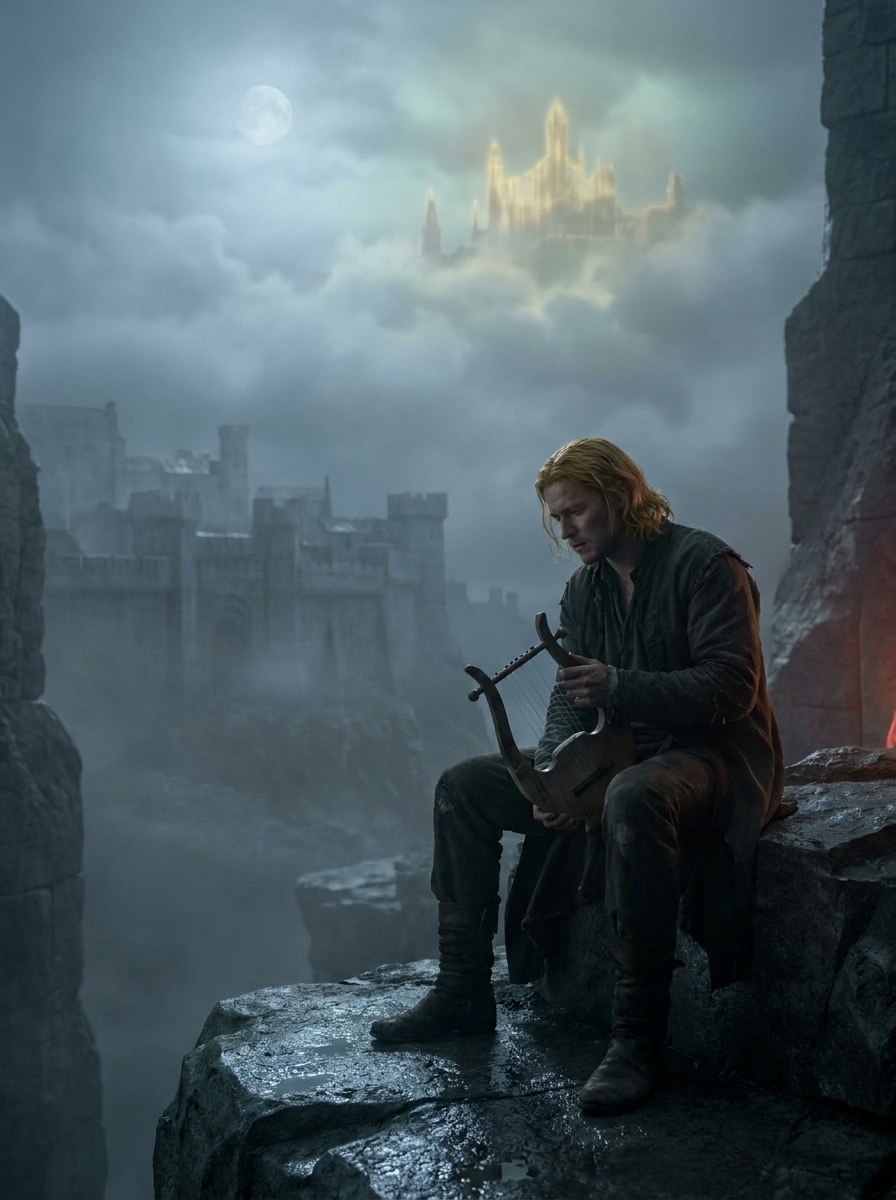
The golden-haired singer Iranon enters the hard, joyless city of Teloth, saying that he comes from beautiful Aira and is a lost prince. All his life he seeks both a homeland remembered in song and someone who can understand his music, until an old shepherd tells him the cruel truth.
Article
Summary
Iranon comes to Teloth, a city of granite, and sings to its people of Aira: its moonlight, rivers, and palaces. He says he is a prince of that land, driven from home in childhood and now searching for his lost kingdom. The people of Teloth do not understand his dream. They tell him to become a cobbler, for Teloth believes in labor, not songs. By the river, a boy named Romnod hears Iranon and longs for the world beyond the city. He leaves Teloth with the singer. Together they pass through hills and forests, seeking Oonai, a city said to be full of lutes and dancing, and hoping it may somehow be Aira under another name. During the long journey, Romnod grows toward manhood, while Iranon remains strangely young, as if preserved by his dream. Oonai is indeed bright and merry. At first its people applaud Iranon’s songs, and the king gives him fine robes and a room in the palace. Yet the city’s pleasure does not truly understand Aira; it treats his music as a passing amusement. When new dancers and flute-players arrive, the crowd turns elsewhere. Romnod sinks into wine and feasting, grows heavy and old, and at last dies at a banquet. After burying Romnod, Iranon takes off his splendid garments and resumes his wandering, still young, still singing of Aira. At last an old shepherd recognizes the names in his songs: they were only the imagined words of a beggar child from the shepherd’s youth. That child had never been a prince and had never lived in a city of marble. Iranon understands that the homeland he has sought never existed, and beneath the moon he walks into the quicksand.
The Singer in the Granite City
When a golden-haired young man entered the city of Teloth, his robe was torn by the brambles of the hills, and vine leaves still crowned his head.
Teloth was a hard and cheerless city. Its houses stood square and severe; its stone walls were heavy, and its people wore gloomy faces. They asked the stranger where he came from, what he was called, and what possessions he owned. The young man answered that his name was Iranon, and that he came from far-off Aira. It was a city he could not remember clearly, yet had spent his life seeking. He had no money, only childhood memories, dreams, and songs.
At evening, Iranon sang in the square before the tower. He sang of Aira’s moonlight, of the streets outside the window where his mother had rocked him to sleep, of palaces built of marble and beryl, of the river Nithra and the flowering trees of the valley. A few listeners were moved for a moment, but many yawned, laughed, or turned away to sleep.
The next day the rulers of the city told him that every person must work. He was to become an apprentice to Athok the cobbler.
Iranon said that he was a singer, and that his heart held no wish to make shoes. He asked why these people labored, and where joy could be found if work existed only so that more work might follow. But Teloth did not understand such questions. The rulers merely said that song was foolish, and that the gods of the city approved of labor.
The Boy by the River
Iranon left the streets and went down to the stone embankment.
There a boy sat beside the sluggish river Zuro, watching the water and waiting for green branches washed down from the mountains. The boy was named Romnod. He had been born in Teloth, but the city had not yet hardened him completely. He had heard that beyond the mountains lay Oonai, a city of lutes and dancing, and he longed to go there with Iranon.
Romnod said that perhaps Oonai was Aira. Names could change, and cities could wear different shapes in rumor and memory. Iranon did not believe that Oonai was truly Aira, but he was willing to take with him a child who still knew how to yearn.
At sunset they left Teloth and entered the woods of the hills.
For a long while they walked among green slopes and cool forests. By day they ate fruit; by night they watched the stars. Iranon sang of Aira, and Romnod listened. In those hours they were almost happy. Yet the road seemed never to end, and Oonai always waited somewhere beyond the next distance.
The Lights of Oonai
Years passed like wind. Romnod grew tall, and his voice deepened; Iranon, however, seemed not to age at all, and still adorned his golden hair with vine leaves.
On a night of full moon, they finally saw Oonai from a mountaintop. Countless lights burned below, and voices and music rose from the city. At once Iranon knew it was not Aira. The light of Aira, in his memory, was as soft as moonlight; Oonai’s lamps were bright, sharp, and noisy.
But Oonai at least had music and dancing. So they descended and entered the city.
At first the people loved Iranon. They threw flowers to him and applauded his songs. The king invited him into the palace, gave him fine garments in place of his tattered purple robe, and housed him in a chamber hung with woven cloth. Iranon sang of Aira in the hall, and the polished floor seemed no longer to reflect the drunken crowd, but a city long vanished and beautiful.
Yet Oonai did not truly understand his song. Its people loved novelty, wine, dancers, and clamor. Later, when dancers and flute-players from abroad came to the palace, fewer flowers were given to Iranon.
Romnod changed as well. He came to love the feasts of Oonai. He wore flowers in his hair; his face reddened with wine, and his body grew heavier day by day. The boy who had once waited by the river in Teloth for green branches no longer listened closely when Iranon sang of Aira.
One night Romnod died on a banquet couch. Iranon wept for him, laid on his grave the green branches the boy had loved in his youth, then took off his rich clothing, put on his old purple robe again, and left Oonai.
The Truth of Aira
Iranon went on searching.
He passed through many cities and across desolate lands. Children mocked his old songs and ragged clothes, yet he remained young, still wearing vine leaves on his head, still singing of Aira’s marble palaces, the river Nithra, and the little waterfalls of Kra.
One night he came to the hut of a poor shepherd. The shepherd was very old and lived beside a stony slope above a marsh of quicksand. Iranon asked him what he had asked so many others: did he know where Aira lay?
When the old man heard the names Aira, Nithra, and Kra, he stared at Iranon for a long time.
He said that he had indeed heard those names when he was young. They had been the dream-words of a beggar boy who was always speaking them. That child, too, had been beautiful and golden-haired, and loved to invent tales of moonlight, flowers, and the west wind. He said he was a prince, and that a city called Aira waited for his return. But everyone in the village knew he had been born there and had never known any marble city, nor anyone who understood his songs.
The old man said the child had later run away, searching for people who would listen when he sang.
Iranon heard this, and understood.
Moonlight lay upon the marsh like the light a child might see before sleep. He did not argue, and he did not sing. A very, very old man, wearing a torn purple robe and withered vine leaves on his head, gazed ahead as though he saw a city of golden domes, and slowly walked into the deadly quicksand.
That night, something young and beautiful in the ancient world died with him.