Cthulhu Mythos
The Shunned House — Cthulhu Mythos
On an old street in Providence stands a house the neighbors have long avoided. Those who live there weaken, sicken, and seem to be slowly drained by something unseen. A young investigator and his uncle search old records, keep watch in the cellar by night, and at last discover the evil hidden deep beneath the foundations, destroying it with strong acid.
Article
Summary
On an old street in Providence there is a house that the neighbors have shunned for years. Those who move inside often grow weak and pale, dream terrible dreams, and fall ill; children are especially likely to waste away and die. Even the yard seems touched by sickness, its plants yellow and crooked, while the cellar is haunted by a damp, mold-rotted smell. The young investigator and his uncle, Dr. Elihu Whipple, refuse to accept the matter as a simple ghost story. They search deeds, burial records, family papers, and old newspapers. Again and again they find death and illness circling the house, and every thread leads them downward—to the cellar, and especially to the pale patches of fungus on the floor, which seem to trace the outline of some enormous buried shape. The uncle and nephew enter the cellar for a night’s vigil with lamps, instruments, and paper for notes. As the hours deepen, the outline in the mold grows clearer, and the air seems to be drawn away by something invisible. Dr. Whipple suddenly withers and dies, as though his life has been sucked out by something beneath the ground, and the young investigator can only flee the old house in terror. Later, the young investigator returns to the cellar with a great quantity of strong acid. He digs into the floor and uncovers, beneath the foundations, a rotting thing that is almost human in shape and yet not truly formed. Like a root buried for years in the soil, it has endured by feeding on the breath and vitality of the living above it. When the acid destroys the thing, the chill leaves the house, the plants begin to grow again, and the long-shunned dwelling at last falls quiet.
The Empty House on the Old Street
There are old streets in Providence that seem dim even in daylight. Low eaves lean over the sidewalks, rain has blackened the stone steps, and old house numbers cling to the walls like names no one wishes to read aloud again.
From childhood, the narrator knew that one house on such a street was best left alone.
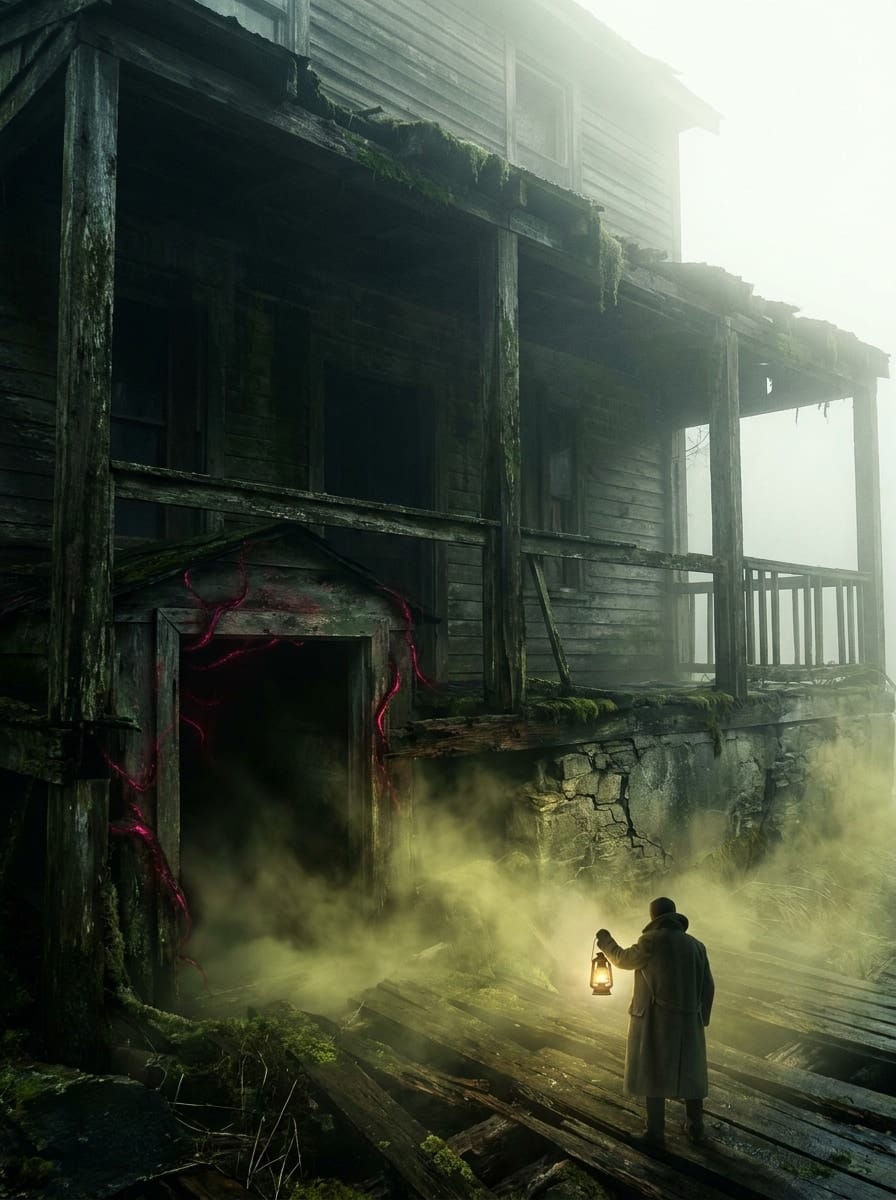
It was not a ruin. It had doors, windows, stairs; people had moved into it and tried to live there. Yet it always seemed damper than the houses beside it. Mold clung to the base of the walls, and the wood held a sour, decaying odor that no one could quite name. In summer, when vines elsewhere shone green, the grass in its yard grew bent and sickly, as if something had wounded it at the roots. At dusk a dark film seemed to settle behind the windowpanes, and passersby often quickened their steps without knowing why.
The adults did not like to speak plainly in front of children. They only said the house was unwholesome. But children hear fragments: one family moved in and soon all of them fell ill; one lively child grew paler day by day after sleeping under that roof; someone heard a dull sound from the cellar at night, as if something underground were shifting softly in its sleep.
As the narrator grew older, such scraps of rumor no longer satisfied him. He had an uncle named Dr. Elihu Whipple, a careful physician who was not quick to believe in ghosts. He had heard many patients groan and seen many dead faces, and he preferred to think that sickness had causes and death had reasons. Yet even he did not laugh easily when the old house was mentioned.
There had been too many deaths there—too many to feel like chance.
The Old Records, One by One
When Dr. Whipple began his investigation of the house, the narrator was still young. His uncle took him through old newspapers, property deeds, family papers, and cemetery registers. The pages had yellowed; their corners crumbled at a touch; some of the writing had faded to pale brown. Yet line by line, the shadow of the old house grew sharper.
Long before, the Harris family had lived there. Those who first moved in had meant to make a proper home of it. They repaired doors and windows, brought in furniture, and let children run through the rooms. But before long, illness crossed the threshold.
At first it was weakness and anemia. People bore no visible wound, yet day after day the color drained from them. Some coughed; some burned with fever; some woke in the night saying they had dreamed of a face that should not have been near them. Children suffered worst of all, often wasting away in only a few months. Doctors were called, rooms were changed, windows opened, prayers said, beds moved—but nothing helped.
Stranger still, the sickness did not spread like an ordinary contagion. Some people were healthy enough while living elsewhere, then declined rapidly after occupying certain rooms. Others improved after leaving. The house seemed almost to choose its victims, as if an unseen abyssal mouth lay hidden between the floors and the foundations, waiting for the breath of the living.
The deeper his uncle searched, the farther back the trail ran into the ground itself. Before the house was built, the plot had known old graves, old rumors, and a foreign woman disliked by her neighbors. The tales about her were confused and dark. Some said she carried a strange disease; some said she did not rest quietly after death; others blamed her for every misfortune that followed. Dr. Whipple did not accept these stories whole. But he noticed one thing: all the rumors, symptoms, and deaths flowed at last to the same place—the cellar of the house.
The cellar was always wet. Salt bloom seeped from the brick joints, and cold rose from the earth. In the corners, odd white patches of mold sometimes appeared. They did not spread at random like common fungus, but seemed to reveal, little by little, the shape of something buried below.
“If there is a source,” his uncle said, “it is most likely beneath us.”
Their Vigil in the Cellar
In time, the uncle and nephew decided to keep watch inside for a night.
They did not go in like ghost-hunters from a tale, armed only with courage. Dr. Whipple brought electric lamps, a folding cot, note paper, a thermometer, and certain supplies for defense and emergency care. The narrator also carried a pistol, though he could not have said what bullets were meant to fight.
After dusk they entered the old house. As the door opened, the air came out to meet them—cold, damp, and heavy with the smell of something long shut away from sunlight. The rooms upstairs were empty. Wallpaper curled from the walls; only ash remained in the fireplaces. The wooden stairs creaked underfoot, as though the whole house objected to their descent.
The cellar entrance lay toward the back. Lamplight fell down the steps, one after another, into darkness. Water sweated from the walls, and heaps of broken brick and rotten wood lay in the corners. They set up the cot and placed the lamps where they could see the foot of the walls and the floor. The cellar was so still that they could hear each other breathing.
As the night deepened, the cold grew worse.
At first it was only a chill underfoot. Then the narrator smelled a stronger reek of mold, like rotten roots turned up from underground. In the lamplight, the white patches on the floor seemed clearer than they had at evening. They were not scattered clumps. They joined into a vast outline: curving lines, a broad trunk-like mass, something like a malformed body lying in the soil—yet no part of it looked truly human.
Dr. Whipple bent over it, and his face changed. He reached to write something down, but his hand suddenly began to tremble.
There was no wind in the cellar, yet the lamp flames sank as if pressed down by an invisible breath. The narrator heard his uncle give a short gasp. Turning, he saw him curl violently inward, as though something had hollowed him out from within. The calm face the narrator knew grew old and ashen in a matter of minutes; the skin lost its living sheen; the eyes stared into the depths of the cellar, as if fixed on something no one else could see.
The narrator rushed to support him, but his uncle’s body was frighteningly cold. He tried to drag him toward the stairs, yet his own legs weakened and his head filled with a buzzing roar. The mold-stench thickened. The white markings on the ground seemed almost alive, rising outward from the soil.
Dr. Whipple did not survive the night.
The narrator fled the old house in terror. In the morning the street looked quiet and clean, sunlight bright on the neighboring windows, as if nothing at all had happened. But he knew his uncle had not died of common sickness, nor merely of fright. Something in that house had taken a life before his eyes.
The Shape Beneath the Ground
Another person might never have returned. But the narrator could not leave his uncle’s death unanswered in that cellar.
He went away for a time, giving himself space to recover from the shock. Then he began to prepare for a second entry into the old house. This time he did not intend to keep watch, nor to wait for the thing to move first. He bought a large quantity of strong acid and gathered tools for digging. Like a poisonous root buried underground, it would have to be destroyed at its source.
When he entered the house again, daylight slanted through cracks in the door and broken windows. The place was still cold, but he no longer paused to listen to every groan of the boards. He went straight down to the cellar and began to dig where the mold was thickest.
The soil was wet and sticky, and the shovel sank into it with a dull sound. The farther down he dug, the stronger the odor became: rotting flesh, fungus, and the cold water of an old well mingled together. Bricks came up; black earth turned over; sharp dampness filled the cellar air. Fighting nausea, the narrator kept digging until the point of the shovel struck something that was neither stone nor wood.
When the thing was uncovered, he nearly lost his footing.
It lay beneath the foundations, enormous, soft, broken, and sunken—like a corpse that should long ago have dissolved, yet also like a root that had grown crooked at the edge of human form. It had something like a torso; twisted branch-like extensions reached into the soil; but it had no clear face, no true limbs. Years of damp and darkness had kept it from wholly rotting away. Or perhaps it had never been an ordinary corpse at all, but something that had remained in the earth by some unnatural means.
The narrator understood then that the house was not merely cursed, nor simply unhealthy. It had been built over a living grave. People upstairs ate, slept, spoke, and dreamed; beneath them, in the dark, the thing slowly fed on their lives. The mold on the walls, the pallor of children, the nightmares in the night, the sudden withering of his uncle’s body—all had begun here.
He did not look at it any longer than he had to.
He poured the acid down, bucket after bucket, over the monstrous remains. It struck with a dreadful hissing. White fumes rose; the cellar filled with choking vapor. The narrator covered his mouth and nose, retreated again and again, then returned again and again. The thing sagged, bubbled, and broke apart in the acid, like an evil root that had gripped the earth for years and was at last being burned through.
It was not a glorious battle. There were no shouted challenges, no swords, no thunder. Only stinging smoke in a cellar, black earth turned open, the clang of metal buckets against stone, and one living man forcing himself to finish what had to be done.
The Old House Falls Quiet
Afterward, the house slowly changed.
At first the difference was small. The foul smell in the cellar thinned, and the foot of the walls no longer seemed so cold. Later, the grass in the yard grew upright, and its leaves lost their yellow cast. When sunlight entered the empty rooms, it was no longer swallowed at once by dampness. The neighbors still feared the house and still walked around it, but the narrator knew that what had hidden below was gone.
Dr. Elihu Whipple did not return. Nor did the people who had died in the house. Their names remained in the old records, lying in the pages like letters soaked and blurred by years of damp.
Yet the house that had been feared and avoided for so long no longer reached invisible hands toward the living.
It still stood on the old street, with aging doors and windows and peeling walls. But after that, those who passed it no longer felt the same chill. The root beneath the ground had been burned away, and the long-hungry thing in the dark had vanished with the acid smoke and the rotted earth.