Cthulhu Mythos
The Horror at Red Hook — Cthulhu Mythos
Among the old buildings and wharves of Red Hook, New York, Detective Thomas Malone investigates a series of disappearances and discovers that an aged scholar is being drawn by subterranean rites toward a dreadful depth. When the raid is over, houses collapse, many are dead, and Malone can no longer bear the dark streets and doorways of the city.
Article
Summary
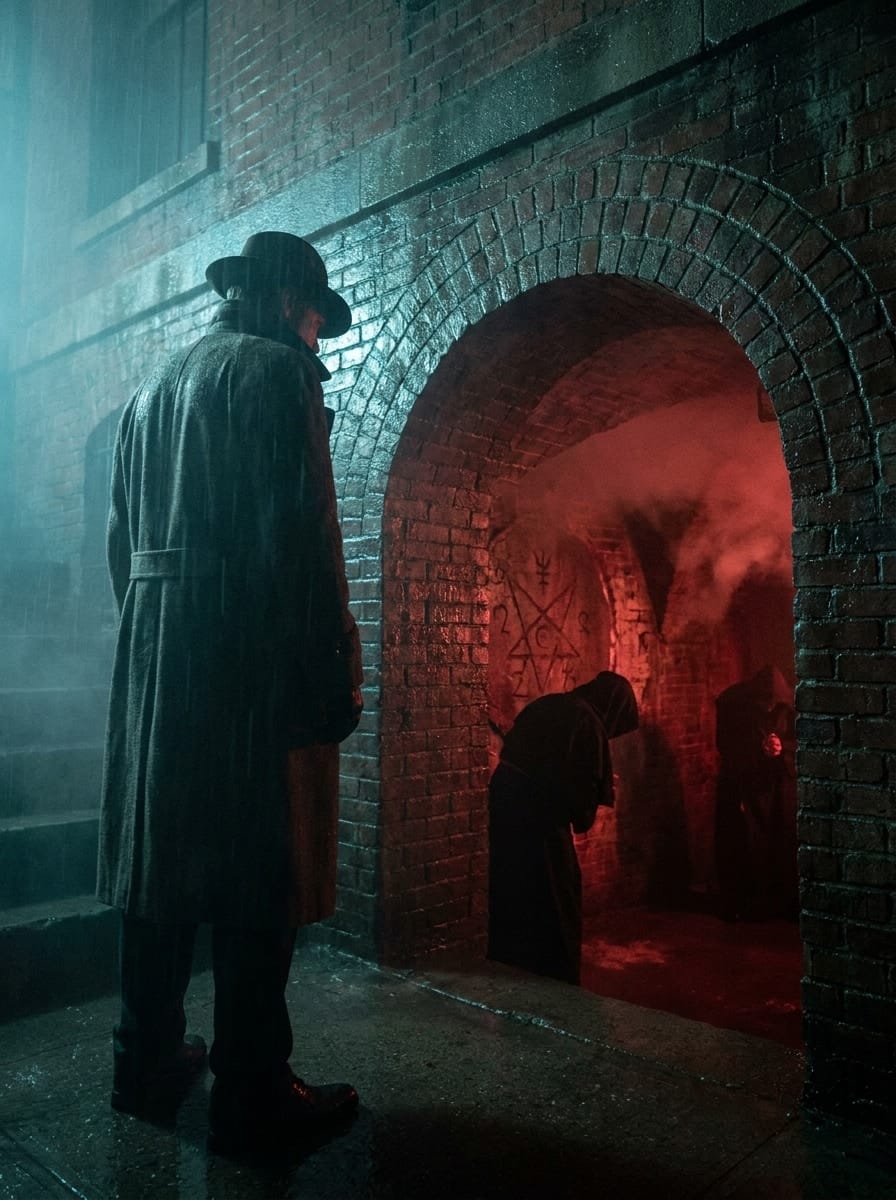
Thomas Malone is a calm, well-educated detective in the New York police, assigned to investigate the disappearances and secret gatherings troubling Red Hook. By day the old waterfront district is disorderly; by night it seems to hide another life beneath its visible one. Songs rise from cellars, strangers carry parcels through back doors, and many scattered clues lead toward the same hidden circles. Malone notices that the aged scholar Robert Suydam has also begun to visit Red Hook often. Suydam was long absorbed in old books and obscure rites, and his relatives once tried to have him declared incompetent. Yet he suddenly regains his vigor, announces his marriage, and becomes still more deeply entangled with the groups beneath the district. Soon after the wedding, Suydam and his bride meet disaster aboard ship, and his body is carried back to Red Hook by mysterious men. Malone leads police in a raid on the old buildings connected with Suydam. Underground they find passages linking several houses, braziers, stone platforms, and a ritual already underway. Suydam's corpse lies at the center of the ceremony. The chanting grows quicker and harsher, as if it means to summon the dead man back, or call something else up from below. Then the earth beneath the houses begins to shake. Malone glimpses inhuman shapes, a corpse borne away, and presences below the city that no official report can explain. The buildings collapse soon afterward, and many of the worshippers die underground. In the records the affair becomes a raid on criminals and a terrible accident. Malone survives, but he can no longer endure narrow streets and shadowed doorways, for he knows that under the city's brick and stone another gate once opened.
Malone Comes to Red Hook
When Thomas Malone served in the New York police, he was often sent into cases that would not easily yield. He was educated, steady-minded, and stubborn in the pursuit of a trail. His friends said he seemed less like an ordinary detective than a scholar walking into dark alleys with a notebook in his hand. Malone himself knew better: a footprint in the street, a sliver of light under a door, a crate carried away at midnight could sometimes tell the truth more plainly than any book.
In those years, trouble kept returning to Red Hook.
The district lay near the waterfront. By day, trucks ground over the paving stones, sailors quarreled outside taverns, and children darted out of damp alleys only to be pulled back indoors by their mothers. At night, many windows still shone, but not with the homely light of cooking or mending. Malone saw red glimmers moving behind curtains. He heard broken singing rising from cellars. The voices did not sound like prayer, nor like drunken nonsense. They sounded like many throats deliberately lowered, afraid that a patrolman in the street might hear.
The disappearances multiplied. First a few homeless men vanished. Then children went missing. Someone reported strange carriages passing in the night. Someone else said that back doors of old brick tenements opened and shut before dawn. Others had seen figures in black cloaks carrying heavy bundles down into cellars. The witnesses contradicted one another in detail, but again and again their stories pointed to the same quarter.
Malone searched taverns and warehouses with his men. He caught smugglers; he caught frauds who made a trade of superstition. Yet the deeper he looked, the less the matter resembled ordinary crime. Some of the arrested men did not fear the police. They seemed instead to be waiting for something. Odd names slipped from their mouths before they fell silent. On their persons Malone found rough signs carved into bits of wood or copper, as if cut there with the point of a knife. He could not read the marks, but he knew they were no common gang symbols.
The Withered Robert Suydam
While these cases tangled together, Malone noticed a man who did not belong in Red Hook.
His name was Robert Suydam. He came of a respectable family, lived in a quieter part of the city, and was no longer young. For years people had regarded him as an eccentric scholar, a collector of old books, a student of forgotten languages and rites. At first he had seemed only a shabby, irritable old man. Later, however, he began to visit Red Hook more and more often, keeping company with people whose movements invited suspicion.
Suydam's relatives grew alarmed. They heard that the old man was spending money on strangers and moving books and trunks into Red Hook. They asked the court to intervene, hoping to prove that he had lost his judgment and should no longer control his estate. That was how Malone became involved. He learned that Suydam had rented several old houses and had ordered some of their cellars joined. The buildings were ruinous enough on the surface, with crooked window frames and peeling walls, but at night people came and went through them, and the thresholds were polished by the scrape of boots.
Strangest of all, Suydam did not appear to be declining, as his relatives claimed.
After a time, he changed. Those who saw him said his back seemed less bent, his eyes brighter, the sickly color fading from his face. He dressed more carefully and spoke with greater composure. Some said he had suddenly recovered the spirit of his youth. Others felt it was not recovery at all, but a kind of vigor that made the watcher uneasy.
Malone felt the same when he met him. Suydam spoke gently, like an old man relieved at last from misunderstanding. He admitted that he studied ancient religions. He admitted that he knew people in Red Hook. But he called it scholarship and charity. He did not avoid the detective's gaze. He even smiled as he spoke of his approaching marriage.
He was going to be wed.
When the news spread, his relatives were more frightened than before. The man they thought nearly mad had regained his energy, announced that he would marry a young woman, and planned to take his bride to sea. Malone had no evidence strong enough to stop him. All he could do was keep watching the houses in Red Hook.
The Sounds of Carrying in the Night
Not long after Suydam's marriage, a ship departed from the docks. People saw him go aboard with his bride, neatly dressed and pleased with himself, like a man who had won a victory late in life. But the voyage brought no happiness.
Before the ship had gone far, disaster struck. The bride died, and Suydam died as well. Those on board could not clearly explain what happened that night. They only knew that the cabin had fallen into confusion, and when the bodies were found, an unspeakable chill seemed to hang in the air. Stranger still, Suydam's remains were not quietly returned to his family. A group of men quickly claimed the body and carried it back to Red Hook.
When Malone heard the news, he understood that the affair had reached its final hour.
He led police into the old streets. Night pressed low over the roofs, and a wet wind blew in from the harbor, smelling of seawater, coal smoke, and rotting wood. Several familiar windows were dark, yet shadows slipped across the corners. The police separated to seal the alleys, while Malone brought his party toward one of the old buildings Suydam had frequented.
At first the house was silent. Dust lay on the stairs. Broken boxes were piled against the walls, as if no one had lived there for years. But when they forced open the door to the cellar, a low chant suddenly rose from below. The sound came in waves, like surf striking a cavern of stone, or like many people repeating the same words to the darkness.
Malone raised his lamp and went down.
This was no ordinary cellar. Brick passages ran away in several directions. Some led toward neighboring houses; others sloped into deeper blackness. Strange marks covered the walls. Candle ends, rags, splinters of bone, and crushed spices littered the floor. The farther they went, the heavier the air became, and the more clearly firelight glowed ahead. The police heard running feet, doors slammed shut, and somewhere far off the brief cry of a child.
They rushed through a low passage and came at last into a broad underground chamber.
Many people stood there. Braziers burned red, their smoke rolling along the vaulted ceiling. Beside the wall stood a stone platform, and on it lay Suydam's corpse. His face looked waxen in the firelight, yet the corners of his mouth seemed fixed in a stiff smile. Those gathered around him were performing some rite. Their voices climbed faster and faster, as if they meant to call the dead man back from death, or invite something else up from a deeper place.
The police fired and shouted for them to stop.
The ritual broke into chaos. Some lunged for the exits. Some fell to their knees screaming. Others went on chanting despite the gunfire. Malone rushed toward the stone platform, trying to understand why Suydam's body had been brought there. At that moment a heavy tremor rose from somewhere beneath the ground.
The Door of Hell Opens
It was not the ordinary sound of a house beginning to collapse.
Malone would try countless times afterward to describe it, and always fail. He remembered first the faint shiver of the floor. He remembered the flames in the braziers suddenly leaning to one side. Then a wind blew from the dark passageways, cold as air moving over grave soil. The chanting changed at once into cries of triumph, and then, almost as quickly, into weeping terror.
Something seemed to be moving at the end of the passage. Malone saw shadows stretch across the walls, like many crooked bodies pressing together. The firelight never showed them whole. It caught only wet gleams, writhing outlines, and faces that should not have belonged to living men. They were not criminals from the street. They were not masked sorcerers. They seemed to have been hidden beneath the city all along, waiting for someone to open the way on this night.
Suydam's body was lifted.
Malone saw a figure with a faint, cold radiance move through the crowd and take up the fat, rigid corpse as if carrying away an offering long promised. The things from below followed after it, sliding over the stone floor and crowding toward the deeper tunnels. Among the living, some followed them; some were knocked down and trampled; some crawled desperately toward the police.
Malone wanted to fire, but his fingers had frozen. He had seen corpses before. He had faced frenzied crowds before. Yet what lay before him tore open the most settled part of his mind. The city was no longer merely streets, houses, and wharves. Beneath those familiar bricks and stones there seemed to be another city, a black one, waiting through long years for human hands to lift the first covering slab.
Then the house came down.
First came a dull crash in the distance. Then the whole underground passage shook. Bricks fell from the vaulting, a brazier overturned, and smoke mingled with dust. Malone was knocked down, and his lamp went out. In the dark he felt a stretch of slick wall, then the sleeve of a fellow officer. Someone called his name. Someone begged for help. Somewhere a scream rose that did not sound human.
He was nearly hurled out by the blast of air and the breaking ground.
By the time the police outside dragged out the survivors, the old building had split open, and several neighboring houses had been damaged with it. Dust poured from windows and cracks in the earth, as if the district had at last exhaled ashes buried for years. Many who had taken part in the ritual died below. Many secret passages were sealed. Suydam's body was never found again, or, if anything was found, no one dared say with certainty that it was he.
Streets He Could No Longer Endure
In official records, the Red Hook affair could be written as a raid on a criminal gang, a cellar disaster, a cult case of unusual scope. The police did seal several old buildings, rescue some hidden captives, and gather enough evidence for convictions. The newspapers made a great noise of it, but no article could set down what Malone had seen underground.
Malone survived, but he was no longer the detective he had been.
He left New York and went to a quieter place to recover. There were no packed old tenements like those of Red Hook, no damp black alleys by the docks. By day he could walk, read, and speak with others like an ordinary man. But at night, if wheels passed over stone outside the window, or if a voice sang softly in the distance, his face would go pale.
People asked him what he had seen. He rarely answered. At times he would speak of a cellar beneath a house, of braziers, a stone platform, and a corpse borne away. He would speak of the connected hollows below the city, like a net hidden in brick and stone. Then he would stop, as if one more word might open those dark passages again inside his memory.
People went on living in Red Hook. Ships still came to the wharves. Taverns still opened their doors. The market streets were as noisy by day as ever, and children still ran past the stoops. Yet those who endured that night knew that some old houses are not merely old, and some cellars are not merely places for storing broken things.
In the most crowded and clamorous corners of a city, secrets sometimes grow close to the walls. By the time people hear singing under the ground, it is often already too late.