Cthulhu Mythos
The Shadow Out of Time — Cthulhu Mythos
Nathaniel Wingate Peaslee, a professor at Miskatonic University, suddenly loses his sense of self. When he awakens five years later, he discovers that another will has been using his body during the blank years. Seeking to learn whether the ancient cities from his dreams were real, he follows the trail to the Australian desert and, in ruins beneath the sand, finds evidence that should never have survived into the age of humankind.
Article
Summary
Nathaniel Wingate Peaslee, a professor at Miskatonic University, collapses without warning while lecturing. When he wakes, he no longer seems to be himself. For five years his body is used by another will, traveling and studying in strange directions. When Peaslee’s true consciousness returns, those years are empty to him; he can only learn from others how unnaturally he behaved. To understand what happened during the five lost years, Peaslee begins to investigate the ancient city that keeps returning in his dreams. He suspects the visions are not mere hallucinations, and follows the clues to the Australian desert, searching for the place where dream and waking world might meet. Beneath the desert, Peaslee enters a buried ruin and at last sees relics and evidence that prove his dream experiences were real. What lies there does not belong to the human age, and confirms that some power beyond time once entered his life. He returns to the ordinary world with that discovery, but can never again explain what happened to him as illness or dream.
The Collapse at the Lectern
One day in 1908, in a classroom at Miskatonic University, Nathaniel Wingate Peaslee stood at the front of the room delivering a lecture.
He was a steady, careful man, a professor of economics, and his life had always moved along orderly lines. His students knew the sound of his voice, and the way he tapped the blackboard with a piece of chalk when his subject carried him forward. But that day, in the middle of a sentence, he stopped.
Someone saw his face turn ashen, and his eyes fix on something very far away. The chalk slipped from his hand and broke in two on the floor. He caught at the desk as if he meant to speak, but no words came. Then he fell.
When the doctors arrived, he was still breathing, but no one could wake him. His family and colleagues gathered at his bedside, thinking it must be some grave illness. After a time he did awaken; yet the man who opened his eyes no longer seemed to be the Peaslee they had known.
He knew his own name. He knew the people around him. But his recognition had a peculiar quality, as though he had just consulted a file and found the proper facts. He looked at his wife, his children, and his colleagues with a calm, alien gaze. When he spoke, he often paused, as if searching first for the words a human being ought to use.
More troubling still, he no longer behaved like a professor of economics. He developed a frightening interest in astronomy, archaeology, occult languages, and legends of the ancient world. He wrote to scholars across the globe, asking about lost cities, elder peoples, and inscriptions no one could read. In the library he would sit for hours, turning the pages of books most ordinary professors would never touch in a lifetime.
At first his family told themselves that illness had altered his temperament. But as the days lengthened into months, fear grew among them. The person living in their house and wearing Peaslee’s clothes seemed less like a recovered husband and father than a cool-minded visitor, treating human society as a lodging borrowed for a little while.
The Stranger of Five Years
During those five years, Peaslee did many things.
He learned with astonishing speed. Languages that took others years to master seemed to return to him like notes from an old notebook. He visited scholars, examined ancient books, and traveled to many places. Now and then someone heard him speak of history and felt a chill, for he did not discuss the past as a scholar making guesses. He spoke as one who had seen those ages with his own eyes.
He showed little interest in the human present, yet regarded humanity’s past and future with a strange patience. He would ask which layer of soil a stone from some ruin had come from. He would ask whether any legend mentioned a race capable of exchanging minds. He would press for details about old symbols that seemed to appear on different continents at the same time.
His family could not endure the change. His wife drew away from him, and his children were afraid to come near. Only his younger son, Wingate, still watched him closely, though even he felt that some cold mist had settled over his father.
Then, in 1913, the strangeness ended as suddenly as it had begun.
One day Peaslee collapsed again. When he woke, his old expression had returned to his face. He stared in terror at the people around him and asked why he had grown so much older, and why his children looked at him like strangers.
He believed he had merely slept. But they told him that five years had passed.
He would not believe it. He looked through newspapers, asked the date, and stared at himself in the mirror. Little by little he understood: through those five years his body had continued to live, speak, and move through the world, but his true self had not been inside it.
Worse still, after that, the dreams began.
The City of Cyclopean Stone
At first the dreams were only blurred fragments of light and shadow.
Peaslee dreamed that he awoke in a vast city. It was no city built by human hands. Its towers rose like mountains, its walls were made from strange, enormous stones, its corridors were wide, and its stairways were not shaped for human feet. There was no rumble of modern streets in the air, and no human voices—only a heavy movement far away, as if some immense body were dragging itself over stone.
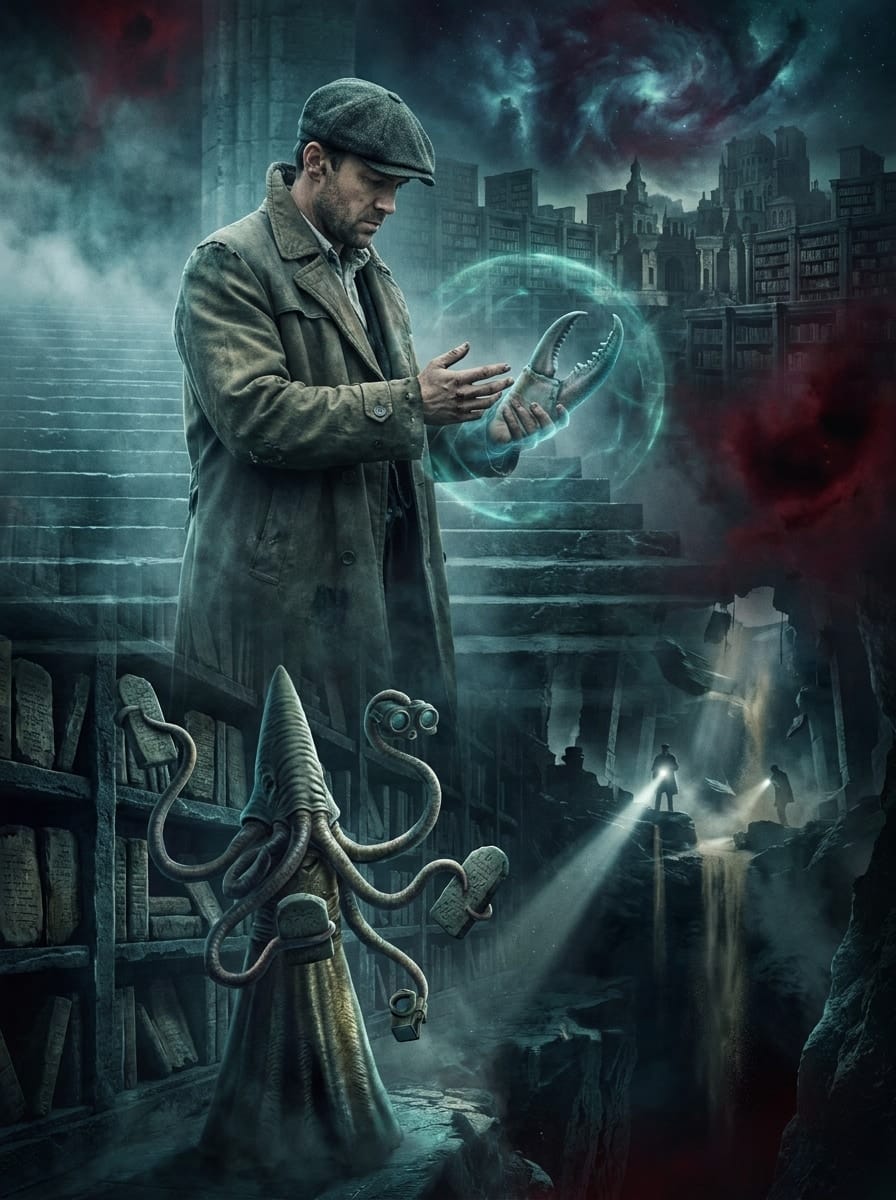
He dreamed that he had no human hands or feet, and yet he could move, see, and touch. From a height he looked out beyond the city and saw ancient plains, beneath a sky unlike the sky of the present. Around him moved beings with cone-shaped bodies, from which flexible limbs extended, bearing eyes, pincers, tentacles, and other organs hard to describe. They moved with grave purpose, spoke with one another, and managed libraries, laboratories, and roads like the citizens of a highly ordered civilization.
Later, the dreams became clearer.
He dreamed that he was told he had come there not because he had died, and not because he had gone mad, but because his mind had been carried into the remote past. The will that had occupied his body belonged to a race able to cross time by exchanging consciousness. They called themselves the Great Race of Yith.
These beings could not freely change their bodies, but they could send their minds into other ages and other forms. By this means they studied the history of the universe: witnesses were taken from the past, scholars from the future, and those exchanged minds were housed for a while in the Great Race’s own age, where they wrote down all they knew. When the research was done, the captives were returned to their proper bodies, and their memories were erased as completely as possible.
In his dreams, Peaslee became both their prisoner and their recorder. He was allowed to read in immense libraries, and to converse with minds drawn from many ages. Some belonged to creatures of the ancient earth; others came from futures humanity had not yet reached. Some had once ruled the oceans; some had not yet appeared in the world. All had been brought there to set down the knowledge of their eras for the Great Race to preserve.
Yet the dreams were not wholly peaceful.
Deep beneath the city, Peaslee heard of enemies sealed underground. Those things had occupied the earth even earlier, before the Great Race defeated them and buried them in the lowest ruins. The Great Race disliked speaking of them. Only when necessary did they reinforce passages and close the shafts. Whenever an unnatural tremor sounded from far below, the guards moved quickly, and a tension spread through the streets.
Peaslee woke from such dreams drenched in cold sweat. He told himself they were only hallucinations after illness. But the buildings, writings, and instruments in those dreams were too clear—far too clear to feel like dreams.
Traces Left by an Erased Memory
To escape his fear, Peaslee began to investigate.
He studied medical records and ancient legends alike. He found that, throughout history, others seemed to have suffered experiences like his own: a person would abruptly change in character, then years later become himself again, remembering nothing of the intervening time. Some saw a majestic stone city in dreams; some claimed to have been carried into ages unimaginably remote.
The records were scattered across different countries and different languages. Taken one by one, they sounded like madness. Taken together, they seemed like fingerprints left by the same hand in different centuries.
His scholarly reputation suffered. Many people believed his illness had left his mind unstable. But Peaslee did not treat the dreams as tales he could easily tell to others. He feared they were true; he also feared that he was insane.
Then news came from the Australian interior: explorers had found strange megalithic ruins in the desert. The stones were gigantic, ancient, and arranged in a pattern unlike any known civilization. More disturbing still, the moment Peaslee heard the place described, the scenes from his dreams rose up before him.
At last he resolved to see it for himself.
With a party of scholars and assistants, he traveled to the desolate deserts of Western Australia. By day, hot winds drove sand past the camp; by night, the sky was cold and black as glass. The party dug, measured, and recorded, gradually uncovering stones no one could explain. Outwardly Peaslee remained calm, but inwardly his dread deepened.
For the angles of those stones, the marks of erosion, and the faint traces of patterning were exactly as he remembered them from his dreams.
Sand by Night
One night the wind blew hard.
Peaslee lay in his tent, unable to sleep. He heard the canvas snapping in the gusts, and the sand scraping softly over crates and stakes. The dream-city seemed to rise again in the dark: high walls, long corridors, deep shafts, sealed stone doors.
He got up, took a flashlight and some tools, and went out alone toward the ruins.
The moonlight was faint, and the sand lay in uneven ridges. He walked for a long time, then stopped among half-buried stones. There he found a cleft opened by the wind, like an entrance leading underground. By daylight the party had not noticed it—or, if they had, no one would have dared enter. But as Peaslee stood before it, a dreadful familiarity came over him, as if he had passed that way countless times before.
He bent down, entered the opening, and followed the sloping passage downward.
The air below was cold and close. His flashlight struck the walls, revealing immense stone surfaces and joints made by no human craft. Farther on, the passage broadened, and stone steps descended. Peaslee went on, step by step, his shoes leaving clear prints in the dust.
At last he came into an underground space.
It was not a natural cavern, but part of a city. Towering doorframes lay collapsed on the floor; corridors stretched beyond the reach of sight; the walls bore worn reliefs and symbols. The sight matched his dreams completely. Peaslee held up the flashlight, and his hand began to tremble.
He had been here before.
At least, in those dreams, he had.
Evidence in the Library
He pressed on through the buried ruins and found a place that resembled a library.
Many of the stone shelves had fallen, and dust lay thick as the sediment of ages. The Great Race had not recorded history on paper, but on hard tablets. Many were shattered; others lay buried beneath rubble. Peaslee looked at them, and his heart beat faster.
He remembered that in the dreams he had been required to write down knowledge from the human age—history, languages, and society as he knew them. Perhaps that record had been placed somewhere here, sealed in this underground city, waiting for him to discover it again after uncounted millions of years.
He began to search.
The beam of his flashlight moved over broken shelves, slanting slabs, and half-visible marks in the dust. Suddenly he saw a tablet better preserved than the rest. Its writing was not human, yet part of the arrangement of symbols made him go rigid.
It was his own hand.
Not handwriting in the ordinary sense, but the mode of writing he had learned in the dream. He recognized his own habits in recording information; he recognized the symbols for names, dates, and places. In that instant, every last refuge of doubt collapsed.
The dream had not been a dream.
He truly had been carried into the remote past, housed in an alien body, and made to write in the city of the Great Race. The being that had occupied his body for five years had not been an illness, but a mind from an ancient age.
Peaslee could barely stand. He wanted to take the tablet with him, to prove everything. But then a sound came from deep below.
It was distant, but heavy and viscous, as if something were moving through passages long sealed. Then came the sound of stones being knocked loose, one after another, from the black depths.
Peaslee remembered the warning from his dreams: beneath the city lay older enemies, sealed away, but perhaps not sleeping forever.
Flight Through the Dark
He clutched the tablet and ran.
The corridor lurched in the beam of his flashlight, and fallen stones caught at his feet. He stumbled, scraped his hands, and nearly dropped the tablet from his arms. Behind him the sound drew closer, like many soft and heavy things forcing themselves through narrow passages at once.
He did not dare look back.
Wind poured underground through some unseen fissure, making a low moan. The flashlight swung wildly, showing grotesque reliefs on the walls and fresh marks on the floor that should not have been there. Peaslee gasped for breath as he climbed back the way he had come. The tablet in his arms was hard and heavy; each step felt as though he were dragging a slab from a tomb.
At last he saw a faint wash of night above.
He struggled out of the opening and fell onto the sand. From the depths behind him came a greater tremor, as if the whole ruin were groaning under its breath. Peaslee ran toward camp, still holding the tablet. But the sand was loose, the night wind fierce, and he fell more than once. By the time he reached the tents, his arms were empty.
The tablet was gone.
Perhaps it had slipped away during his flight. Perhaps the sand had covered it. Perhaps it had fallen back into the earth. Whatever had happened, it did not return with him to the human world.
The next day, the others saw only an exhausted, injured, terrified Peaslee. He tried to lead them back to the entrance, but the desert wind had altered the ground. The cleft from the night before could not be found. Dunes and stones looked alike in every direction. There was no tablet, no entrance, and no proof that could make the others believe him.
The Shadow Left Outside Time
Afterward, Peaslee returned to the human age and continued to live within it.
He could still see streets, electric lights, the campus, and his desk; he could still hear people talk about the weather and the news in the papers. But now he knew that a human life is only a thin layer in the river of time. Before humanity, the earth had other masters; after humanity, other eyes would read our records.
He could not prove what he had seen beneath the Australian desert. The tablet bearing his record was lost, and the entrance to the ruin had been swallowed by sand. Others could say that old dreams had returned after his illness, or that he had lost his way at night and suffered a frightened hallucination.
But Peaslee knew the matter was not so simple.
He remembered the roads of the cyclopean city, the libraries of the Great Race, and the minds from different ages silently writing in alien bodies. Above all, he remembered the sound from the depths, a sound that meant the things feared by the Great Race might still be waiting in the dark.
From then on, he could never again imagine time as a safe and steady line.
Between past and future, some shadows reach out their hands, borrow human bodies, search human memories, and then send their victims home. When a person wakes, he may think the nightmare is over. But the true horror is that the nightmare was once real—and still lies buried under the world.