Cthulhu Mythos
The Dreams in the Witch-House — Cthulhu Mythos
Miskatonic University student Walter Gilman takes a room in Arkham’s supposedly haunted attic, hoping to explain witchcraft and otherworldly passages through mathematics. But his dreams begin to bleed into waking life, and an ancient witch draws him into a terrible rite from which he can no longer tell sleep from reality.
Article
Summary
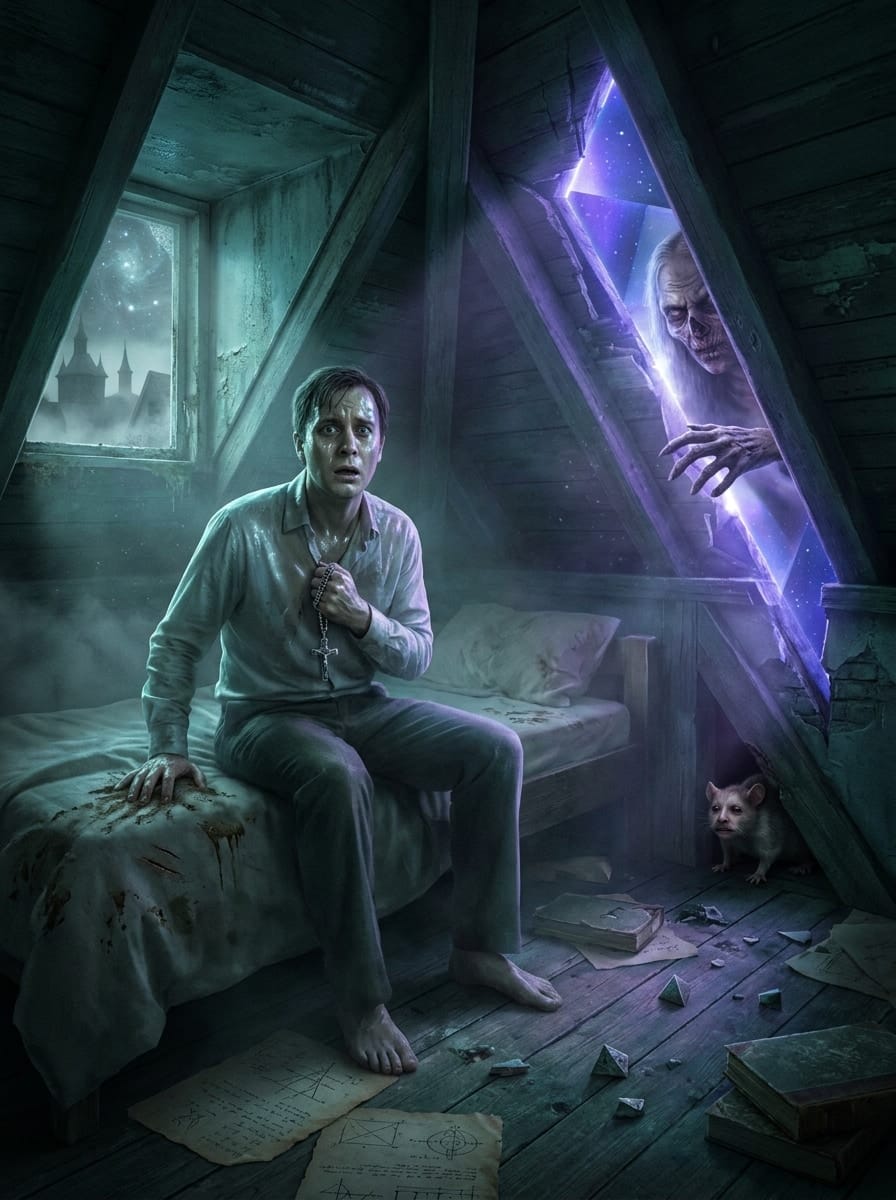
Walter Gilman, a student at Miskatonic University, comes to Arkham and rents an attic room long rumored to be haunted. The house once belonged to Keziah Mason, a woman accused of witchcraft who, according to legend, escaped from prison by using impossible angles and curves. Gilman studies mathematics, folklore, and witchcraft, and he becomes convinced that non-Euclidean geometry may reveal a way for human beings to enter other realms. On that belief, he chooses to live in the room with the crooked walls. Once he moves in, Gilman is tormented by dreams. He sees Keziah Mason and her rat-like familiar, Brown Jenkin, and finds himself passing through spaces no ordinary reason can explain, into strange cities and alien vistas. Soon the dreams begin to invade waking life: he wakes with scratches on his body, with mud and impossible objects in his room, while his neighbor Frank Elwood hears him cry out in the night. Joe Mazurewicz, who lives below, fears witches and May Eve and gives Gilman a cross, but the dreams continue to pull him deeper. As May Eve approaches, Gilman is taken in dream by Keziah, Brown Jenkin, and the Black Man to a rite in which a baby is to be stolen and sacrificed. He fights back and strangles Keziah with the chain of his cross, yet Brown Jenkin slips away. When he wakes, the real world contains signs of a missing child and blood, and he can no longer tell what happened in dream from what happened in fact. Not long after, Gilman dies screaming in the attic. Elwood sees Brown Jenkin flee from the bed, blood on its fur. Later, when the old house collapses, people discover children’s bones, Keziah Mason’s remains, and a grotesque little skeleton with human features hidden in the walls and attic framing, proving that Gilman’s nightmare had long been rooted in that witch house.
The Student Beneath the Slanting Walls
When Walter Gilman came to Arkham, he was still only a young student at Miskatonic University. He was not a lively fellow, nor one who cared much for food or dress. He was forever carrying papers and pencils, muttering equations and odd words to himself. He studied mathematics, but he also studied folklore, and above all he was fascinated by tales of witchcraft, other worlds, and forbidden books.
Arkham was a city made for legend. The Miskatonic River ran by its edge, and the old streets were crowded with houses that had stood for generations. Their roofs leaned and overlapped, their gables were crooked, and their attics seemed to hide eyes. Old people said that long ago, during the witch trials in New England, some of the accused had hidden beneath such eaves.
What interested Gilman most was a house people kept away from. It had a strange attic, with slanting walls, low beams, and triangular corners crowded together as if the carpenter had measured badly. The landlord would not say much about it, except that it had once been occupied by a woman named Keziah Mason. In 1692, he said, she had been denounced as a witch and locked in the jail at Salem; yet before the execution could take place, she had somehow escaped from her locked cell.
The stories said Keziah Mason knew more than herbs and spells. At her trial she had used words nobody understood, as if she were speaking of space, angles, and other worlds. She had also named certain beings known only from the Necronomicon. When Gilman heard this, he became even more excited. To him, the old testimony of witchcraft might only have been the mathematics of people who did not understand it. Flying over walls or passing through sealed chambers might simply have to do with higher dimensions.
So, against every warning, he moved into the attic room.
The place always smelled of mildew. Rats ran within the walls, and the wood gave off small creaks at night. Gilman put his bed beneath the slanting wall, with books and sheets of calculations piled beside it. By day he attended lectures at the university; by night he returned and worked on formulas that grew stranger with every page. He wanted to prove that certain angles and surfaces might let a person slip from this world into another.
But from the very night he moved into the attic, his sleep went bad.
Footsteps in the Corner
At first, they were only ordinary nightmares.
Gilman dreamed that he floated in a darkness without up or down, left or right. Far away, purple, red, and blue lights whirled like a flock of shapeless stars. Those lights did not seem to shine upon him; rather, they seemed to pass through his mind. At times he felt like a speck of dust being tossed by invisible powers; at others he seemed to be moving along some line that could never be drawn.
When he woke, he was drenched in sweat, but his drafts contained several new equations. He could not remember rising in the night, and yet the writing was unmistakably his.
Soon he began to see an old woman in his dreams. She was thin as a dried branch, with deep wrinkles and eyes that shone horribly. She wore the dress of another age and moved with a quickness that made her seem able to step upon the air. Always at her side was a vile companion: a thing with a rat’s body and a tiny human face, twitching whiskers, long claws, and a voice like a squeaking laugh.
Gilman knew who the woman was. She was Keziah Mason.
As for the creature, Arkham’s legends had long given it a name: Brown Jenkin. It was said to be the witch’s servant, running through wall cracks by night to spy, carry messages, and gnaw at the flesh of sleepers.
At first Gilman took all this for dream nonsense. But one morning he found mud and splinters beside his bed, as though he had crawled back from some narrow tunnel. His feet were raw, and dust was lodged between his fingers. A few days later his hearing became strangely sharp. He could hear the downstairs tenant coughing under his breath, the faint turn of a body in the next room, even the scratch of rats’ paws in the wall.
He began to fear the night.
Frank Elwood, the student who shared the room, saw that something was wrong and urged him to move out. Gilman only shook his head. He said he was close to understanding it: the crooked wall was no accident, for certain angles might correspond to the “roads” of ancient witchcraft. If he got the formulas right, Keziah Mason’s escape from prison may not have involved smoke or sorcery at all, but a departure through directions human eyes could not see.
Yet when he said this, his face grew paler by the day.
The Pen from the Shadow
The dreams grew clearer.
Keziah Mason no longer watched him from far away. She bent close and spoke in a thin, urgent voice, bidding him follow. Brown Jenkin crawled near him, grinning with that tiny human face as though it had always known him.
Once Gilman dreamed he stood at the edge of a city unlike any on earth. Its towers had no doors or windows. The ground seemed built of strange metal slabs, and in the air drifted shadows of shapes that could not be named. Keziah Mason walked ahead as though she knew the place as well as any neighborhood street.
At another time he was brought to a still more dreadful region, where only a black abyss remained, and from far off came drums, pipes, and chaotic thunder. Keziah Mason whispered the name of Azathoth and spoke also of Nyarlathotep. Then Gilman saw a black figure standing before him, not quite human, without warmth or mercy in its face, like a piece of night that had learned to move.
The black figure handed him a pen, and beside it lay a thick book. Keziah Mason seized his hand and tried to force him to sign.
Gilman fought with all his strength. He could not tell whether he was fevered in bed or whether his soul had truly been dragged somewhere else. He only knew that if he wrote his name, something would be lost forever. Brown Jenkin climbed onto him, clawed at his clothes, and pressed that tiny face close to his ear with a repulsive squeal of laughter.
When he woke, there was a red mark on his wrist, as if a small tooth had bitten him.
After that, another tale began to spread through Arkham. Near certain old festivals, children from poor households had to be watched more carefully than usual. Old people said witches had once stolen infants at such times and carried them away for sacrifice. Gilman did not want to believe it, yet at night he often heard crying in the distance, now near and now far, as if it came from the roof, the walls, or even from his own dream.
He grew weaker and weaker. In class he stared at the blackboard, hearing nothing of what the professor said. When he returned to the attic, he could not help checking the slanting wall again and again. The shadow in the corner seemed like a stain that could never be wiped away, and Brown Jenkin’s little feet often sounded within it.
The Cry of May Eve
By the eve of May, the city air had turned heavy. Arkham’s old houses huddled into black shapes under the dark, their windows going one by one to sleep, while damp wind came off the Miskatonic River.
Gilman was very ill, yet he dared not sleep. He knew Keziah Mason would come. He placed every charm he could think of beside his bed and kept telling himself that whatever he saw in dreams, he must not go with her.
But deep in the night he was dragged back into dreaming.
This time he was not floating through impossible space. He stood in a low room that was half cellar, half cavity between walls. Blackened boards and old bricks were stacked all around. Keziah Mason stood by a rough table, and Brown Jenkin crouched at her feet. On the table lay a small bundled shape, and from it came a weak cry.
It was a child.
Fear turned at once to fury. Gilman rushed forward to take the baby away. Keziah Mason screamed and sprang at him, her gaunt fingers hooking at his face. Brown Jenkin leaped too, biting his wrist.
The low room became a frenzy. Gilman overturned things, struck his shoulder against a beam, and blood ran from his forehead. Keziah Mason fought with a strength no old woman should have possessed, crying out those strange names as if summoning unseen helpers. Gilman clamped his hands around her throat and would not let her continue.
He never knew how long it lasted. At last Keziah Mason’s hands loosened, and her body collapsed like a bundle of rags.
But the child’s crying stopped as well.
When Gilman looked down, he saw only Brown Jenkin darting from the table, blood at its mouth. The creature let out a shrill squeaking laugh and vanished into the dark.
He woke before dawn. He was back in the attic bed, battered and bleeding, his wrist torn open. Outside, there was suddenly commotion in the street. Someone said a child had gone missing; someone else said a strange cry had come from the old house.
Gilman remembered the table in the dream and grew cold from head to foot. He could not tell whether he had truly killed Keziah Mason or whether the child was already beyond rescue. He only felt that something in the corner was watching him.
Teeth Beneath the Bed
After that, Gilman nearly broke.
Frank Elwood stayed near him and listened to his broken, feverish muttering. Sometimes Gilman cried out Keziah Mason’s name. Sometimes he begged someone to tear the wall open. Sometimes he said Brown Jenkin was still alive and looking for a way back inside.
Others thought it was only delirium. Yet at night the room truly did fill with tiny clawing sounds. They came from behind the boards, from beneath the floor, and at times from under the sheets. Elwood would light a lamp and search, but never find anything.
One night Gilman suddenly sat up in bed, as white as chalk. He clutched his chest with both hands, as though something beneath his clothes were biting into him. He opened his mouth but could only manage a broken cry. Elwood tore back the covers and found him doubled over in agony, his chest already soaked through with blood.
Brown Jenkin sprang from him, flecked with blood, and leaped for the corner. In the lamplight its tiny human face flashed once, showing a look of malicious triumph. Then it slipped through a broken place and was gone behind the boards.
Gilman never woke again.
When the attic was searched, the only things found were blood, torn bedding, and scratches no one could explain. The doctor could not account for his wounds, and the police found no killer. The landlord was terrified, the tenants moved away one by one, and the old house grew colder and more silent.
But the matter was not yet finished.
Later, a storm damaged part of the house. When workers tore open the walls and hollow spaces, they found dreadful things hidden within: small bones, old relics, and other remains too awful to look at closely. In one concealed corner they discovered the skeleton of a woman, twisted as though she had been trapped and left to die there long ago. People remembered the tale of Keziah Mason, and no one called it mere invention after that.
Farther in, they found the bones of a small monster. It was rat-like, yet unlike any rat, with a skull distorted almost into a human shape. Those who saw it fell silent, for at last they understood that the thing that had run squeaking through the walls at night may truly have lived there.
After that, the whining in the old house ceased. Yet the people of Arkham avoided that street for a long time. Whenever the wind moved through the broken rafters and gave out a thin, crying sound, the old folks closed their windows and warned the children away from the corners of the house.
Gilman had tried to explain witchcraft by formula, and had walked straight into the darkness behind the formula. He thought he was only studying legend, and in the end he became part of the legend himself.