Cthulhu Mythos
The Music of Erich Zann — Cthulhu Mythos
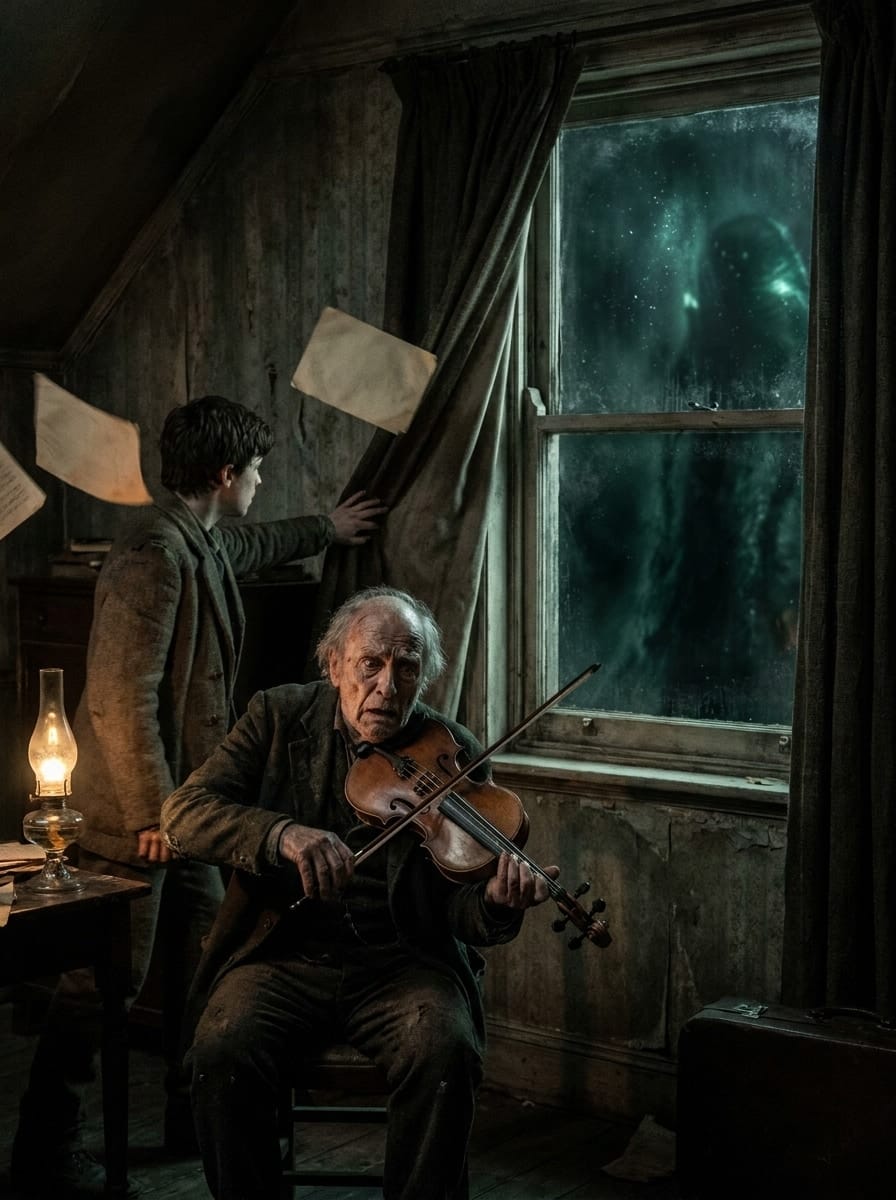
A poor student takes a room on an old street he can never find again, and at night hears the strange music of Erich Zann, a mute viol-player in the attic above him. Zann seems to be using his music to hold back something unseen beyond the window, until both man and music vanish into darkness, leaving the student with a terror that lasts all his life.
Article
Summary
A poor student moves into an old street that he will later be unable to find again. He rents an upper room in a tall house and often hears the mute musician Erich Zann playing strange music in the attic at night. Drawn by the sound, the student tries to approach Zann, only to discover that the old man is terribly afraid of the darkness beyond his attic window, as though his music is meant to keep some invisible presence away. Later, the student enters Zann’s room, and Zann begins writing an explanation, hoping to tell him what danger he has been facing. At that moment the darkness outside the window presses near, and Zann plays with frantic desperation. The music grows wilder and more broken, as if he is struggling to bar whatever waits beyond. The student sees that the window does not open on any ordinary city view, but on a terrifying depth of blackness. In the end, Erich Zann disappears amid the shrieking music, the room falls into chaos, and the student flees the old street. He never finds that street or house again, and carries forever the memory of Erich Zann’s music and the darkness beyond the window.
The Street That Could Not Be Found
Many years later, the man who had once studied in the city would still unfold old maps, searching them one by one for the Rue d’Auseil.
He searched new maps and yellowed old ones alike. He walked along the riverbank, questioned doorkeepers, shopkeepers, and policemen, and went in person through narrow streets whose names had changed. Yet no one had heard of the Rue d’Auseil, and no one remembered the tall, ancient house.
That was hard for him to believe. In the days when he was young and poor, he had truly lived there for several months. He had been studying metaphysics at the university then, sickly in body and nearly penniless, and could afford only the cheapest lodgings. The Rue d’Auseil lay across a black river. Along the water stood steep warehouses with damp brick walls and windows like dark little holes. After crossing the bridge and climbing upward, the streets grew narrower and steeper, while the houses on either side leaned inward as if they meant to squeeze the sky away.
The street did not end in a square, nor in another road, but in a high wall. Beyond that wall there seemed to be some wide open space, though nothing of it could be seen from the street. Few people lived there, and even by day there was little sound. At night the smell of the river, the mould of old wood, and the distant lights of the city all seemed to sink together, until the whole street felt as if it had been forgotten somewhere outside the world.
The student’s room was on the fifth floor of that house. The building rose higher than its neighbors; its staircase was narrow, the banister blackened, and every step creaked underfoot. The concierge told him that an old man lived on the top floor, a musician who played the viol, and that his name was Erich Zann.
Music from Above
At first, the student heard the music only at night.
He often studied late, and when the oil in his lamp was nearly spent, the sound of strings would drift down from overhead. It was not music such as one heard in theatres, played for dancing or drinking, nor did it resemble the music of churches or parlors. Sometimes it was thin as a thread, creeping along the corners of the wall; sometimes it suddenly rose, quick and urgent, like someone running through the dark. The student could not say why those melodies disturbed him, but whenever he heard them, his heart tightened and the book in his hands became impossible to read.
By daylight, he had seen Erich Zann on the stairs. He was a small, thin old man, a little bent, dressed in clothes worn but neat, his face deeply lined. He played the viol in a theatre orchestra and lived in the uppermost attic on that small income. Zann could not speak, and his hearing was poor; when he dealt with others, he used gestures or wrote with a pencil on paper. His eyes were wary, as if he were always bracing himself against questions no one ought to ask.
The more the student listened, the more he wanted to know where those nocturnal pieces came from. One evening, as Zann returned from the theatre with his instrument case and climbed the stairs slowly, the student gathered his courage and stopped him. In as gentle a tone as he could manage, he said that he admired Zann’s music and wished to hear him play in person.
At first Zann hesitated. He stared at the student for a long while, but at last he nodded and led him into the attic.
The Little Room at the Top
The room was very small, with a sloping roof pressing low above it and old paper on the walls. It held only a few poor furnishings: a bed, a table, several chairs, and scattered sheets of music. Its one remarkable feature was a window, covered by heavy curtains, which seemed to face out beyond the high wall at the end of the street.
The student tried to step closer and look, but Zann immediately blocked his way, moving with a speed that seemed impossible for an old man. He shook his head, his face pale, his fingers almost trembling. The student withdrew and sat down in a chair.
Zann took up his instrument and played several pieces for him. They were strange, but still recognizably music that a human being might have written. They had clear passages and melodies one could remember. The student listened with fascination, yet his doubt only deepened: these were not the sounds he had heard at night. The music that came down from above after midnight was more urgent, deeper, and far less like anything meant for an audience.
Unable to resist, he hummed a few phrases he remembered.
The moment the notes left his mouth, Zann’s expression changed. He sprang forward, seized the student by the shoulder, and stared at him with eyes full of terror. He seemed to want to speak, but only blurred sounds came from his throat. Then he snatched up paper and pencil and wrote several hasty lines. The student understood the meaning well enough: he must not listen, must not mention those pieces again, and must not tell anyone.
Zann wrote more, claiming in effect that he was ill, and that his nighttime playing was only a habit, nothing more. But his hand shook so badly that the ink tore through the lines. The student knew he was concealing something.
After that night, Zann became even more cautious. If the student came near him on the stairs, he shut his door at once. Yet deep in the night those strange pieces still sounded, fiercer than before. Sometimes the music seemed to plead, sometimes to rage; sometimes it was like an invisible wall being raised again and again by bow and string.
The Old Man’s Request
Before long, Zann came to the student of his own accord.
It was already late when he knocked, carrying a sheet of paper he had written in advance. It said that he was willing to pay part of the student’s rent if the student would move down to a cheaper room on the third floor. It was farther from the attic, and perhaps he would sleep better there at night.
The student ought to have refused. But he was desperately poor and physically weak, and the money would be useful. Besides, he thought that moving a little farther away would not stop him from uncovering the truth. So he agreed.
After he moved to the third floor, the music did indeed become much fainter. Floors, walls, and two layers of darkness swallowed many of its details. But the student’s curiosity did not fade; it grew heavier. He began to wait by his door at night for sounds from above. Sometimes he crept a few steps up the staircase and stood listening at a turn. Zann’s playing became more and more agitated, like the effort of someone driven to the edge of a cliff, holding off a pursuer with the last of his strength.
At last, one night, the student heard a sound from above unlike anything that had come before.
It was no ordinary performance. The bow seemed to tear at the strings, notes collided with one another at frantic speed, and amid them came the crash of overturned chairs and tables. The student could bear it no longer. He caught up his coat and rushed upstairs. The higher he climbed, the colder the wind grew, though there was no open window in the stairwell. Light showed beneath the attic door, and from behind it came Zann’s hurried footsteps.
The student knocked, but no answer came. He knocked again, and within there was a sudden instant of silence. Then the door opened. Erich Zann stood behind it, his face white as paper. He dragged the student inside and shut the door at once, as if something outside were trying to follow.
The Darkness Beyond the Window
The room was in wild disorder. Music sheets lay scattered across the floor, chairs were overturned, and the flame of the oil lamp leaned sideways in a wind that seemed to come from nowhere. The window that had always been covered was now stirring beneath its curtains, as though an invisible hand outside were tugging at the cloth.
Zann pressed the student to the table, seized a pencil, and began to write at furious speed. He seemed to have decided at last to reveal his secret. He filled one page, then reached for another. The student bent down to read the words, but just then a strange gust swept in from the window.
The window was closed.
Yet the wind whirled through the room and lifted the pages from the table. The freshly written sheets flew toward the window, fluttered against the glass, and were suddenly snatched into the darkness. Zann gave a soundless cry and lunged after them, but caught nothing.
In the next instant, the curtains were swept aside.
The student had expected to see the high wall at the end of the street, or perhaps the lower roofs, lights, and river beyond it. But outside the window there was nothing of the kind. There was no city, no stars, no ground—only a blackness without edge or bottom. Nor was that darkness still. It was like a shapeless sea in which something heaved and drew nearer, and like countless unseen eyes watching from far away.
Zann seized his viol and stood before the window, playing.
In that moment he no longer seemed the poor old musician from the theatre, but a man keeping watch before a broken gate. The bow flew madly over the strings, and the sound was sharp, urgent, almost impossible to believe as coming from wood and gut. The student heard terror in that music, and command; pleading, and resistance. Zann seemed to know that if the music stopped, the thing beyond the window would enter.
The wind grew stronger. The oil lamp flared and dimmed, while the shadows in the room stretched long and were crushed to pieces. The student wanted to flee, but his legs were weak. He watched Zann’s back, watched that withered hand still drawing the bow. The music was impossibly swift, as though it were no longer being played by human fingers.
Then, at the height of that frenzy, the student suddenly realized that Erich Zann’s face had gone blank.
The old man sat there with eyes open, mouth slightly parted, body rigid. His hand still moved; the music still screamed. But he was already dead.
At last the student’s terror broke through his throat. He knocked a chair aside and hurled himself toward the door. Behind him the music shrieked on, and the darkness beyond the window pressed forward like a tide. He raced down the stairs, nearly falling more than once. No one came out of the old house; no one asked what had happened. The whole Rue d’Auseil was silent as the dead.
He burst through the front door, plunged down the steep street, crossed the black river, and did not stop until he saw the ordinary lights and passersby of the city.
After that, he never returned.
Years passed. He tried to prove that it had not been a fever dream, and tried to learn what Erich Zann had been holding back at the window. But no matter how he searched, he never found the Rue d’Auseil. No map showed such a street; across the river there was no such high wall, and no old house with a strange window in its attic.
Only the music of that night remained in his memory. Whenever he thought of it, he felt that some darkness not belonging to the city had once listened, through a single window, to the last desperate music a human hand could play.