Cthulhu Mythos
The Festival — Cthulhu Mythos
A man long absent from his ancestral home returns at Christmastide to the old seaside town of Kingsport, where family legend summons him to a secret festival held once in a hundred years. Following silent kin through an ancient house, a church, and the depths below, he discovers that the rite is older than human memory and more dreadful than any tale his bloodline preserved.
Article
Summary
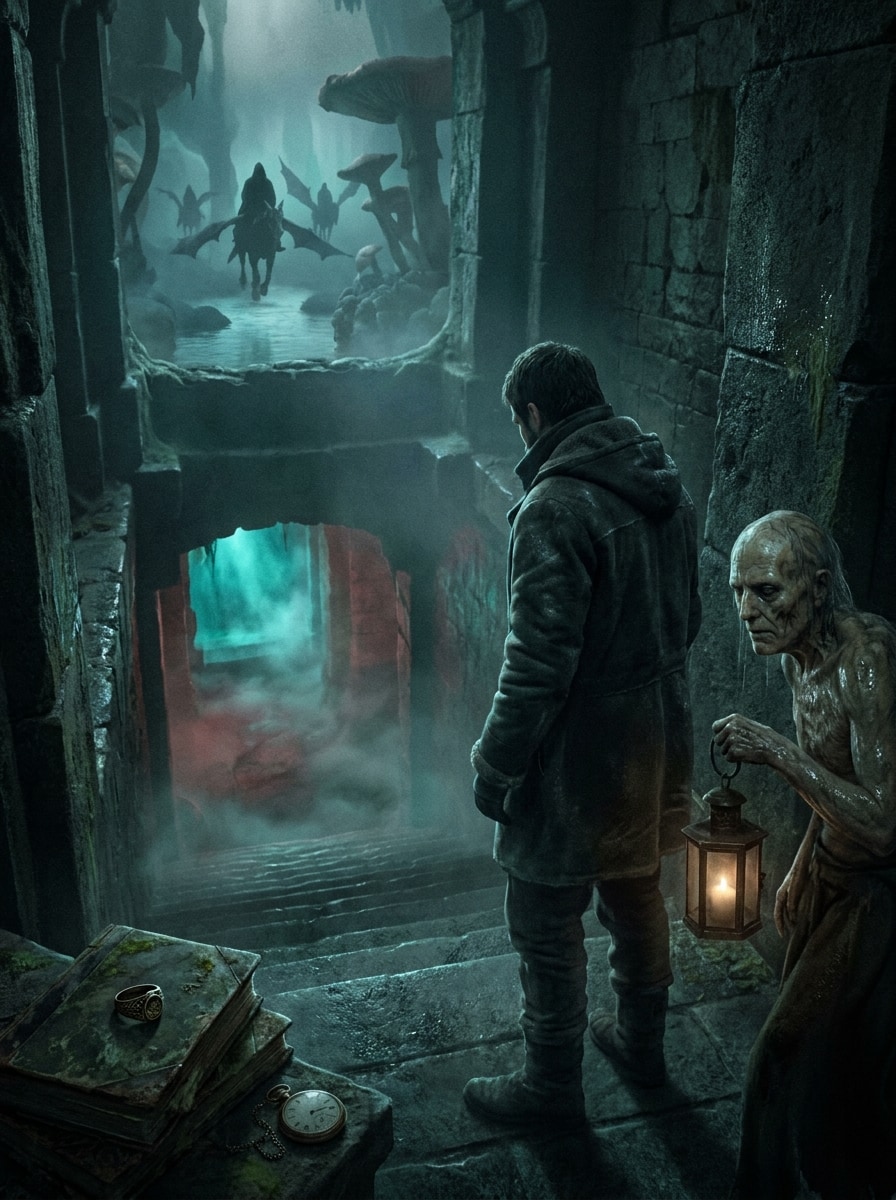
Obeying an ancestral summons, the returning man comes on a winter night to Kingsport, a town he has never seen with waking eyes, though it has often visited him in dreams. Snow lies white over the roofs, the streets are ancient, and a sea wind moves in from the wharves; yet the place has none of the ordinary warmth of the season. It is quiet, as though every shuttered window and closed door were waiting for the same hidden rite. He finds the old family house and is received by a speechless old man whose face seems as smooth and fixed as a mask of wax. Inside are an old woman silently spinning, antique furniture, and several disturbing books, among them the Necronomicon. Its passages concerning caverns beneath the earth and the secrets of the dead chill him before the festival has even begun. Late in the night, the old man and the old woman put on hooded cloaks and lead him into a procession of masked figures emerging from the houses. Without a word they pass through the old town, enter the church on the hill, and descend through the tombs into the underworld. Long stone steps lead into the mountain’s heart, where cold green fire, a subterranean river, enormous fungi, and a ritual older than Kingsport wait in darkness. During the ceremony, the gathered worshippers bow before the pillar of fire and the Necronomicon, then mount loathsome winged creatures and fly away along the underground river. He refuses to follow. The old man produces a watch and ring buried long ago with one of his ancestors to prove who he is; but when the old man’s mask slips, he leaps into the black water to escape. Afterward he is told that he merely fell from a cliff into the sea, yet when he reads the same terrible account in the Necronomicon at Miskatonic University, he knows that the night was no delusion.
A Snowy Night in Kingsport
On a winter night, the narrator walked alone toward the old seaside town of Kingsport.
It was the Christmas season, but he knew in his heart that the festival awaiting him was far older than Christmas. The legends of his ancestors had called him back, saying that, after long intervals, the descendants of the family must return to the old town and keep certain secrets from being forgotten.
He had never truly visited Kingsport, yet he had often seen it in dreams. When he crossed the ridge, the town rose before him in twilight and snow: steeples, weather vanes, old houses, wharves, graveyards, and steep, crooked streets climbing and crowding above the sea. Wind came in from the water, but there was no laughter in the streets, and no footprints marked the snow. Curtains were drawn. Lamplight hid indoors. It was as if the whole town were waiting for an hour no outsider was meant to witness.
Following his map, he found the old house of his family. It had been built in an earlier age, with its second story jutting over the street, its roof sharp and peaked, and the snow before its door strangely clean.
The Books in the Old House
He struck the iron knocker, and the door opened without a sound.
The one who admitted him was an old man in a long robe and slippers. He seemed unable to speak, and welcomed the narrator by writing on a wax tablet. His face looked gentle, almost too still; the longer the narrator studied it, the more uneasy he became, until at last it seemed less like a face than a very cunning mask of wax.
The rooms were low-ceilinged and damp, with bare beams and ancient furniture. An old woman sat with her back turned beside a spinning wheel, silently spinning even on the festival night. There was no fire in the hearth, but the room held many old books. The narrator sat down and began to look through them, finding volumes on witchcraft and demons; most dreadful of all was a Latin translation of the Necronomicon by Abdul Alhazred.
When he came upon a certain passage, a coldness passed through him. The book’s hints of underworlds and of secrets kept by the dead almost made him forget where he was.
At eleven o’clock, the old man returned and brought out two hooded cloaks. He put one on himself and placed the other over the old woman. Then they led the narrator out through the door and into streets where the moonlight did not reach.
Down Beneath the Church
Then it seemed that every door in Kingsport had opened.
Cloaked figures came silently out of the old houses and gathered into a procession in the narrow lanes. They did not speak, and their footsteps were unnaturally light. Carrying lamps, they moved toward the white church that stood high at the town’s center.
The narrator followed behind them. He deliberately stepped last over the church threshold and looked back at the snow outside. In that instant he saw that there were no footprints before the door—not even his own.
Inside the church, the light was dim, and the procession had already begun to descend through a cellar entrance near the pulpit. He followed the old man and the old woman into the crypt, and then farther down through an opening beneath an ancient tomb. The stone stairs spiraled downward, damp and narrow, while the walls breathed a smell of decay. The deeper they went, the less the passage seemed made by human hands; it was more like a wound cut into the body of the mountain itself.
At last a sickly green light appeared ahead, and with it came the sound of underground water.
The Rite Beside the Cold Fire
They entered a vast cavern beneath the earth.
There were shores like beds of fungus, a glossy black river, and a pillar of cold green flame rising from some hidden depth. The flame gave no warmth and cast no shadows like ordinary fire. The cloaked figures formed a half-circle around it, while the old man lifted the Necronomicon and made stiff ceremonial gestures.
The narrator knelt with the others, for he was a descendant summoned by his ancestors. Yet fear mounted in him with every moment.
From the darkness came a thin piping sound. As the piping changed, something in the distance beat its way nearer. A flock of trained winged creatures approached—things that were not birds, not bats, and not men, but forms so hateful that the eye longed at once to forget them. One by one, the cloaked worshippers mounted them and flew along the underground river into a deeper dark.
The old man gestured for the narrator to mount as well. On the wax tablet he wrote that he served as the representative of the ancestral rite, and that the narrator must continue into its more secret portion. To prove his identity, he brought out a family ring and a watch.
That proof was more terrible than any threat. The narrator remembered that the watch had been buried with one of his ancestors in the seventeenth century.
After the Mask Fell
Still the narrator would not move forward.
The old man grew agitated, and his motions suddenly quickened. As he turned to stop one of the winged creatures that was about to depart, the waxen mask beneath his hood slipped loose.
The narrator did not wait to see clearly what lay behind it. The way back was blocked, and before him ran only the black underground river. Screaming, he hurled himself into the cold, viscous water that flowed toward the caverns of the sea.
When he awoke, he was in a hospital.
The doctors told him he had been found at dawn in Kingsport Harbor, frozen and unconscious, clutching a piece of driftwood. They believed he had lost his way on the hills the night before and fallen from the cliffs at Orange Point into the sea, for certain footprints had been found in the snow. Outside the window came the sounds of trolleys and motorcars, and the roofs of modern Kingsport spread beneath the daylight, nothing like the ancient town through which he had walked in the night.
Later he was taken to St. Mary’s Hospital in Arkham. The doctors thought him troubled by delusions, and helped him obtain the copy of the Necronomicon kept at Miskatonic University. When he read that chapter again, he knew that the horror he had seen underground had not been born from madness alone.
The book said that the deepest caverns are not places for human eyes to explore; there, dead thoughts may gain strange new bodies, and certain things that ought to crawl will learn to walk.
From then on, he could no longer dismiss that night as a dream after a fall into the sea. By day, the streets of Kingsport may seem quiet; but in older depths beneath them, the festival left by his ancestors still waits in silence for its appointed representative to pass through the cold fire and go on his way.