Cthulhu Mythos
Celephaïs — Cthulhu Mythos
Kuranes, wearied by the cold indifference and poverty of the waking world, sinks ever deeper into dream in search of Celephaïs, the seaside city he once glimpsed in youth. At last, he is welcomed back by the city’s fleet and crowned king of that land where youth never fades, while the waking world is left only with a body no one values.
Article
Summary
Living among the crowds of London, Kuranes grows tired of the waking world’s indifference, poverty, and lack of understanding, and so he slips more and more often into sleep. In his dreams he pursues Celephaïs, the seaside city he saw in boyhood, longing to return to a place that feels more intimate and more worthy of love than reality itself. As his bond with the waking world weakens, Kuranes finally reaches Celephaïs in dream. The city’s fleet comes out to greet him, and he is hailed as king of that ageless realm of dream. In London, meanwhile, only an unclaimed husk remains.
Among the crowds of London
In the waking world, he was not called Kuranes. By day, people knew him under another name and took him for a ruined, strange, useless man. But in dreams, he was Kuranes. The name was like an old cloak; once he put it on, he was no longer the poor fellow ignored in London’s streets, but a traveler who could see the shine of distant seas.
He had not come from the lowest ranks. Once, his family had land, and there had been an old house he loved to remember. Yet those things slipped away one by one. His kin died, his friends drifted off, the old rooms were no longer his, and the shadows of the trees outside, and the stories he had heard in childhood, were all driven behind him by time. In the end he lived alone in London, surrounded by people and yet seldom truly seen.
He tried to set his dreams down in writing. In them there were walls and valleys, seas and a beauty only youth seems ready to believe in. He showed these words to others, and they laughed, saying he was out of step with the age, that he was fleeing reality. After hearing that often enough, Kuranes stopped answering. Later, he stopped writing altogether, for the dreams had grown too vivid, too wide; paper and ink could no longer hold them.
He did not care for the streets of the waking world. They were lined with chill walls, greasy fog, hurrying crowds, and many people full of their own importance. They said the world was rough, and that the more one could endure its roughness, the more mature one became. Kuranes would not accept that. If life was only to endure ugliness, laughter, and a purse growing lighter by the day, then it was better to seek the light that had once shone in dream.
So he wandered farther and farther away. By day he moved through the streets like a shadow; by night he returned to places no one could steal from him.
The white city in the valley
At first, Celephaïs appeared only in dream.
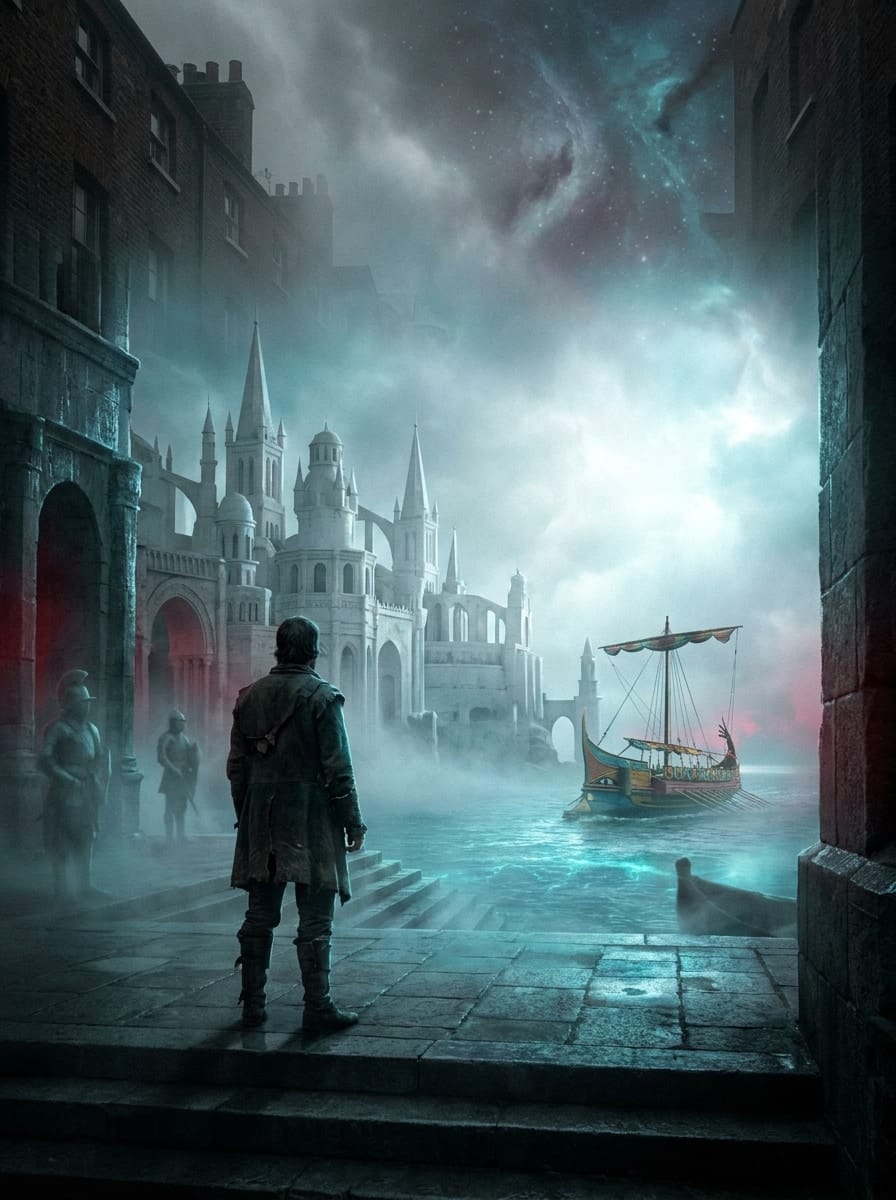
Kuranes saw a city resting in a valley, with the coast beyond it and the bright sea spread wide past the shore. A snow-capped mountain looked down upon the water, its summit white as if washed by moonlight. In the sun, the walls and towers glimmered, and at the harbor lay oared ships painted in vivid colors, their sails swelling as they prepared to head for the far line where sea and sky met.
This was not London’s fog, nor the damp black stone of reality. The sky above Celephaïs was clear, and the air seemed touched with salt and flowers. Beyond the city gates lay the valley of Ooth-Nargai, with grass, orchards, and roads leading down to the shore. Kuranes walked those roads in dream and heard the murmur of the market in the distance, saw merchants carrying their goods, saw sailors calling out by the ships. He felt as though he had not come here for the first time.
Perhaps he had visited it in early childhood. Perhaps he had only built it from the fragments of stories heard in those years. But dreams do not explain themselves; they merely place the city whole before one’s eyes.
He walked the streets of Celephaïs without the fear of a stranger. The steps, the arches, the sunlight upon white walls, the seabirds wheeling above the harbor—all of it felt like old things met again after a long parting. He watched the bright ships glide from the bay, their prows aimed toward distant waters where sea and sky became one, as though endless sailing might reach the fairest end of the earth.
When he woke, London was still outside his window. The clatter of carriages, the tramp of feet, the gray rooftops, and the cold faces returned. Yet Celephaïs remained in his heart, like a lamp hidden beneath the breast.
Shut out by dream
For a time, Kuranes returned often to Celephaïs. He knew how to cross the valley in dream, how to reach the harbor, how to glimpse the snow-clad peak. But dreams do not always obey desire.
One night he tried to go there again and did not arrive. He wandered into other dreams and found strange places instead. When he woke, he was both disappointed and anxious, like a man who has come to his own door only to find it locked from within.
After that, he searched for Celephaïs with even greater devotion. The more the waking world wearied him, the more he yearned for the city of dream. He would not waste himself on the petty demands of reality, nor submit to those who mocked him, nor pretend to love poverty, age, and dust. He meant to go back, back to the city that would never grow old.
To make his sleep deeper, he began to use drugs. At first it was only to escape the day; later he could not do without them. His rooms grew untidy, his clothes no longer clean, and his money ran out quickly. He wandered London’s streets half-awake and half-dazed, seeing not the walls before him but the white towers and blue harbor of dream.
At times he would stop in a filthy alley as though hearing a distant sailor’s song; at others, when he passed a shop window, the glass reflected not his gaunt face but the masts of the harbor he knew from dream. He grew more and more like a dreamer lost in reality, and the waking world grew less and less willing to keep him.
At last, Kuranes lost his lodgings. London did not become gentler because he had dreams. The streets remained crowded, the rain still fell, and passersby still moved by him without a glance. Yet he no longer much cared, for he felt himself drawing nearer to Celephaïs.
Knights from dream
That day, Kuranes was walking the streets of London, wretched in body though his mind was elsewhere. He moved through the crowd as if through a field of meaningless shadows. Suddenly, he saw a company of knights appear ahead of him.
They were no London policemen, no parade from the market. They wore the splendid armor of dreams and rode solemn horses, their faces those of men sent to welcome a lord long absent. The gray fog and brick walls behind them seemed unreal; it was as if one blink and the whole city would dissolve.
The knights came before Kuranes and saluted him. They told him that the people of Celephaïs had long been waiting for him. He belonged there by right; he would rule the beautiful valley of Ooth-Nargai. Hearing this, Kuranes did not step back in astonishment. He was like a wanderer too long abroad who at last hears the door of home open, and he went with them.
They left London, or else London withdrew from around them. The filthy lanes became dream roads, the heavy sky brightened. Kuranes crossed the border between waking and dream and saw the familiar valley spread before him. The snow-clad peak still looked down on the sea; the white walls of Celephaïs still shone in the sun; the colorful ships in the harbor still lifted their sails as if no tide had ever been missed.
The people of the city welcomed him. There was cheering in the streets; faces appeared at windows; sailors at the harbor paused in their work with ropes; merchants and children alike looked on. Kuranes passed through the gates, and the chill of London’s streets was gone from his heart. At last he understood that he had not been seeking a city in dream, but a home the waking world could not take away.
From that time on, he became king of Celephaïs.
A body no one claimed
In Celephaïs, time is not as urgent as it is in the waking world. White walls never fade, the sea never grows old, and the marvelous tales of childhood are never mocked. Kuranes could sit high above the harbor and watch the painted ships sail toward the edge of the world; or he could walk through the city market and hear people speak of voyages, orchards, and the wind in the valley. At last, he possessed the beauty he had always wanted.
Later, a man’s body was found in a dark corner of London. He was in rags and had died soundlessly, like so many poor souls swallowed by the great city. No distinguished family came to claim him, and few remembered that he had once set his dreams on paper. To the waking world, he had been nothing more than a failure—odd, pitiable, and forgotten.
But in Celephaïs, Kuranes had not died.
He lived in the valley of Ooth-Nargai, guarding that white city by the sea. The snow peak watched over the water, sails bloomed in the harbor like flowers, and beyond the line where sea and sky met, a road of light always shone. The waking world saw only a man fall; the Dreamlands welcomed home a king.