Cthulhu Mythos
From Beyond — Cthulhu Mythos
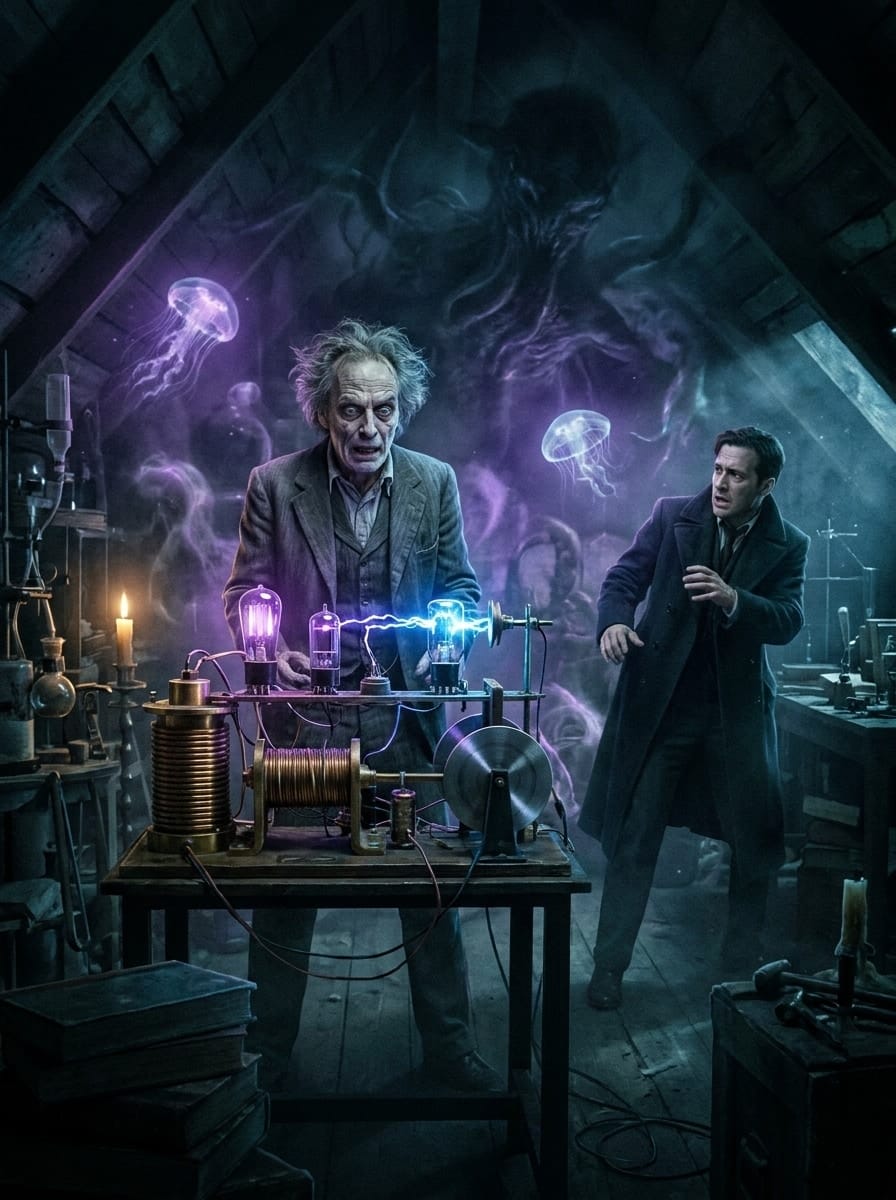
Crawford Tillinghast builds a strange machine and claims it can open human senses to another world lying all around us, overlapped with our own. When his friend is summoned to the laboratory, he sees invisible creatures swimming through the room—and discovers that Tillinghast did not invite him there to prove a theory, but to take revenge.
Article
Summary
Crawford Tillinghast has spent a long time working on a bizarre machine that can alter the senses. He claims it stimulates perceptions human beings do not normally use, allowing them to see another world layered over ordinary reality. His friend once opposed the experiment, and the two became estranged. Then, late one night, Tillinghast summons him to his shadowed house and laboratory, where the friend finds him wasted, feverish, and surrounded by the machine’s unnatural glow and vibration. Once Tillinghast starts the machine, his friend’s sight and hearing are forcibly widened. He sees things moving through the room that had always been invisible: transparent jellyfish-like beings and larger, more monstrous shapes drifting through the air. Tillinghast explains that these creatures have always existed beside humanity, unseen by ordinary senses. Gradually, he reveals his true purpose. He did not invite his friend to prove his discovery, but to punish him for his earlier mockery and resistance—and he hints that the disappearance of the servants has something to do with these beings “from beyond.” As the creatures seem to become aware of the two men and danger draws nearer, the friend, overcome with terror, fires his pistol and destroys Tillinghast’s machine. When the machine stops, the visions vanish at once, and Tillinghast lies dead in the laboratory. The outside world explains his death as sudden illness or mental collapse, but the surviving friend is left with a dreadful memory of the machine and the world that lies folded against our own.
A Visit in the Night
Crawford Tillinghast had once been a respectable man.
He was not robust; in fact, he had been somewhat heavy, always clean-shaven, with a habit of resting his fingers on the edge of a table as though working through equations for an invisible audience. But after he became obsessed with his research, that air of steadiness slowly vanished from him.
What he studied was difficult to explain in ordinary language. He said that human eyes, ears, and skin were pitifully dull, touching only the smallest corner of the world. Countless things, he insisted, passed close by us—through our rooms, beside our chairs, over our heads—yet because we lacked the proper senses, we never knew they were there.
The narrator was deeply uneasy. He and Tillinghast had been the closest of friends, so he urged him to stop, or at least not to spend every last ounce of himself on such experiments. Tillinghast flew into a sudden rage. His face went pale with fury, and his voice sharpened. He drove his friend out of the laboratory, then out of the house, as if those few words of caution had been an act of betrayal.
For ten weeks after that, the narrator did not see him. He heard only stray reports: the old house, set away from the busy streets, remained shut up; Tillinghast hardly ever came downstairs; even the servants rarely saw their master. Day and night he stayed in the attic, busy over a complicated electrical apparatus, often sending his meals back untouched.
Then one night the narrator received a hurried note. The handwriting lurched across the paper as if the writer’s hand had been trembling. It said only that he must come at once, for there was something he had to see with his own eyes.
He went.
Tillinghast himself opened the door. When the candlelight fell across his face, the narrator almost failed to recognize his old friend. The man who had once been stout had withered to a frame of bones. His skin hung loose and sallow; his eyes had sunk deep, yet burned with a frightening brightness. His hair had gone white at the roots, his beard straggled across his face, and his clothes were rumpled and neglected. In one hand he held the candle; with the other he clutched the doorframe, glancing again and again into the darkness behind him, as though something inside the house were following along the wall.
“You came,” he said, in a low, urgent voice. “Good. Tonight you will know that I am not mad.”
The Machine in the Attic
The old house was unnaturally still.
As the narrator stepped into the hall, it seemed to him that the place had been empty for a long time. Dust lay on the banister, no servant’s footsteps sounded in the corridors, and no smell of fire or cooking came from the kitchen. Only Tillinghast’s candle moved ahead of him, swinging light over dark stains in the wallpaper.
They climbed one staircase, then another, narrower flight, until they reached the attic laboratory.
The room was crowded with wires, glass tubes, metal discs, coils, and parts whose purpose could not be guessed. In the center stood a machine assembled from curving supports and shining tubes. Batteries and switches were connected around it, and several long, needle-like instruments rose from its top, pointing in different directions. Even silent, it made the room feel wrong, like some monstrous insect crouched on the table with its feelers folded in.
Tillinghast shut the door, set down the candle, and turned to face his friend.
“You laughed at me once,” he said.
“I did not laugh,” the narrator answered. “I was afraid you would hurt yourself.”
“Afraid?” Tillinghast gave a cold little laugh. “You cautious people know nothing but fear. But fear does not make the world any smaller. It has always been there.”
He went to the machine and ran his fingers over a switch as tenderly as if it were a beloved instrument.
He said that human beings believed they saw the world, when in truth they were trapped in a narrow slit by a handful of senses. If there were a way to stimulate a dormant organ deep within the brain, a person could gain another perception—perhaps many perceptions. Then walls, air, and darkness would no longer be what they had seemed.
The more the narrator listened, the colder he felt. While Tillinghast spoke, his eyes remained fixed on the machine, as if another person stood there in the room. He said he had succeeded. The machine could emit a certain vibration that awakened the senses normally unused by humankind. Once it was switched on, the room itself would not change; the one who looked at the room would change.
“What do you want me to see?” the narrator asked.
Tillinghast turned his head and showed a strange hint of a smile.
“Not what I want you to see,” he said. “What I want you to know is what has always been watching you.”
In the Violet Light
The moment the switch was thrown, the machine began with a faint tremor, then gave out a thin, piercing hum.
It was not loud, yet it seemed to bore into the roots of the teeth and the bones. The air in the room grew heavy. The candle flame shrank to a small knot of fire, and from the corners there slowly spread a violet light that had no business being there. It was unlike lamplight and unlike moonlight; it seemed to seep out from the depths of the air itself, staining the table, the chairs, and Tillinghast’s face with a cold color.
The narrator tried to speak, but his tongue felt stiff.
Distance changed first. The attic had not grown larger, yet the four walls seemed to withdraw, and the roof rose so high he could scarcely see it. The machine still stood before him on the table, but around it appeared layer upon layer of half-transparent depth, like panes of invisible glass suddenly filmed with mist. Those layers slid over one another, passing through furniture and through human bodies alike.
Then he saw the things.
Some resembled jellyfish, drifting slowly through the air, soft-bodied and luminous, with fine tendrils trailing from their edges. Some were smaller, like pale clots of dust, yet they chased and tore at one another. Others were too indistinct to name; he could see only the shudder they left behind as they swept past. They had not come in through the door, nor flown through the window. They had been here all along. Now they were merely visible.
The narrator stumbled backward and struck a chair. It toppled with a dull sound, but the floating things did not move aside. One translucent mass passed slowly through the fallen chair back, as though wood offered no resistance at all. Another thing brushed past the narrator’s shoulder, and he felt a chill, like damp fingers sliding over his skin, though nothing had truly touched him.
Tillinghast stood beside the machine, his face blazing with triumph.
“You see,” he said. “Now you see.”
The narrator managed a nod. He wanted to beg him to turn the machine off, but only a hoarse sound came from his throat.
Tillinghast grew more excited. He said these things were beside people every moment: gliding by beds while they slept, passing through tables while they ate, filling rooms when human beings thought themselves alone. Humanity could not see them, and perhaps they could not see humanity. But the machine had pried open the crack between the two.
At that, his voice suddenly dropped, and a colder light came into his eyes.
“My servants saw them too.”
The narrator stared at him.
The house had been too quiet all along. No footsteps, no voices, no one to tend the fire or bring tea. Only then did he fully understand that, apart from the two of them, there seemed to be no living person in the whole house.
Tillinghast bared his teeth in something like a grin, though the muscles of his face seemed scarcely under his control.
“They came too close. They burst in while the machine was running. The things found them.”
He did not finish the sentence. But in the attic the swimming shapes were devouring, merging, and separating, and the narrator understood what he meant.
The Ones Who Were Seen
At last the narrator cried out, “Turn it off!”
Tillinghast did not move.
He stood in the violet light, his wasted body stretched into a crooked shadow. He looked at his friend, and his expression slowly changed from pride to hatred.
“You said I was wrong,” he said. “You said I should stop. You thought yourself sane, gentle, clever. I did not invite you here tonight merely so you could admit I was right.”
The narrator’s palms were wet with sweat. He heard the machine’s hum growing thinner and sharper, like an invisible wire tightening inside his skull. The things in the air were clearer now. Some had begun to turn toward them. Though they had no eyes, the narrator felt an attention settling upon him.
Tillinghast slowly raised a hand and pointed toward the upper part of the room.
A greater shadow was approaching there.
It did not descend from the ceiling or drift in from far away. Rather, it seemed to emerge in outline from another space that overlapped this one. Its edges changed constantly—now like soft flesh, now like a wet membrane. Wherever it passed, the smaller things scattered, like little fish fleeing the mouth of a predator.
The narrator felt his scalp prickle. The thing sank lower and lower, violet light sliding across it without revealing any complete shape. It seemed, at last, to have noticed the two prey that had once been hidden from it.
“Now,” Tillinghast whispered, “it sees you.”
Those words were more terrible than any scream.
By instinct, the narrator reached toward his waist. He had brought a pistol with him, meant only for protection while walking at night; now, when his fingers found the grip, it felt like the first real thing in the room. He did not fire at the shadow, for he did not know whether a bullet could wound it. Instead he turned and aimed at the machine on the table.
Tillinghast sprang toward him, shrieking to stop him.
The gunshot burst through the attic.
The first bullet shattered a glass tube beside the machine, and the violet light convulsed. The second struck the metal frame, scattering sparks. After the third shot, the machine gave a shriek of breaking parts, and the hum ceased at once, as if a drawn string had been cut.
Darkness fell back into the room.
The candle was again the only light. The table, chairs, walls, and ceiling returned to their proper places. The floating things were gone, and the enormous shadow had vanished. Only the smell of gunpowder, broken glass, and the sound of Tillinghast collapsing remained in the attic.
He lay on the floor with his eyes open, his face still marked by anger and fear. No bullet had struck him, yet he was dead. The heart that fanaticism and hatred had strained to its limit seemed to have failed at the same instant the machine was destroyed.
After the Shattering
Later, the police came to the old house.
They saw the ruined machine, saw Tillinghast dead, and heard the narrator’s broken testimony. Of course no one wished to believe such a story. Invisible creatures swimming through a room; a machine that let a man see the world layered beside his own; servants who might not have run away, but been devoured by something—these sounded too much like the ravings of a disordered mind.
Yet the servants were truly gone.
There was no sign that they had left, no luggage missing, and no one could explain where they had gone. As for the machine in the attic, bullets and sparks had reduced it to a twisted heap of parts. Even if someone had wanted to restore it, it would have been hard to know how Tillinghast had made it work.
The narrator survived, but he could never again look at a quiet room as he once had.
Sometimes at night, after the lights were out, he would remember what he had seen in the violet glow: jellyfish-like shadows swimming through the air, smaller things devouring one another, and something larger drawing near from unseen depths. Then he would hold his breath and stare into the dark corner of the room, waiting for that cold brushing sensation to pass once more across his shoulder.
He knew the machine had been destroyed. But he also knew that the machine had destroyed only a brief widening of human perception, not the things themselves.
Perhaps they were still there.
Beside the table, beside the bed, in the places human beings cannot see, moving silently through the world.