Cthulhu Mythos
The Mound — Cthulhu Mythos
Beneath an ancient mound in the American Southwest lies an underground kingdom older than human history. The explorer Zamacona enters it and encounters subterranean inhabitants who possess astonishing knowledge but have long since lost their humanity. When he tries to escape to the surface, the secrets of the mound follow him upward.
Article
Summary
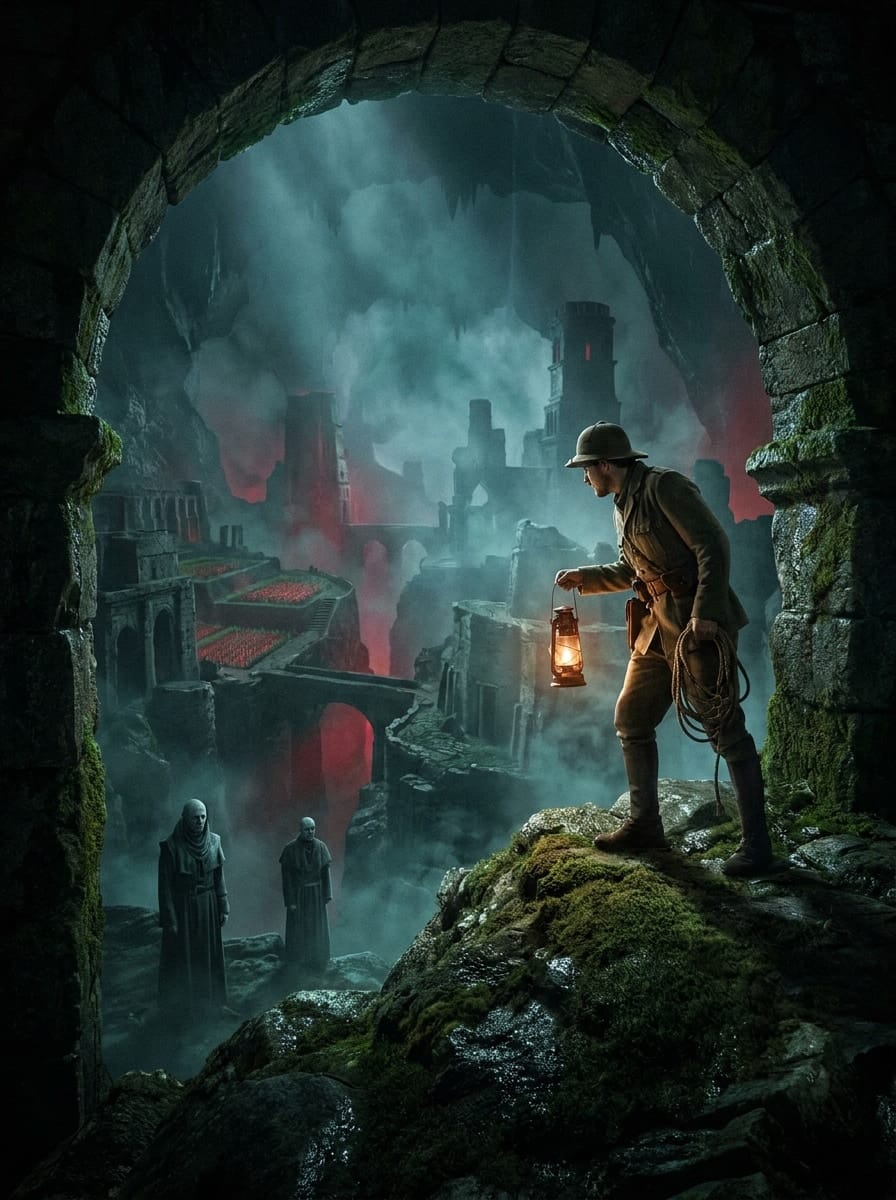
On a desolate stretch of land in Oklahoma, an unremarkable Indian mound has long been feared by the locals. They say that footsteps can sometimes be heard around it at night, though no one is ever seen. Years later, investigators discover the manuscript of the explorer Pánfilo de Zamacona y Núñez and learn that a passage to an underground world lies beneath the mound. Zamacona comes here in the early twentieth century, carrying rope, lamps, and digging tools. He enters through the mound and follows a stone passage steadily downward until he reaches a vast cavern. There is no sun below, yet a gentle red glow illuminates cities, roads, and fields. The inhabitants possess scientific knowledge far beyond that of the surface world; they can reshape their bodies, control minds, and even make the dead move again. The subterranean people regard Zamacona as a savage from the surface. They tell him how their ancestors fled underground, then built cities and conquered disease and death over the course of ages. Yet their civilization, for all its intelligence, has no mercy. They treat surface humanity as primitive animals, delight in cruel entertainments and ancient sacrifices, and regard even their own bodies and souls as things to dismantle and remake at will. Zamacona finally realizes that the underground kingdom is not a lost paradise, but a prison wearing the mask of civilization. He manages to escape with his records, only to discover at the last moment that the subterranean inhabitants have been watching him all along. His manuscript and belongings are eventually found, but he himself never returns to the surface. The mound still rests quietly on the wasteland, as though the road beneath it has never truly been closed.
The Mound on the Prairie
In southwestern Oklahoma lies a broad, dry stretch of country. Wind moves through the short grass, lifting pale dust, while a few low hills crouch along the distant horizon.
One mound rises higher and steeper than the rest. The nearby residents avoid it. The old people say that anyone passing by at night may hear a soft tapping beneath the earth. Some have even seen, by moonlight, a shadow with no visible source flicker past the mound.
Outsiders generally dismiss such stories.
Pánfilo de Zamacona y Núñez was one of them. An explorer fascinated by ancient ruins, he had crossed deserts and valleys and descended into abandoned mines. When he heard that burial chambers belonging to an ancient tribe might lie beneath the mound, he brought his equipment and resolved to investigate it himself.
The locals warned him not to begin.
“That is not a road meant for the living,” one old man said.
Zamacona merely smiled. He coiled his rope and checked his lantern once more. To him, the supposed curse was only the fear people felt toward ancient graves. The next morning, he and two hired workers opened a hole in the side of the mound. Before long, stone slabs appeared beneath the soil. They had been laid with such precision that they resembled no ordinary tomb. They looked more like a passage deliberately sealed.
Zamacona ordered the workers to pry the slabs loose.
A cold draft poured from the darkness, carrying the damp smell of earth. Within it came a faint sound, like someone speaking in a whisper far away.
The two workers immediately backed out.
Zamacona lit his lantern, tied the rope to a stone pillar at the entrance, and crawled into the passage alone.
The Road Below
The passage descended continuously. No torches burned along its walls, and no inscriptions could be seen. Zamacona had only his lantern to guide his steps. He walked for a long time, until the entrance behind him faded into darkness and the only sound was the echo of his shoes against the stone stairs.
Eventually, the stairs became a smooth ramp.
Arches and spacious chambers appeared on either side. Within them stood rotting wooden frames and several metal instruments whose purposes he could not identify. When Zamacona picked one up, its surface suddenly gave off a faint glow, as though answering his touch.
He quickly dropped it.
Farther on, the passage ended before an enormous stone wall. Carved into it was a strange design: several winding lines encircling a round body without eyes. Zamacona pushed against the stone. The wall, which had seemed perfectly seamless, slid aside and revealed a much larger tunnel.
He followed the tunnel downward and at last entered a cavern too vast to compare with any structure on the surface.
Its ceiling was lost beyond sight, and its boundaries seemed to reach the very limits of the underworld. A soft red radiance seeped from deep within the rock, illuminating broad roads, stone bridges, and clusters of buildings. In the distance lay lakes and fields, with tall towers rising above them.
Zamacona stood on the steps, unable to move.
He had expected to find a dead city. Instead, he saw a world still in motion.
People moved along the streets. Their bodies resembled those of surface humans, but their faces were pale and rigid. When they saw Zamacona, they neither cried out nor fled. They simply stopped and watched him in silence, as though studying a beast that had just crawled out of a cage.
Before long, several armed inhabitants surrounded him.
Zamacona raised his hands to show that he meant no harm. A figure in a dark red robe approached and asked in a stiff but intelligible language:
“From which level do you come?”
Zamacona replied that he came from the surface.
The others exchanged glances, then led him into the city.
The Inhabitants Below
The inhabitants of this underground kingdom called their home K'n-yan. They said their ancestors had come there in the distant past. In those days, the surface was a chaotic wilderness. Humanity had built no cities and possessed neither writing nor law. The first settlers discovered the broad caverns below and brought their families and tools into hiding.
There they built roads, cultivated fields, domesticated strange subterranean animals, and eventually raised cities.
The passage of ages did not make them old.
They had mastered the art of altering the body. They could harden the skin or soften the bones; they could shrink themselves, stretch themselves, or temporarily become masses of flesh without fixed form. Disease was no longer a calamity among them, and death was no longer unavoidable.
An elder showed Zamacona one of their laboratories.
Several bodies lay upon white stone tables. They had not decayed. One suddenly opened its eyes and slowly sat upright. Its limbs moved stiffly, like a puppet pulled by invisible strings. Nearby, an experimenter recorded observations while the others watched with complete indifference.
“Why do you treat the dead this way?” Zamacona asked.
“Because we can,” the elder replied. “The people of the surface call what they cannot understand profane. We have long since escaped such fears.”
The answer unsettled Zamacona.
He had assumed that a civilization with such an ancient history would be more peaceful than the peoples of the surface. But the subterranean inhabitants had grown cleverer over the centuries, not kinder. They treated life as material, suffering as an experiment, and unfamiliar creatures as toys to be controlled at will.
They also worshiped many ancient beings.
Unrecognizable statues stood in the city’s temples, while dark red flames burned upon the altars. During their rites, the inhabitants called upon names from beyond the stars and from the depths beneath the earth, offering flesh, shadows, and memories to those powers. Zamacona could not understand every word of the prayers, but some of their sounds resembled the names of serpent gods, frog gods, and the dark earth remembered in tales from the surface.
The subterranean people told him that surface humanity was descended from those they had left behind.
They had once sent emissaries to the tribes above and had even taught them certain arts. Yet every contact ended in disaster. Surface people were too fragile, too short-lived, and too eager to mistake the unknown for gods. In time, the subterranean inhabitants abandoned the surface, observing its people from the shadows as they multiplied, endured, and perished.
As Zamacona listened, an icy dread grew within him.
To these people, the wars, famines, and deaths of the surface were merely interesting experimental results. They spoke of ancient cities falling as casually as one might speak of rain.
Terror in the City
Zamacona was given a room without windows. No lock barred the door, yet guards remained outside at all times. He soon understood that the subterranean people did not consider him a guest. They were simply waiting for a more entertaining way to dispose of him.
He tried asking how he might return to the surface, but each answer differed.
Some said the passage had long since collapsed.
Some said the surface was not worth returning to.
Others laughed and told him that sunlight would burn his eyes. He should remain below, they said, and become a “living specimen” of the underground world.
Several days later, Zamacona was taken to witness a ceremony.
At the center of the city stood a vast circular plaza. Heavy breathing rose from somewhere beneath it. The inhabitants surrounded a deep shaft, carrying spears and bowls filled with black liquid. Several captives who looked like surface humans were forced toward the edge. They struggled in terror, but an unseen force held their shoulders down.
Zamacona rushed forward to stop the rite, only to be struck down by a guard behind him.
As he fell, he saw a priest raise both hands. The air in the center of the plaza began to warp like heat shimmering above sand. Darkness rose from the shaft, extending into thin tendrils that silently coiled around the captives.
The crowd erupted in cheers.
At that moment, Zamacona understood that the civilization below had merely refined its cruelty. Its people no longer needed knives, axes, or flames. They could touch a person’s body, memories, and even soul directly.
That night, when he returned to his room, he found a small piece of surface stone in the corner.
It was one of the objects he had carried into the mound.
Soil clung to its surface, and within the soil was a fresh finger mark, as though someone had just pressed outward from inside it.
Escape from K'n-yan
Zamacona knew he could not wait any longer.
He began pretending to submit, asking the guards about the underground city’s roads, food, and water. In the laboratory, he helped carry equipment while secretly memorizing the direction of every corridor. Near the ritual grounds, he noticed that the inhabitants rarely approached an abandoned old tunnel.
The tunnel led outside the city.
A young subterranean inhabitant once told him, when no one else was listening, that the old tunnel led deeper still, where there was a road that went “up.” The child did not sound sympathetic. It was merely curious about the world above.
“Is there really a sun on the surface?” the child asked.
“There is,” Zamacona said. “It makes the day bright, and it makes a shadow follow you.”
The child was silent for a moment.
“There are no shadows here.”
The words stayed with Zamacona.
Several days later, the city held a great festival. Every inhabitant gathered near the temples, and even the guards were called away. When the red light flickered and dimmed, Zamacona slipped into the abandoned tunnel.
The passage was filled with standing water and loose stone. He dared not light his lantern and could only crawl forward with one hand against the wall. Soon he heard pursuit behind him: footsteps measured and slow, unlike the running of men, more like the dragging tread of many heavy things moving together.
Zamacona pressed on faster.
Ahead, a flight of stone steps rose upward. As he climbed, a deep voice called from behind him. It did not travel through the air. It formed directly inside his mind:
“Stay.”
He did not look back.
At the top of the stairs, a narrow fissure admitted a thread of cold air. Zamacona forced his body through, seized the loose soil with both hands, and hauled himself upward. Pale fingers reached into the crack behind him and almost closed around his ankle.
With all his strength, he kicked them away and continued climbing.
The earth collapsed behind him, sealing the fissure. The fingers vanished into the darkness, leaving only several long scratches.
The Secret Left by the Mound
At last Zamacona emerged inside the mound.
His clothes were soaked with mud and water, his lantern had gone out, and his arms were covered with scrapes. He did not dare linger at the entrance. Grabbing the rope, he climbed toward the surface. The sunlight stabbed at his eyes, but the morning wind against his face made him feel safe for the first time.
When the two hired workers saw him, they nearly assumed he was dead.
Zamacona did not explain what he had witnessed. He simply ordered them to seal the entrance at once and bury every stone slab beneath the earth again. He then spent several weeks writing down what had happened: the roads of the underground city, the customs of its inhabitants, and the details of the terrible ceremony.
But he did not publish the manuscript.
He knew no one would believe in a city beneath a mound, still less that its inhabitants continued to watch the surface and wait for another opportunity. Even if someone believed him, that person would surely come with more tools and dig the entrance open again.
Zamacona gave the manuscript to an acquaintance, asking that it be preserved if he disappeared.
Not long afterward, he left Oklahoma.
No one ever saw him again.
Some said he died in the desert. Others claimed he went south to the ports. Still others said that one night he returned to the mound. In time, all that was found were scattered belongings and the manuscript filled with its account of terror.
The mound still stands on the prairie.
By day, it looks like nothing more than a heap of earth dried by the wind. But at night, anyone who comes too close may still hear a slow tapping from deep beneath the soil.
It comes once, then again, as though someone inside is searching for a way out.
Or waiting for someone on the surface to open the door again.