Cthulhu Mythos
Pickman's Model — Cthulhu Mythos
A painter explains to a friend why he suddenly withdrew from the art world: he once followed Richard Upton Pickman into an abandoned house in Boston's North End, and there saw horrors no ordinary model could have supplied. After Pickman vanished, a photograph the painter carried away proved that those monsters were not merely inventions of an artist's mind.
Article
Summary
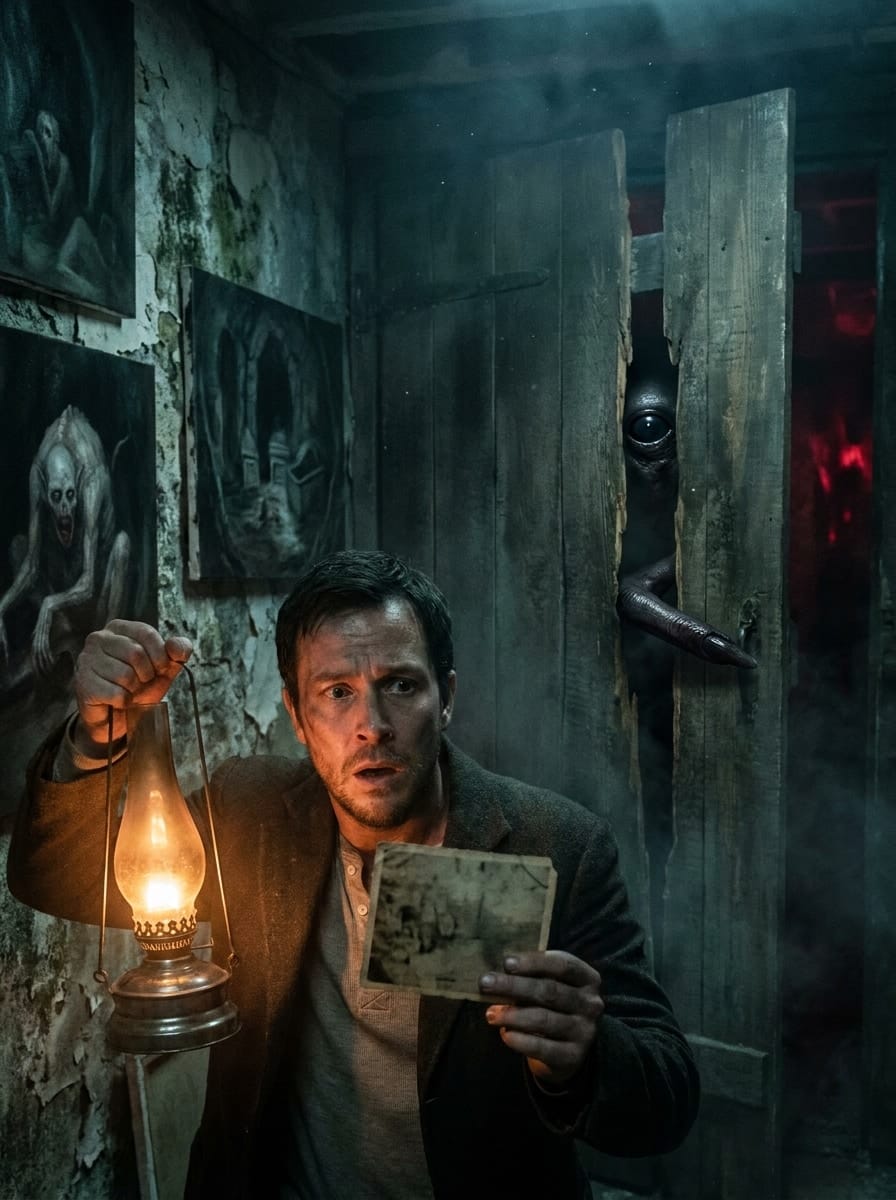
As they left the old house, Pickman casually handed the narrator a photograph, saying it was only reference material from the studio. Only after returning home did the narrator discover that the creature in the photograph was not a painting, but a living thing: its posture, eyes, and folds of flesh matched the figures on Pickman's canvases exactly. After that Pickman disappeared, and the narrator never dared search for the house again, because he knew what had been left in the cellar was no model, but something truly alive.
Why I No Longer Go to the Art Club
"Don't think I've gone mad, Eliot."
That was what I told my friend as he stood in the doorway of my study, still holding an unsent letter in his hand. Lately I had stopped taking the subway, and I no longer cared to walk alone through the older parts of the city. Whenever the train doors shut in the tunnels underground, I remembered that house, the scraping behind the wall, and a pair of eyes staring at me out of the dark.
My friend thought it was merely nerves. He did not know that I had left the art club, and broken with Pickman so abruptly, for reasons far worse than an ordinary quarrel.
Pickman was the finest painter I had ever known, and the most disturbing. Others called his work vulgar, sickening, even unfit for respectable exhibitions. I knew better. They were afraid. The monsters in Pickman's paintings looked too real: the creases of their skin, the crooked joints of their fingers, the marks left where teeth sank into flesh. Such things did not look invented.
He had painted many scenes of underground tombs. In some, creatures crouched over stone coffins and gnawed at corpses. In others, they crawled from narrow pits and dragged living people into darkness. The paintings made one recoil, yet it was impossible to look away. Pickman once laughed and said that a true painter could not content himself with pretty faces. He had to know how a face twisted in terror, and what became of a body after it had lain too long on the ground.
At the time I thought this was only his way of shocking an audience.
The Old House in the North End
Pickman had rented a house in the old North End. He used a false name, and neither the landlord nor the neighbors knew what he did inside. The place stood at the end of a lane few people used, with walls crowding close around it and windows small and filthy. Even by day it looked like twilight there; by night, not even moonlight seemed able to enter.
One day Pickman came to see me and said he had finished several new pictures. He wanted me to be the first to look at them. He did not call a cab, but led me through one twisting street after another. We passed shuttered shops, ash-strewn vacant lots, and brick walls blotched with black mold. By the time we reached the house, night had settled completely.
He opened the door with a key. The hinges gave a long groan, and at once a damp odor rolled out of the house, like standing water, dust, and a coffin that had not been opened for many years.
"It's quiet here," Pickman said.
I did not answer. There was no furniture inside. Thick dust lay on the stairs. Wallpaper curled away from the walls, exposing blackened boards beneath. Yet Pickman moved through the place as if he had lived there for years. He led me through the parlor and opened a door that led down to the cellar.
The Monsters on the Canvas
Several kerosene lamps burned in the cellar. Their light struck the walls and seemed half swallowed by the damp. Pickman's paintings hung there one after another, and the things inside them appeared to shift slowly in the wavering glow.
In the first painting, a group of gaunt creatures gathered around a stone well. Their heads looked softened by water, their mouths split far too wide, yet their limbs moved with a horribly human dexterity. In another, a woman was dragged across a graveyard while the soil behind her had been clawed open and several gray-white hands reached up from below. There was no theatrical crimson, no cheap ornament meant only to frighten; but the shape of those fingers was far too exact.
I asked Pickman who posed for him.
He glanced at me, and a small smile touched his mouth.
"Do you really want to know?"
I expected him to say he had studied anatomy books, or visited graveyards. He did neither. Instead he moved a large canvas away from the wall and revealed an even larger work behind it.
The painting showed a low stone chamber. A monster crouched beside the wall, pale-skinned, with a mouth much too broad. Its arms were far longer than a man's, and its fingers hung to the floor like wet roots. Beside the monster stood a child, face warped with terror, both hands clamped over the mouth, as though the smallest sound would mean being dragged into the creature's arms.
The most dreadful thing about the painting was the wall behind the monster. Every joint in the masonry, every patch of mold, every flake of fallen plaster had been rendered with pitiless clarity. I could even see a small black smear in the corner, as if something had once left a claw mark there.
"Details like that don't come from imagination," Pickman said. "Imagination makes mistakes. The eye doesn't."
I asked whether he had seen such a thing himself. He gave no direct answer, but led me to the farthest part of the cellar. There stood a wall sealed with planks, and between the boards ran a narrow crack.
"Look through here," he said.
The Sound Behind the Wall
I bent down and looked into the crack.
At first I saw only blackness. It was deeper than any ordinary cellar dark, as if there were no room behind the boards at all, but a passage sinking into the earth. After a moment, I heard a sound.
First came a faint scraping, like nails drawn over stone. Then a dull vibration rose from beneath the floor. Dust sifted from the ceiling and settled in my hair and across my shoulders.
Pickman stood beside me and did not stop me.
I pressed my eye once more to the crack. Something moved in the dark. It was not a rat, nor a cat. As it shifted, its body brushed the stone with a wet, sliding sound. An eye slowly approached the opening, almost without any white to it, the pupil like a black stone soaked in oil.
I lurched backward and knocked over a kerosene lamp. The flame rolled across the floor, and for one instant it lit the space beneath the boards. In that instant I saw several crooked fingers draw back from the edge of the crack.
"You saw it," Pickman said softly.
I asked him what it was. He only bent to right the lamp and settled the flame back under its shade, as though nothing had happened.
"My model."
The words nearly took my legs from under me. I rushed toward the stairs, but Pickman called after me. He did not pursue me. He merely thrust a small photograph into my hand.
"Look at it when you get home," he said. "You won't understand it now."
I did not look back. As I ran from the house, a heavy impact sounded from the cellar, and every door and window in the building shook with it. There was no one in the street. I ran until I reached a place bright with lamps, and only then dared stop to breathe.
The Truth in the Photograph
When I got home, I threw the photograph on the desk and did not dare touch it. Not until the next morning did I light the desk lamp and pick it up.
The photograph showed a wall in Pickman's studio. Several paintings hung in the background, but in the foreground stood a small figure. It was not posed like a studio model, and it wore no clothes. Its body was thin as something long buried in the earth, yet its head was grotesquely broad. The face had almost no nose, and the mouth split back nearly to the ears, showing a row of fine, sharp teeth directly to the camera.
I recognized it.
The thing in the photograph was the very monster crouching beside the child in the painting. The artist had not painted it from imagination. The thing had truly stood in Pickman's studio. It had faced a camera, and perhaps Pickman himself.
Worse still, the lower right corner of the photograph showed part of a plank. Three deep scratches scored the wood, and it was the same plank wall that sealed the cellar.
From that day onward I never returned to the art club, and I never saw Pickman again. I heard later that he had vanished. Some said he had left the city; others said he had merely found another place to go on painting. The police searched his rooms, but found little of use. The old house was sealed up afterward, but I do not believe any such door can truly hold back what lives within.
My friend asked why I would not give the address to the police.
I could not tell him that I remembered the way perfectly well, and that I simply refused to walk it a second time. For I knew the darkness beneath that place had not vanished with Pickman.
Pickman had only found a better studio, and truer models.
And the photograph is still in the drawer of my desk. Whenever I hear a faint scraping behind the wall at night, I remember that split-open mouth in the picture, and the thing Pickman once said: the true horror is not that a painter can paint monsters, but that after seeing them, he is still willing to paint them at all.