Cthulhu Mythos
The Walls of Eryx — Cthulhu Mythos
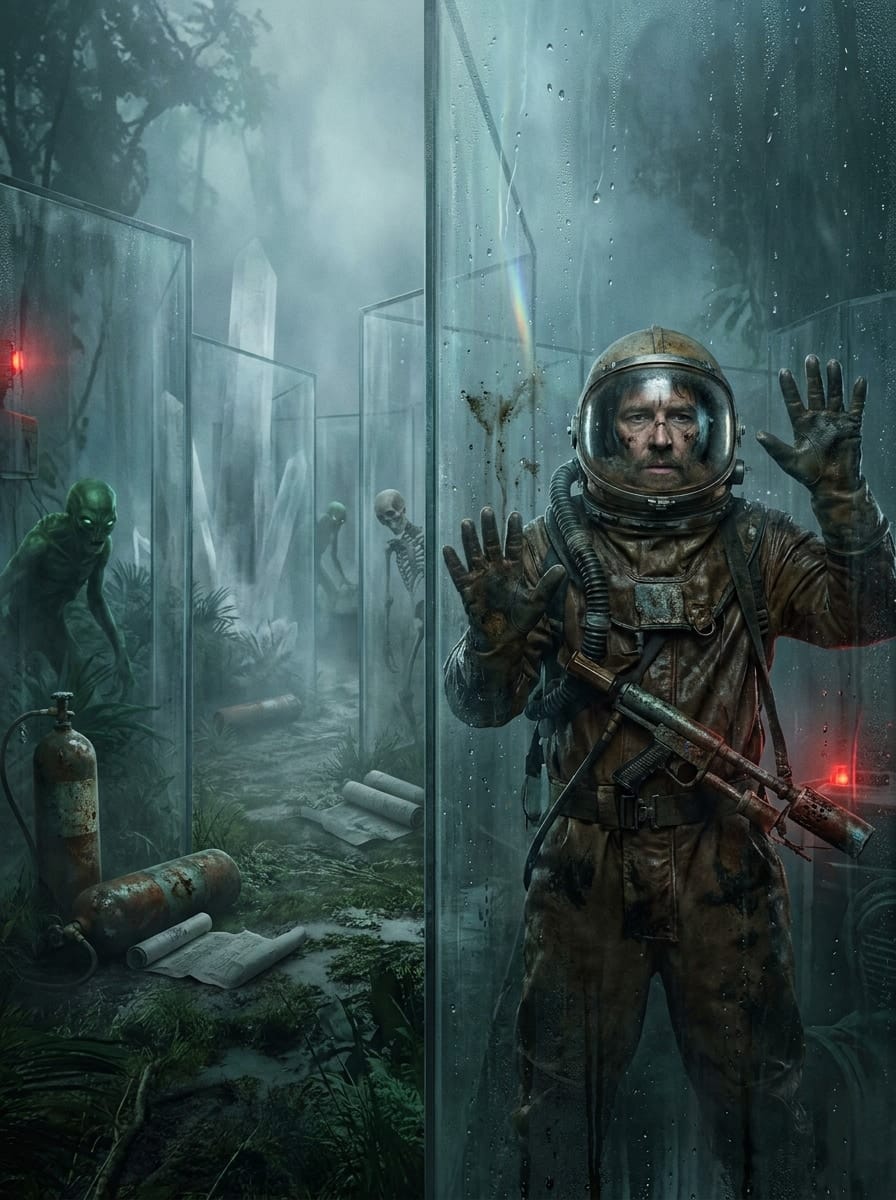
In the jungles of Venus, Crystal Company prospector Kenton J. Stanfield follows a detector to a colossal crystal, only to wander into a labyrinth whose walls are completely transparent. Trapped within its invisible passages, he exhausts his water, oxygen, and strength before realizing that the Venusians humanity dismisses as beasts built the trap themselves, and have long understood the human hunger for crystals.
Article
Summary
Crystal Company prospector Kenton J. Stanfield leaves the human base at Terra Nova and ventures alone into the southern jungles of Venus in search of high-energy crystals. After forcing his way through steaming vines, carnivorous plants, and flowers that produce hallucinations, he reaches the Eryxian Highland, where he discovers an unusually immense crystal beside the body of another prospector. Stanfield tries to take the crystal, but collides with a wall he cannot see. Following it by touch, he finds an entrance and enters a circular structure made of transparent barriers. He takes the crystal from the corpse, only to discover that he is lost in a maze of invisible corridors. The walls cannot be marked, cut, burned, or excavated; all he can do is feel his way forward and draw his route on a recording roll. As his water and oxygen supplies dwindle, more and more Venusians gather outside the labyrinth and silently watch him struggle. Stanfield is finally forced to admit that the beings humanity calls inferior reptiles possess language, intelligence, and materials technology far beyond anything humans can match. The crystal is bait, and the labyrinth is a trap built to resist plunderers. Several days later, he dies little more than twenty feet from the exit, leaving a final plea that humanity abandon the Venusian crystals. A search party finds his body and his records, confirming that the labyrinth exists, but the warning is ignored. The Company takes the crystal, destroys the labyrinth, and prepares to send troops to purge the Venusians so that more crystals can be mined. The understanding Stanfield gained in his final hours changes nothing. Instead, it becomes intelligence for the next stage of the plunder.
Morning Beyond Terra Nova
This is the record left by Kenton J. Stanfield.
He arrived at Terra Nova on the ninth day of the sixth Venusian month and was assigned to the Crystal Company prospecting group supervised by Wesley P. Miller. During the next two days he was issued a protective hide suit, a flame gun, a crystal detector, and a heavy Carter oxygen mask. He also reset his watch to match Venus's shorter days and nights. On the morning of the twelfth day, he left the base alone and entered the jungle along the southern route mapped from the air by Anderson.
The rain had only just stopped, and the soaked vines were tough as leather thongs. Stanfield often had to hack at the tangled growth for ten minutes or more before he could force his way through. Mud swallowed his boots, while the weight of the oxygen mask dragged at his shoulders, making every step harder than it would have been on Earth. He had no intention of returning empty-handed. The detector's needle held steadily toward the south, indicating a deposit of exceptionally powerful crystal somewhere ahead.
Crystals were the reason humanity had come to Venus. They could store immense quantities of energy and were worth a fortune on Earth. To the Venusians, however, they were sacred objects, things to be guarded and revered. Stanfield understood none of that reverence. He called the tall, green-skinned beings with tendrils hanging from their chests "man-lizards," and decided they were capable only of building towers, throwing poison darts, and ambushing travelers. In his record he even wrote that twenty troopships from Earth would be enough to clear away these obstacles to mining.
Around noon, a poisoned dart grazed his helmet. Three Venusians approached beneath the colors of the jungle. Stanfield raised his flame gun and burned them down in the mud, then pressed onward. Farther ahead, carnivorous plants clamped onto his boots. Slender creatures writhed beneath the muck, while spotted mirage-plants released their gases into the air. For a time the flowers around him turned deathly white. Points of light wheeled to the rhythm of a silent beating, and even the temperature seemed to breathe. Closing his eyes and covering his ears did nothing to dispel the hallucination. He could only hack wildly toward open ground, away from the flowers, until the world settled again.
At five in the afternoon he finally emerged from the dense jungle and climbed onto an open plateau. The maps marked the region as Eryx, also called the Erycian Highland. Far away, in the mist, a point of cold white light hung over the plain. The detector's needle trembled violently, as if it might snap.
Stanfield knew he had found a rare giant crystal.
The White Light in the Jungle
Without stopping to examine his surroundings, he ran toward the white glow through the thin mud. When he was within a hundred yards of it, he suddenly rebounded as though he had struck a stone wall. Pain shot through his chest and knuckles, and he fell backward into the mud.
There was nothing visible before him.
Once he was on his feet, he held out his small knife and advanced cautiously. The blade soon struck a hard surface. He felt it with his gloved hand, then removed the glove to make certain. The thing was cold and smooth, like glass or metal, yet perfectly transparent. It neither reflected light nor distorted the scene beyond it. The wall stretched away in both directions, and he could not find its upper limit by reaching overhead.
Stanfield tapped it with his knife and kicked it with his boot. He even threw a lump of squeezed mud upward. It struck the wall and spread before sliding down. Only when he threw a larger lump nearly twenty feet into the air did it finally clear the top. The barrier was not infinitely high, then, but it was far too high to climb with bare hands.
He began following the wall to his left, trying to determine its shape. Before long he saw that the white glow came not from a mound but from a body lying within the enclosure. The dead man wore a Company hide suit. He lay on his back, his oxygen mask several feet away, his right hand still clutching a fist-sized oval crystal against his chest. Stanfield recognized him as possibly Frederick N. Dwight, a prospector who had disappeared two months earlier.
As he continued feeling his way along the wall, Stanfield's hand suddenly passed through an opening three feet wide. There was no door and no hinge. He stepped inside and followed an invisible corridor to the body. Dwight bore no visible wound, but his mask had come off. Perhaps, in despair, he had removed it himself and ended his prolonged torment with Venus's poisonous atmosphere.
Stanfield pried the crystal from the dead man's stiff fingers, put it in his own pocket, and covered the staring face with his helmet. He could have left by the way he had come, but the impossible structure had seized his curiosity. Humanity had been on Venus for scarcely seventy years and could not create material that was seamless, shadowless, and incapable of refraction. If the structure belonged to the Venusians, then the beings he had treated as beasts possessed technology far beyond human understanding. If it did not belong to them, who had left it there?
He decided to investigate.
The Invisible Walls
Stanfield stretched out both hands and advanced along the passage like a blind man. The corridor turned, then slowly curled inward, branching again and again along the way. Some junctions offered only two passages; others split into three or four. Each time he chose the route that seemed to lead closer to the center, until he entered a circular chamber roughly ten feet across.
There was no roof. Six invisible corridors opened outward from the chamber. Stanfield judged from the position of the corpse and the distant trees that one of them must be the passage by which he had entered. Evening was approaching, and he did not want to spend the night in the mud, so he followed it back.
When he neared the body again, his raised hand struck another wall. He had entered a dead-end passage running parallel to the entrance.
He returned to the central chamber and tried another corridor, only to wander even farther away. A third attempt failed as well. The transparent walls cast no shadows, and the wet ground quickly erased his footprints. His pen, knife, and lumps of mud could leave no mark on the barriers. Once night fell, the corpse, his only visible landmark, vanished into the darkness. Stanfield had no choice but to retreat to the central chamber and spend the night lying in the mud.
The next day he placed his helmet beside one entrance and began recording every turn on a corrosion-resistant roll. He worked through the six corridors in sequence, yet always lost his bearings somewhere along the way. Sometimes the corpse seemed close enough to touch, only for him to strike another cold wall with his next step. At other times he knew he was walking outward, yet somehow ended up back at the center.
He tried digging beneath the wall. The surface mud was only a few inches deep; below it lay gray clay that grew harder with every foot. At a depth of three feet his knife could no longer cut, and he still had not reached the foundation. He tried burning the barrier with his flame gun, but the fire merely spread along the invisible surface, leaving not even a scorch mark.
The digging and repeated journeys consumed a great deal of oxygen. Stanfield rested briefly, then prepared to feel his way onward. At the edge of the forest he saw four or five Venusians appear. Soon a dozen, then several dozen green figures emerged from the mist and formed a ring around the labyrinth.
They did not attack.
They simply stood outside the walls, their chest tendrils moving constantly as they exchanged some kind of message. Some pointed at Stanfield. Others imitated his collisions with the walls and his blows against them. More Venusians continued arriving from the forest, replacing those who departed, as though a ceremony were unfolding here that everyone understood except the trapped creature at its center.
Then Stanfield finally understood.
This was not a ruin or an accidental geological oddity. It was a trap still in use. The Venusians had built the invisible maze and placed the crystal inside it as bait, waiting for self-important Earthmen to follow their detectors into the snare. Dwight had been the previous victim. Stanfield was the next.
More humiliating still, he was forced to admit that the Venusians really did communicate with their tendrils, and that they possessed materials and architectural techniques Earth could not reproduce. They were not ignorant beasts guarding a treasure. The ones who had failed to understand the situation were the humans who had come to Venus armed with weapons and driven by greed.
Despair Drawing Near
Once he understood the truth, Stanfield briefly lost control. He ran through the invisible corridors, striking wall after wall, until he fell into the mud with blood covering his face. Outside, the Venusians waved their tendrils. Some even imitated his punches. He took it for mockery. Perhaps it was.
But he soon forced himself to regain his composure. Dwight's body had fallen near the entrance, proving that the way out could be reached. If he recorded every branch, he would eventually find it.
The thirteenth day passed without an exit. His canteen grew lighter, and only a small supply of chlorate cartridges remained for producing oxygen. By midday on the fourteenth day he had drunk the last of his water. An afternoon downpour let him catch a little rain in his helmet, enough to survive another night. The food tablets kept him alive but could not ease his thirst. To conserve oxygen, he dared not move quickly. He could only lie in the mud and feel his way forward inch by inch.
Dwight's body decayed rapidly before his eyes. Flies gathered in black clouds, while small creatures in the mud and carrion plants slowly stripped away the hide suit and flesh. By the third day, only a skeleton remained, tangled in vines. Its teeth showed in the dim light as though urging him to hurry.
Stanfield's records grew increasingly disordered. His drawn routes covered the entire length of the metal roll, yet many of the turns contradicted one another. Sight was no help here; it actively deceived him. The walls were transparent, the corridors were transparent, and the distant bones and trees appeared to offer direction while making several neighboring entrances look exactly alike.
On the afternoon of the fifteenth day, he discovered a passage he had never entered before. It followed a spiral and gradually brought him toward Dwight's skeleton. The Venusians had gathered at the outer entrance, leaping and moving their tendrils with frantic urgency. Stanfield thought they were assembling for the battle that would begin when he emerged. He gripped his flame gun, lay flat in the mud, and crawled onward, planning to burn his way through as soon as he escaped.
The skeleton was only a few yards away.
He crawled forward, but his forehead struck another wall.
It was still a dead end.
Three days of searching had not brought him closer to the exit. They had merely returned him to the place where his despair had begun. Stanfield fitted his last oxygen cartridges and crawled a few more feet, but the passage remained closed. He no longer had enough water, air, or strength to make it back to Terra Nova.
The Venusians still waited beside the entrance. Only then did he begin to wonder whether they had been doing more than laughing at him. Were their gestures meant to show him the way? Had they gathered at the entrance to make the exit visible? He was too weak to decide and had no strength left for another attempt.
The Record He Left Behind
Before he died, Stanfield wrote the rest of his message on the roll.
He begged those who came after him not to return and seize the crystals. Earth had other sources of energy, while the Venusians regarded these crystals as part of their own world. Humans had entered their land for profit, killed its guardians, cut through its jungles, and called the resistance barbarism. Dwight and Stanfield had already paid with their lives. If the plunder continued, these isolated deaths might be only the beginning of a far greater disaster.
In his final pages, he abandoned the belief that humanity was naturally superior to the Venusians. He asked which race, measured against the scale of the universe, was truly closer to what people called civilization: the beings of Venus, who could build invisible labyrinths and protect their world, or the humans who came with flame guns to take their sacred treasures?
His handwriting grew crooked. Only a few phrases remained: night had fallen; the Venusians had lit green torches; they were still near the entrance; he thought he could hear voices in the sky.
On the sixteenth day, Wesley P. Miller's search party reached the Erycian Highland. A scout aircraft struck one wing while flying low. After the crew disembarked and felt their way forward, they discovered the invisible structure. They found Dwight's skeleton first, then Stanfield, who had died only recently, in another corridor. The recording roll was still clutched in his left hand. The giant crystal lay buried in mud, while the detector continued to point accurately toward it.
The search party entered the labyrinth with ropes and soon mapped the entire route. Only then did they discover that, at the moment of Stanfield's death, the exit had been twenty-two or twenty-three feet behind him. He needed only to turn around, pass through one entrance, and follow the passage on the right for a short distance. The Venusians gathered outside may have known this all along.
The men read the roll and confirmed nearly everything Stanfield had written about the labyrinth.
But the Company did not accept his plea.
At the end of his report, Miller wrote that Dwight and Stanfield would be buried in the Company cemetery, while the giant crystal would be shipped back to Chicago. Rescue workers would use drills and explosives to destroy the labyrinth, analyze its invisible material, and apply what they learned against the Venusian cities. Once the Company brought in enough troops to eliminate resistance in the highlands and jungles, they would be able to mine still more crystals.
Stanfield had used his last moments of clarity to leave a warning, hoping his death would make those who came after him stop.
The Company read it instead as a prospecting report.