Cthulhu Mythos
Cool Air — Cthulhu Mythos
A poor young man moves into an old New York apartment house and befriends Dr. Muñoz upstairs, whose room is always kept as cold as an ice vault. When the cooling machinery breaks down in the heat of summer, the young man learns that the cold air is no eccentric habit, but the doctor's last defense against a death that should have claimed him years before.
Article
Summary
As a young man, the poor lodger takes a cheap room in an old New York apartment house. Upstairs lives Dr. Muñoz, a reclusive physician whose quarters are always cold as a vault and crowded with medicines, glass tubes, and refrigeration apparatus. One night, when the lodger suffers a sudden attack of the heart, it is this cold, pale doctor who saves him. The two men become acquainted afterward. Whenever Dr. Muñoz speaks of medicine, he grows strangely animated. He believes that death is not necessarily unconquerable: if one understands how to maintain the human body as a machine, its collapse can be postponed. Little by little, the lodger notices that the doctor almost never leaves his refrigerated room, eats almost nothing, and has a gray-white look unlike that of a healthy living man. Then the summer heat arrives, and the doctor's cooling apparatus suddenly fails. In terror, he sends the lodger for ice, mechanics, and repairs, as though the slightest rise in temperature might kill him. Block after block of ice is carried upstairs, yet the heat presses in, and the doctor's voice and written notes become more desperate by the hour. At last, Dr. Muñoz leaves an explanation. He admits that he died years ago, and has kept his body from dissolution only through cold and chemicals. With the machine broken, he can no longer hold decay at bay. The lodger sees what remains in that room, and from that day onward he cannot bear cold air, for its chill is forever joined in his memory with the residue of death.
The Man Who Feared a Cold Draft
I have never been able to endure cold air.
Other people think nothing of opening a window in winter for a little freshness, or of hearing ice strike the side of a glass. I shrink away at once. If a draft creeps down a hotel corridor, I would rather sit wrapped in my coat until morning than let that chill touch my face.
I was not born with this fear. Many years ago, I lived for a time in an old apartment house in New York. Since then, cold air has never been merely cold air to me. It brings back a room where the curtains were always drawn, a machine that breathed in a low metallic murmur, and a doctor whose face was ghastly pale while his eyes shone with a frightening brightness.
I was young then, and had little money, so I looked for the cheapest lodging I could find in the city. The building I chose had darkened outer walls, narrow worn stairs, and banisters that always seemed filmed with dust. The landlady told me the room was small, but quiet enough. I glanced at the window, heard the mixed clatter of carts and motorcars in the street below, and decided I was in no position to be particular.
There were not many tenants in the house, and most kept to themselves. Only the doctor upstairs seemed unusual. He lived near the top floor and almost never went out. Delivery men were forever carrying up bottles, medicines, blocks of ice, or odd pieces of apparatus. Now and then a sharp smell drifted down the stairwell, something like medicine and something like spoiled chemicals. Stranger still, a current of cold air often seeped from beneath his door; even in mild weather, one shivered when passing it.
The landlady said he was Dr. Muñoz, once well known in Spain, who had come there to live quietly because of ill health. He disliked being disturbed, she said, but if someone were truly ill, he would not refuse help.
At the time, I took all this as ordinary house gossip. Then, one night, I became the one who had to ask him for my life.
The Doctor Upstairs
That evening I was writing in my room when a sudden tightness seized my chest, as if a hand had closed around my heart from within. The lamp blurred on the table, and the walls tilted before my eyes. I tried to call out, but only a thin breath escaped me.
Clutching the back of a chair, I managed to stand. I staggered to the door. The hall was empty, the light dim and yellow. I do not know where I found the strength, but step by step I climbed toward the door from which the cold air always leaked, and knocked.
The door opened.
Behind it stood a tall, thin man in a neat dressing gown. His face was almost translucent in its pallor; his beard was carefully trimmed, but his eye sockets looked hollowed by shadow. When he saw me, he asked no useless questions. He caught me at once and brought me inside.
In that instant, it was as if I had fallen into an ice vault.
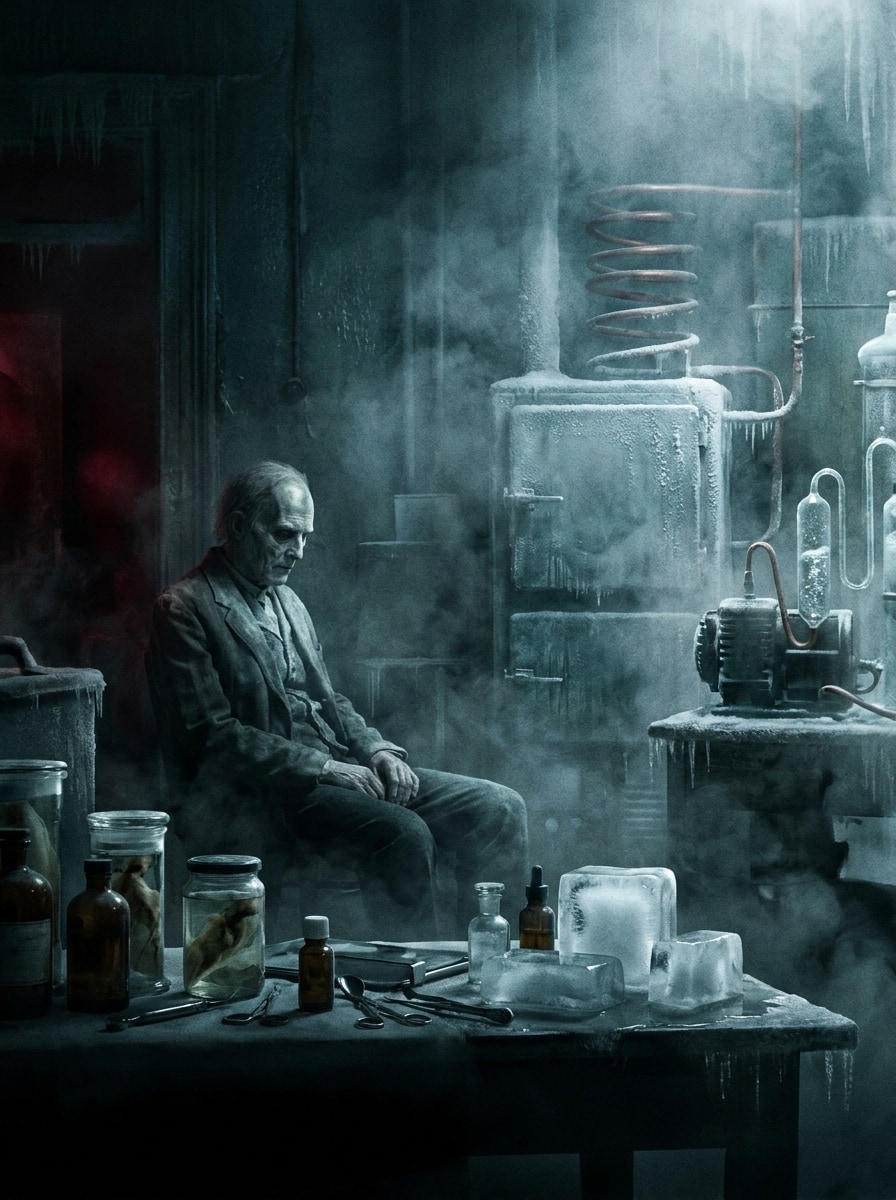
The room was astonishingly cold. The windows were sealed tight, and heavy curtains hung to the floor. Against one wall stood a refrigeration machine, with metal pipes running along the corners and giving off a low vibration. The place was crowded with large bottles of chemicals, glass tubes, metal instruments, and thick medical books. The air was dry, frigid, and edged with a piercing medicinal odor.
Dr. Muñoz made me lie down, moving quickly and surely. He gave me medicine, held my wrist to feel the pulse, and bent close to listen to my breathing. His fingers were cold, too cold for a living hand; but at that moment I had no thought to spare for such things. I knew only that the pain in my chest began to loosen, and the darkness before my eyes slowly withdrew.
After a long while, I could sit up. The doctor stood watching me under the lamplight, his voice low and distinct.
"Your heart has been subjected to a shock," he said. "It is fortunate that you came when you did."
I thanked him. He showed no pride, only nodded, and then turned his burning gaze toward the machine, as though it were the most urgent patient in the room.
After that night, Dr. Muñoz and I became acquainted.
Conversations in the Cold Room
Dr. Muñoz did not smile often, but he was not unkind. His speech was precise, and he knew a great deal, especially about medicine. When he spoke of that subject, his whole being seemed to quicken. He did not treat death as a solemn final boundary; rather, he regarded it as an enemy to be studied, delayed, perhaps even driven back.
"The human body is only a complex machine," he once told me. "When the machine fails, men call it fate. But if one knows how to slow the damage, how to supply what is lacking, then fate may prove less certain than they suppose."
I was young, and he had recently saved me, so these words at first seemed to me only learned and daring. Yet the longer I knew him, the more I noticed that something was wrong.
The doctor never left that cold room. If some matter had to be dealt with, he preferred to send a written note rather than go downstairs himself. The landlady said he required enormous quantities of ice all year, and the hotter the weather, the more ice was carried up to him. He ate very little, or rather, I almost never saw him eat like other men. In the lamplight, his skin always had a gray, waxen cast, and his lips were nearly bloodless.
Once I said the room was unbearably cold, and asked why he did not stop the machine for a while. He turned on me at once, his look sharp as a blade.
"No," he said.
His voice was not loud, but I did not dare ask again. After a pause, he seemed to realize he had spoken too abruptly, and softened his tone. "My illness is unusual. For me, cold air is not a matter of comfort. It is necessary."
He said no more, and I did not press him.
Spring passed quickly that year, and New York grew more stifling by the day. Dust rose in the streets; the walls of the houses drank in the heat by daylight and breathed it out again at night. My little room became a sealed box, and I woke with the sheets wet from sweat. Yet whenever I passed Dr. Muñoz's door, that cold current still slipped through the cracks, as if another season were hidden on the other side.
I did not yet understand that for him summer was not merely oppressive. It was dangerous.
Bad News in the Heat
The calamity came on a morning so close and heavy that breathing felt like labor.
I had only just awakened when a frantic bell rang upstairs. It rang again and again, as though someone were pulling it with all the strength he had left. I threw on my clothes and ran up. Dr. Muñoz's door stood half open, and the cold within was weaker than usual.
The doctor stood in the middle of the room. His face was whiter than ever, but his eyes were filled with panic. He pointed toward the machine by the wall, his voice strained.
"It has broken. Go for a mechanic at once, and have ice sent here. As much as possible. Quickly!"
I had never seen him lose command of himself before. The refrigeration machine, which had always murmured steadily, was silent now; only a few drops of water slid from the pipes. The room was still cold, but no longer with that firm, unchanging cold. Behind the heavy curtains, the summer heat was pressing inward, inch by inch.
I did exactly as he asked. No mechanic could immediately find the right part, but the ice came first. Great blocks were carried upstairs and set in basins, tubs, and canvas wrappings all around the doctor's room. White vapor breathed from their surfaces, and water crept across the floor toward the door.
Dr. Muñoz wrapped himself tightly and sat in a chair, one hand gripping the arm, the other writing note after note. He sent me to hurry the workmen, to buy medicines, to order still more ice. His handwriting began to shake. His words grew shorter.
By noon, the heat outside had worsened. The air in the street felt like heated metal, and even the wind was hot. I ran up and down the stairs, my shirt clinging to my back, coins and receipts in my hand, with only one thought in my mind: that room must be made cold again.
But the ice melted too quickly.
When I entered the doctor's room toward evening, I smelled something I had not smelled before. The medicines and the chill tried to hold it down, yet it crept out of the corners all the same: sweetish, heavy, like something spoiled in a damp cellar. The doctor had covered his face more completely, leaving only his eyes visible. He did not look at me, but handed me a note.
It said that if the machine could not be repaired at once, the whole room must be packed with ice.
I obeyed. Yet a coldness had begun inside me that did not come from the ice. The doctor's terror was not the fear of an ordinary sick man afraid to die. It was the fear of someone who knows what stands outside the door, and knows it is only moments away from forcing its way in.
The Last Note
That night, a mechanic finally promised to bring the needed part the next day. But the doctor could not wait for morning.
After midnight, his bell rang again. This time it was short, broken, confused, as though the hand pulling it had almost no strength left. I rushed upstairs, but the door was locked from within. I knocked and called his name. No answer came. There was only the sound of dripping water, the faint crack of splitting ice, and a worsening odor that poured through the crack beneath the door.
After a while, a sheet of paper was pushed out under the threshold.
I bent to pick it up. The handwriting was crooked, the ink blurred in places, as if the writer's fingers had already ceased to obey him. On that paper, Dr. Muñoz told me that he could no longer see anyone, and that there was no use sending for workmen. Years earlier, he wrote, he had been stricken by a fatal disease, and his body should have died then. But he had refused the ending, and with chemicals, willpower, and cold, he had preserved himself in a dreadful intermediate condition.
He had not prolonged a healthy life.
He had only kept a body that should long ago have rotted from rotting.
The last lines were almost unreadable. He wrote that once the cold air vanished, all the corruption it had held back would return. He thanked me for all I had done, and begged me not to come near what was inside the room.
When I finished reading, my fingers were stiff. The hallway was hot, yet I felt as though I stood in a winter night. From behind the door came a dull sound, as if something had slipped from a chair to the floor. Then all was still.
At dawn, the landlady sent for help. When the door was opened, the room no longer held that clean, biting cold. The ice had melted into cloudy water that ran across the floor. The machine stood silent by the wall, a useless iron shell. In the center of the room lay only an unrecognizable remnant of decay, with clothing collapsed into it, while no medicine could any longer hide the true smell of death.
Dr. Muñoz had failed at last.
He had used cold air to bar the door against death; with knowledge and obsession, he had stretched one final moment across many years. But when one machine stopped and a breath of summer entered, all the postponed corruption caught up with him at once.
Since then, I have never been able to endure cold air. Others know it only as ice, as wind, as a brief relief in summer. I remember instead that door, the note pushed out beneath it, and a man long dead, struggling in a frozen room to keep speaking, writing, and waiting for rescue as though he were still alive.