Cthulhu Mythos
The Haunter of the Dark — Cthulhu Mythos
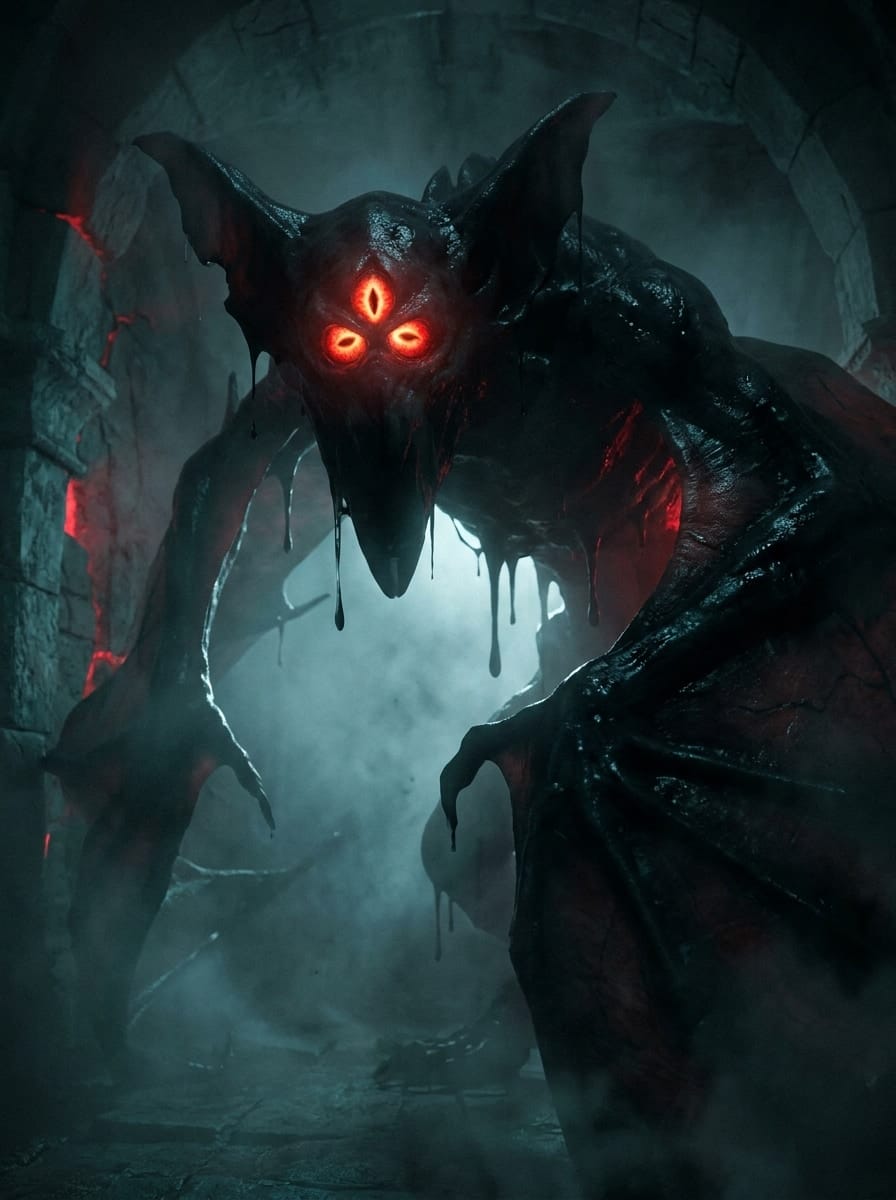
The writer Robert Blake lives in Providence, where he often gazes at an abandoned church on a distant hill—a place the locals carefully avoid. When he enters it, he uncovers the dust-covered remains of a cult and awakens a being that can move only in darkness. At last, during a thunderstorm and a citywide blackout, it comes for him.
Article
Summary
The young writer Robert Blake lives in Providence and often looks from his window toward a black, abandoned church on a far hill. The locals do not like to speak of the place. Their silence only draws him more strongly, until, on a gloomy afternoon, he enters the deserted building. In the church tower he finds old cult records, strange instruments, bones, and a black stone that seems to seize the eye. The papers reveal that a sect once used the stone to look into distant places and to summon a being that could act only in darkness. After Blake leaves, fear spreads among the people near the old church, as though something in the tower has awakened. Back in his room, Blake watches the church spire and studies the records he brought away. He comes to believe that the being fears strong light, but can draw near under cloud, at dusk, and in the night. The surrounding streets keep their lamps burning; rumors and dread spread through the neighborhood. Blake knows that all of it began when he climbed into the tower. On a storm-lashed night, Providence is plunged into a great blackout, and the thing in the old church tower finally leaves its darkness. Blake writes broken notes in his room as he waits for it to come closer. When others find him, he is dead, and only the pages on his desk remain to show that, during the blackout, something from the dark truly came to seek him out.
The Black Spire in the Distance
Robert Blake was a young writer who liked to write strange, cold, unsettling tales. After he came to Providence, he lived in a room from which he could see the western side of the city. By day he sat at his window and worked; when the words failed him, he would look up at the roofs, chimneys, and church spires rising and falling in the distance.
Beyond many rooftops lay a district that seemed older than the rest, as if age had settled on it and never lifted. Its houses crowded the hillside, their brickwork dark, their windows narrow, as though no one had cared to mend them for many years. At the highest point stood an old church, its steeple black and thin, like an iron nail driven into the gray sky.
At first Blake thought only that the place would serve well in a story. But the longer he watched it, the more he sensed a peculiar emptiness around the church. Other streets had carts, pedestrians, children, and the noise of shops. That place seemed to have been deliberately avoided by the city itself. After sunset, the nearby windows lit early; on days when the sky hung low and dim, even the foot traffic in those streets dwindled almost to nothing.
He asked several locals what the church was called and why no one went there. One man frowned and said it had been abandoned long ago. Another told him only that he would do better not to ask. The more they refused to speak, the more Blake wanted to know.
The Shunned Neighborhood
One afternoon, under a sky that promised no clear weather, Blake took his cane and notebook and set out toward the hill.
The farther he walked, the older the streets became. The paving stones were uneven; weeds grew along the walls; paint curled in layers from the porches. Now and then someone glimpsed him through a half-open door, gave him a wary look, and quickly shut it again. An old man sitting on a step saw him going toward the church and quietly urged him to turn back. Blake took it for local superstition, nodded, and continued uphill.
The church door was closed fast. Its boards were heavy, its ironwork black with rust. There were no footprints before it, only dry leaves blown by the wind and gathered on the stone steps. Blake went around the side and found a broken window. With some effort he climbed through; a shard of glass tore his sleeve, and when he dropped inside, dust rose beneath his feet.
Within, it was darker than outside. Rows of pews leaned in rotten disorder. Splintered wood, bird feathers, and fallen plaster littered the floor. The stained glass had long since cracked apart, and the fragments that remained were filmed with dust, so that even the sunlight entering through them became only a few dull patches of color.
Blake raised his flashlight and walked slowly through the church. He saw marks scraped from the walls, and strange stains before the altar, as though secret gatherings had once been held there many years before. It did not feel like a chapel merely left empty. It felt like a place hastily sealed away, then deliberately forgotten by everyone.
Records in the Tower
Behind the altar, Blake found a narrow stairway leading up into the tower. The wooden steps were steep and brittle, creaking dangerously under his weight. He should have gone back, but curiosity seemed to press at his shoulders like an invisible hand, driving him upward.
The tower room was heaped with more debris. Some boxes had broken open, spilling mold-stained papers, old robes, and oddly shaped instruments. Blake turned through the papers and gradually understood that the church had once been occupied by a secret cult. Its members had met there at night, recording names and rites that should never have been preserved, along with rumors of disappearances, deaths, and other terrors.
What troubled Blake most was a dried skeleton lying in the corner. Its clothing had decayed, and its posture suggested a desperate attempt to escape something at the moment of death. Nearby were scrawled words mentioning a thing of darkness worshipped by the cult, mentioning light, and warning that something must not be allowed to leave the tower.
Then he saw the stone.
It had been set within a boxlike frame. Its surface did not shine like an ordinary gem; it was so deep and black that it seemed to drink in all light. Blake turned his flashlight on it. The beam touched the surface and seemed to fall into a bottomless well. He leaned closer, and suddenly felt that shadows were moving within it, as though he were not looking at a stone at all, but into some far-off night.
In that instant, something in the tower seemed to wake.
Blake lurched backward and knocked over a wooden box behind him. Dust billowed up, and from below came the echo of boards trembling. He dared not stay. He snatched up some of the records, thrust them into his pockets, stumbled down the stairs, climbed out through the window, and almost ran from the neighborhood.
Fear Beneath the Light
Back in his room, Blake tried to steady himself. He spread the papers he had taken across his desk and began to decipher the faded writing page by page. The more he read, the colder he felt.
The records said that the cult in the old church had used the black stone to look into remote and unknown places, and through it had summoned a being that belonged wholly to darkness. It could not move under strong light, but by night, in shadow, or wherever lamps had failed, it could draw near to human beings. Many years before, the people of the neighborhood had finally endured no more; they had stormed the church, driven the cult out, and sealed the building. Since then, no one had willingly entered it.
Blake wanted to dismiss the papers as the ravings of madmen. Yet from that day onward, he felt as though the distant spire were watching him.
He began to observe the old church through a telescope. On clear days, all was quiet. The tower stood there like a charred stump. But on cloudy days—especially at that hour of dusk when light had nearly, but not entirely, failed—he often thought he saw something pass behind the tower window. It was not a bird, and it did not resemble a human shadow. It was too swift, too heavy, like a mass of living darkness turning within.
The surrounding streets grew uneasy as well. Blake heard rumors that people on the hill no longer dared to put out their lights at night; if an electric lamp failed, they lit candles at once, and if there were not enough candles, they burned oil lamps. Some said a beating sound came from the direction of the church. Others claimed to have seen an unearthly glimmer in the tower. The police went through the area, but found nothing, and treated it as panic in a poor quarter of the city.
Blake knew otherwise. It had begun when he entered the church.
The Storm Comes
One summer night, a thunderstorm moved over Providence.
Toward evening the sky first turned yellowish, then the clouds piled up in layer after layer, like a heavy lid pressed down over the city. Wind tossed the branches, and the first rumble of thunder sounded in the distance. Blake stood at his window, growing more afraid by the minute. He looked toward the old church and saw the black tower standing before the curtain of rain, its outline clearer than usual.
He turned on every lamp in his room and lit candles as well. His notes lay open on the desk, their edges trembling in the draft. He told himself that as long as the light remained, the thing could not come.
But the thunder drew nearer. The streetlamps flickered, brightening and dimming by turns. Somewhere far off, people shouted, as if warning their neighbors. Blake rushed to the window and saw lights kindling one after another across the hillside district, then wavering in the wind and rain.
Suddenly lightning struck, and the whole city seemed to shudder under the blow.
The lights went out.
The room dropped into darkness, except when lightning from outside briefly whitened the walls. Several of Blake’s candles, too, were snuffed by the wind forcing its way in. He fumbled for matches, but his fingers shook violently. When the next flash came, he saw—or thought he saw—something opening in the black window of the old church tower.
It was no ordinary shadow. Shadows do not leave walls; they do not cross a rain-lashed night toward a human being. Yet Blake saw a mass of darkness detach itself from the tower and move through the storm. With each peal of thunder it came nearer, and with each burst of lightning it vanished for a moment, as though light could drive it back briefly but could not truly destroy it.
The Last Pages
Blake retreated to his desk and seized his pen. He did not know why he was still writing. Perhaps, when there was nothing else left to do, the act of setting down what he saw was the only proof he could leave behind.
He wrote of the blackout, the tower, the thing leaving the church. His sentences came in fragments, his hand growing wilder across the page. Outside, others were screaming too; the whole street seemed to have awakened inside the same nightmare. Some people opened windows and shouted. Some ran. Some tried to relight their lamps. But the storm still roared overhead, and broad stretches of the city remained sunk in darkness.
Blake felt it coming closer.
He dared not look out the window, yet he could not stop himself from raising his head. Rain struck the glass, and the frame shook in the wind. For one instant lightning flooded the room with a ghastly white glare, and he seemed to see a vast black shape pressed close against the window. In the next instant the light was gone, and the room held only the sound of his own breathing.
When people later reached Blake’s room, the storm had passed. The electric lights had come back on, and the city seemed to be waking from a long dream. The window stood open; papers were scattered across the desk; the pen lay on the floor. Robert Blake was dead beside his chair, his face still marked by extreme terror.
The doctors could not explain his death. The police found no sign of an intruder. Only those few pages remained on the desk, speaking of darkness, the tower, the thunder, and something drawing nearer and nearer.
The old church still stood on its distant hill. By daylight it was only an abandoned building in the city. Yet many people in Providence feared blackout nights more deeply from that time on. Whenever the clouds sank low and thunder began to roll, someone would remember the young writer, the black spire he had watched, and the hunter that had come out of the dark to find him.