Cthulhu Mythos
The Thing on the Doorstep — Cthulhu Mythos
Daniel Upton first believed that his friend Edward Derby had been broken by marriage and a strange illness. Only later did he understand that the thing drawing near his doorstep was not merely a dead body, but a sorcery that stole bodies and identities. In the end, he shot his friend's body dead, because his friend was no longer inside it.
Article
Summary
Daniel Upton and Edward Derby had known each other since childhood. Derby was brilliant and sensitive, gifted in poetry and scholarship, yet timid, inward-turning, and dependent on others. Even as a grown man, he seemed to need the care one gives a child. Then he met Asenath Waite of Innsmouth, and was quickly drawn in by her learning, her force of will, and her air of secrecy. Asenath's father, Ephraim Waite, had been notorious in life for sorcery and forbidden books. Rumor said he knew how to send his mind into another person's body. After Derby's marriage, terror and strange lapses began to overtake him. He claimed that Asenath could drive him out of his own body, and that she herself was not truly Asenath at all, but Ephraim prolonging his life in his daughter's flesh. For a time, Derby said Asenath had gone away. But his mind soon broke down again, and he was placed in a sanitarium. When Upton visited him there, he saw that his friend's body sometimes seemed to hold Derby, and sometimes showed a cold, practiced, wholly alien expression. The real Derby appeared to be slowly forced out of his own flesh. One night, a nearly shapeless, decaying thing crawled to Upton's doorstep and delivered Derby's final letter. The letter revealed that Derby's mind had been trapped in Asenath's ruined body, while Ephraim had taken possession of Derby's. After reading the truth, Upton went to the sanitarium and fired upon his friend's body, because he knew his friend was no longer the one within it.
The Man Who Had Always Been Protected
Daniel Upton would later feel compelled to explain one thing before all else: the man he shot did, in outward appearance, have the face and body of his friend Edward Derby. But at that moment, Derby was no longer inside.
Upton and Derby had grown up together. Derby came from a comfortable household, and his parents guarded him closely. They kept him from cold, from fright, and from wandering too far alone. While other children wrestled in the mud or chased one another along the riverbank, Derby was often indoors with his books. His health was weak and his courage weaker, but his mind was remarkably sharp. While still very young, he wrote strange poems and took delight in old legends, shadowed tales, and books that made sensible adults frown.
Upton was steadier by nature, and often watched over him like an older brother. If Derby feared a dark road, Upton walked beside him. If Derby's own imagination kept him from sleep, Upton listened until the terror had spent itself in words. Later, when both had become men, Upton built a career and a family, while Derby still seemed never to have fully left childhood behind. He knew a great deal from books, but very little about dealing with living people.
Derby entered Miskatonic University, where he read, wrote, and studied the occult. His name became known in certain small circles. Some praised his poetry; others said he was too deeply absorbed in dark knowledge. Upton paid little attention to such talk. He had known Derby that way since boyhood, always shutting himself in his study, always speaking of odd dreams and stranger phrases. As long as his friend was alive and unharmed, Upton saw no reason for alarm.
Then Derby met Asenath Waite.
The Woman from Innsmouth
Asenath came from Innsmouth, a town with an ill name along the coast. People lowered their voices when they mentioned it, as if its old houses, sea-fogs, and the look in its inhabitants' eyes all carried some unclean secret.
Her father was Ephraim Waite, an old man who had lived for years in isolation and had left behind a strange reputation. Some said he knew witchcraft. Some said he had studied forbidden books no one ought to open. Others whispered that he could send his consciousness into another body. Such stories sounded like foolish gossip, and Upton did not want to believe them. Yet when he first saw Asenath, he understood why Derby had been captured by her.
Asenath possessed a hard, commanding intelligence. She spoke little, but always seemed to be weighing those around her. When she looked at Derby, it was not quite the gaze of a young woman looking at her lover. It was more like the gaze of someone experienced examining a thing that might be useful. Derby, however, was utterly ensnared. He believed she understood him, that she could speak with him about hidden learning, ancient rites, and forbidden books. Before long, he married her.
After the wedding, Derby moved into the life Asenath arranged for him. At first, he still wrote to Upton, saying he had at last found the companion of his soul. But gradually the letters grew fewer, and their tone changed. At times he was suddenly exhilarated, saying Asenath knew things ordinary people could not imagine. At other times he wrote like a frightened child, setting down confused lines about how he was "not always able to remain in his own body."
Upton felt a chill when he read those words. He went to see Derby and found his friend pale, evasive, and shaken. Asenath sat nearby, listening calmly while the two men spoke. Now and then she added a quiet sentence, and Derby at once fell silent, as though an invisible hand had tightened around his throat.
The Exchange That Was Not a Dream
Over the years, Derby grew less and less like himself.
Sometimes he would vanish from the country near Arkham, only to be found days later with disordered clothes and a dazed expression, as if he had just awakened from a nightmare. Once he came rushing to Upton, his face gray-white and his fingers trembling without pause. He said Asenath could drive him out of his own body, imprison him inside hers, and then use his body to go about her own affairs.
Upton was horrified, but he still tried to explain it as illness. Derby had always been fragile in his nerves, and he had steeped himself in dreadful books; perhaps his wife and his imaginings had simply crushed him. But Derby's account was too precise to dismiss. He said that when he awoke, he would find his hands grown slender and women's clothing against his skin. He would hear his own voice speaking from across the room, and that voice would carry Asenath's cold amusement. He said, too, that Asenath was not Asenath.
The one truly hidden in that body was her father, Ephraim.
The idea was so terrible that Upton could not accept it at first. Ephraim had long been dead, and his body had been buried. But Derby said the old man had completed the most dreadful exchange before death came. He had cast aside his aged body and moved himself into his daughter. As for the true Asenath, she had been crushed, driven out, or left to perish in some darkness no one knew.
If this was true, Derby had not married a young woman at all, but an old sorcerer wearing his daughter's form. And now Ephraim had fixed his desire on Derby's body. Derby was young, healthier, and better able to move through the scholarly circles of Arkham. If the final exchange succeeded, Derby would be trapped forever in a failing body that had never belonged to him.
Upton did not dare believe it. Yet he could no longer simply persuade himself it was madness.
The Vanished Wife
Then, suddenly, matters changed.
Derby told Upton that he had finally escaped Asenath. His explanation was vague. She had gone away, he said, and would never return. Upton saw a sickly kind of relief in his face, like that of a man who has climbed out of a deep well but still cannot bear to look back down.
Asenath had indeed disappeared. No one knew where she had gone. Derby returned to his own house, set his study in order, burned certain papers, and hid away old letters. He tried to resume his former life, but that relief did not last.
Soon he was afraid again. He feared footsteps outside the door, telephone calls in the night, and certain familiar handwriting. He told Upton that the enemy had not truly died. A body could be damaged; it could be put into the earth. But someone who knew that art would seek another way at the final moment.
Upton thought his friend was close to madness. The doctors thought so as well. Derby was lucid at times and raving at others. Sometimes he seemed himself; sometimes his speech turned hard and alien, as though another and much older mind were seated inside the body.
At last Derby was taken to a sanitarium. When Upton visited him, his friend looked at him through the light of the sickroom with spasms of expression crossing his face. For a moment he was Derby himself, begging Upton to save him. The next moment he became sullen and arrogant, and a look rose in his eyes that did not belong to Derby at all.
When Upton left, his heart felt as heavy as stone.
The Visitor on the Doorstep
One night, Upton heard a sound outside his house.
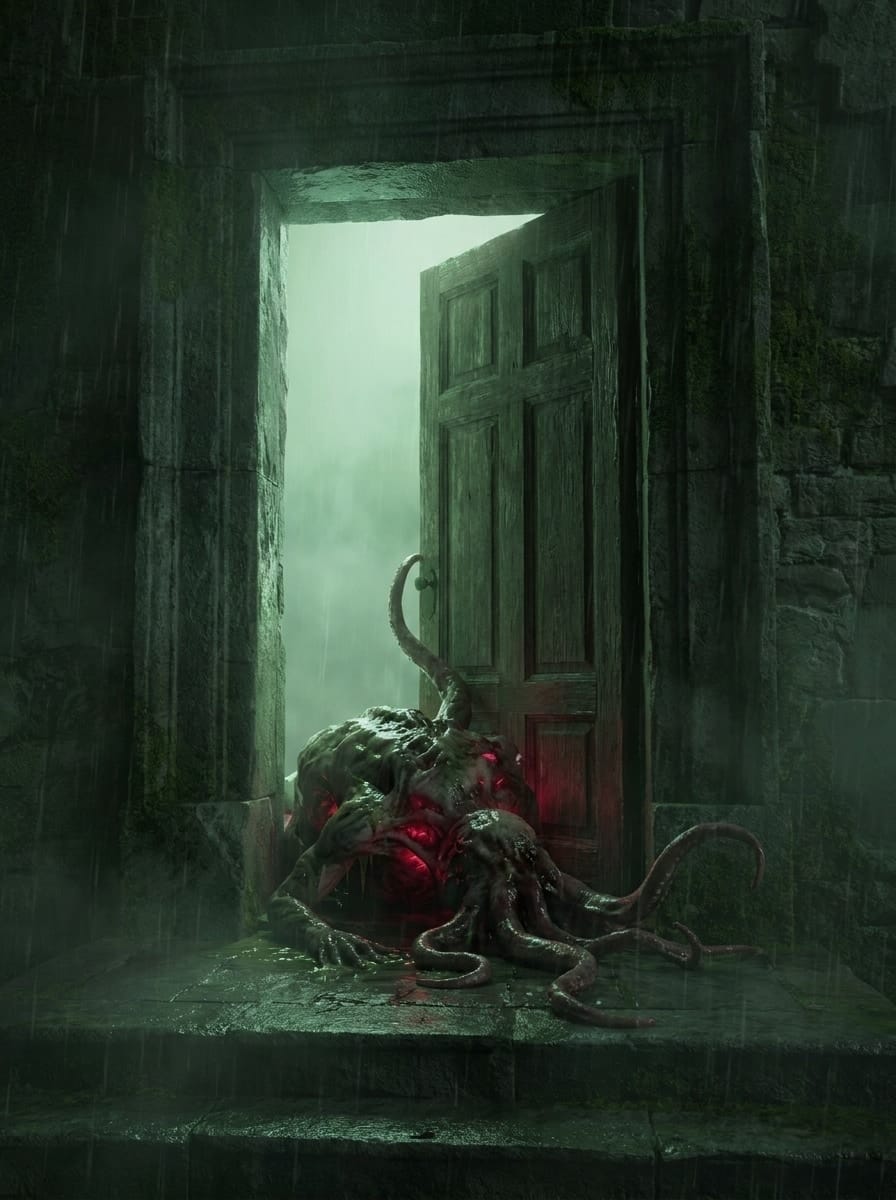
It was faint, but slow and dragging, as if something were laboring up the steps. He opened the door, and cold air swept in. On the doorstep lay a figure almost beyond recognition. It wore ragged clothing, and it carried the smell of grave-earth and decay. Its flesh had been so ruined that it scarcely seemed human. Upton nearly recoiled in terror, yet the thing was not quite dead.
With the last of its strength, it handed him a letter, or rather pushed it toward him.
Upton recognized certain traces. The broken outline of that body belonged to Asenath Waite, missing for so long. But the manner of the writing, the form of address, and the desperate urgency belonged to Edward Derby.
The letter made everything clear. Derby had not truly escaped his enemy. Ephraim, using Asenath's body, had invaded him again and again, and at last had found a way to complete the exchange. Derby's consciousness had been thrust into that already damaged and hidden body, while Ephraim occupied Derby's flesh and waited in the sanitarium for his chance. The collapsing shell on the doorstep contained Derby's final cry for help.
As Upton read, his fingers went cold. He understood at last that the man in the sanitarium, the one with Derby's face, was not his friend. It was a thing that had crawled out of Innsmouth's old houses, forbidden books, and witchcraft: Ephraim Waite wearing a new borrowed shell.
The thing on the doorstep did not endure much longer. It had brought the truth into Upton's hands, as though finishing the last task left to it.
Six Bullets
Upton hesitated no longer.
He took his pistol and went to the sanitarium. Derby's body was still there in the room. That face had shared his childhood, had spoken with him under lamplight about poetry, had turned to him in terror for help. But when the man raised his eyes, Upton did not see his friend's weakness or fear. He saw an ancient and freezing malice.
The thing may have wanted to speak. It may have meant to deceive him with Derby's voice. Upton gave it no chance.
He fired, shot after shot, until the borrowed face could no longer move. Afterward, people knew only that Daniel Upton had killed his friend Edward Derby. The law could question him, doctors could judge him, and bystanders could call him insane. But Upton knew he had not killed Derby.
The true Derby had crawled to his door in a rotting body and given him the final truth.
From that night on, the doorstep remained in Upton's memory. It proved that some witchcraft was more than rumor, and that certain bloodlines and old names concealed things harder to escape than death. A body could be stolen, a voice could be borrowed, and even a familiar face could lie. Only the letter brought out of the dark preserved the last name that still belonged to Edward Derby.