Cthulhu Mythos
The Whisperer in Darkness — Cthulhu Mythos
After the Vermont floods, Miskatonic University lecturer Albert N. Wilmarth tries to explain the strange rumors as nothing more than folklore. But letters from the secluded scholar Henry Wentworth Akeley, along with photographs, recordings, and black stone evidence, gradually convince him that the Mi-Go from Yuggoth haunt the mountains. When he finally goes to Akeley’s farmhouse himself, he learns that the true horror is not a monster appearing in the flesh, but the question of how much can remain of a man and still call itself alive.
Article
Summary
Albert N. Wilmarth, a lecturer at Miskatonic University, first treats the mountain rumors that follow the Vermont floods as no more than rural legend. He assumes the reports of strange beings are born of local superstition and post-disaster panic. Then Henry Wentworth Akeley, a reclusive scholar living in the hills, begins writing to him, insisting that something nonhuman truly moves among the mountains and sending photographs, recordings, and a black stone as proof. As their correspondence deepens, Wilmarth can no longer dismiss the evidence with ordinary explanations. The beings Akeley describes are identified as the Mi-Go from Yuggoth, hidden in the mountains of Vermont and engaged in terrible dealings with humankind. The more proof arrives, the more Wilmarth’s skepticism gives way to dread, until at last he decides to go in person to Akeley’s farmhouse and discover the truth for himself. When he arrives, the surface seems calm. Akeley is there, and the immediate danger appears to have passed. Yet the air, the conversation, and the smallest details all feel wrong. The horror, he realizes, is not a creature openly revealed, but the possibility that the man before him is no longer a man in any complete sense. Wilmarth escapes the farmhouse with his sanity strained and his terror deepened. The stories after the floods are no longer merely folklore to him, but a darkness he has touched with his own hands: bodies, voices, and identities can all be stripped away, leaving behind only something unbearable.
Rumors After the Flood
After the great Vermont floods, the newspapers were filled not only with accounts of damage, rescue work, and the missing, but also with a few strange little notices.
Some people in the mountain valleys claimed that, when the water rushed down from places no one ever went, it carried with it things that were neither human nor any local beast. They were about the length of a man, pale pink in color, with bodies like shells, thin wings, and many jointed limbs; where the head should have been there was an oval mass covered with tiny feelers.
At the time, Albert N. Wilmarth was teaching literature at Miskatonic University in Arkham, and also studying New England folklore. A friend brought him the clippings and asked for an explanation. He saw nothing mysterious in them. Floods wash out corpses and livestock; frightened country people add old stories to whatever lies before their eyes; and so bloated, twisted remains become mountain monsters.
The old Vermont legends offered plenty of ready-made shadows. Mountain folk had long spoken of a hidden race that flew through remote peaks and valleys, leaving tracks impossible to read, blocking caves, and mimicking human speech in a voice like a swarm of bees. Indian tradition, too, described them as “the winged ones” from the region of the Great Bear, coming to the mountains of Earth to quarry some unknown stone and carry the cargo back beneath the northern stars.
Wilmarth gathered these materials into an article and treated the flood rumors as nothing more than a revival of old folklore. But once his skeptical views were reprinted in the papers, someone in Vermont wrote to him.
The writer was Henry Wentworth Akeley, who lived in an old farmhouse on the south side of Dark Mountain, near the village of Townsend.
Akeley’s Evidence
Akeley was not a man easily frightened by stories. He was educated, and had studied mathematics, astronomy, biology, anthropology, and folklore. He knew very well that tales of hidden races were found all over the world. For that very reason, his letters were not easy for Wilmarth to dismiss.
He wrote that the things in question were no illusion of the floods. They truly moved in the mountains. He had seen tracks, heard voices in the woods, and knew that something always came near his house at night. The servants would not stay. The dogs barked through the dark hours. The country people kept their distance.
Then Akeley sent photographs.
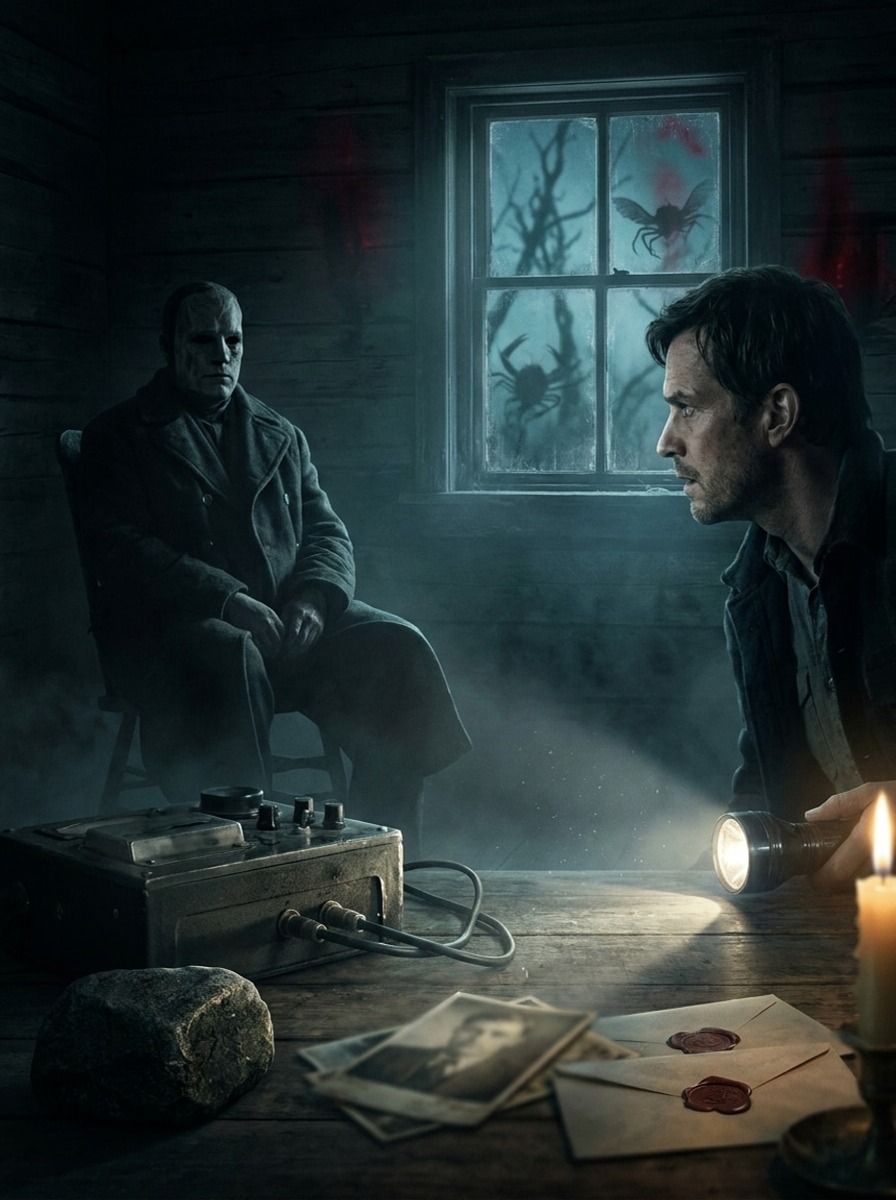
One showed footprints in the mud. They were unlike those of any ordinary animal: a padded center with paired serrated claws at either side, and no clear distinction between front and back. Another showed a black stone found in the woods of Round Hill, carved with symbols no civilized hand should have made. Wilmarth knew certain designs from the Necronomicon, and when he saw similar sign-like marks in the photograph, he felt cold for the first time.
Even worse was a recording.
Akeley said it had captured a sound made years earlier near a sealed cave on the western slope of Dark Mountain. The cylinder began with a learned man reciting a strange rite, and then another voice answered. It was not human, and yet it could speak human language. It was like the humming of a gigantic insect’s wings forced into words; every syllable was clear, but there was no warmth in it that belonged to a human throat.
The cylinder named Cthulhu, Tsathoggua, Nyarlathotep, Azathoth, Yuggoth, and the Black Goat of the Woods. The learning Wilmarth had once used to explain folklore became, instead, the thread that tied those names together. His letters with Akeley grew more and more intimate, and they began to discuss whether the mountain outsiders might indeed be the Mi-Go of legend, and whether they were connected to the terrors said to inhabit the Himalayas under the same name.
Besieged Beneath Dark Mountain
The correspondence continued into summer, and Akeley’s situation grew worse.
He tried to send the black stone to Arkham, but the parcel vanished en route. A station clerk remembered only a sandy-haired countryman with a strange voice asking after a heavy crate, and said he himself had felt oddly dulled, almost hypnotized, while speaking to him. Wilmarth pursued the matter everywhere and found nothing.
After that, Akeley’s letters turned frantic. He wrote of gunshots around the house at night, of dogs and those other things fighting in the yard, on the roof, and along the road. In the morning he found blood on the grass, and pools of foul green slime. Telephone wires were cut, obstacles had been set up on the roads, and suspicious human footprints—Walter Brown’s among them—often mingled with the claw marks.
In one letter he said the dogs had dragged back part of a dead creature. He saw it and touched it himself, yet after a few hours in the shed it seemed to vanish as if it had evaporated, leaving nothing at all in the photographs. From this he became even more certain that the substance of the outsiders was unlike earthly life, and that ordinary cameras could not hold them.
He also wrote that the voices in the hills had at last spoken to him directly. They did not want merely to kill him; they wanted to take him away, to Yuggoth and perhaps even farther out among the stars. And the manner of that taking might not be to drag off the whole body, but to preserve whatever part of him could still be called, in theory, alive.
The more Wilmarth read, the more uneasy he became. He urged Akeley to seek help in Brattleboro, or to let him come with the evidence himself. Then Akeley’s tone changed all at once.
The new letter had been typed. It was calm, neat, and utterly unlike the earlier pages of fear. It said that he had finally understood the outsiders meant no harm. They merely wished human beings to stop spying and destroying, and were willing to let a few learned men know the truth of the universe. They came from Yuggoth, a dark planet still undiscovered at the edge of the solar system. Their biology, chemistry, surgery, and machinery were far beyond anything human beings possessed, and they could even remove a person’s brain from the body and keep it alive in a metal cylinder, still able to see, hear, and speak as it crossed the void of space.
Akeley invited Wilmarth to Vermont with the letters, photographs, and recordings. Everything, he said, was now settled peacefully, and the farmhouse was no longer under siege. They could speak in detail the next day.
Wilmarth was far from reassured, but he set out anyway.
The Silent Farmhouse
When he reached Brattleboro, the man waiting to meet him was not Akeley, but someone calling himself Noyes.
Noyes was neatly dressed and spoke gently. He explained that Akeley had suffered an asthma attack and could not come out. The car carried Wilmarth past the West River, old bridges, abandoned railway lines, and deeper and deeper into the Vermont hills. Wilmarth remembered that after the floods, people had seen those floating things in the West River itself, and his uneasiness only deepened.
Akeley’s white farmhouse stood below the slope of Dark Mountain. Noyes left him at the door and drove away. Wilmarth paused beside the road and looked down: in the dust were several fresh claw prints, exactly like those in the photographs.
What struck him next was the silence.
There were no dogs barking, no chickens, no livestock sounds of any kind. A mountain farm of that sort seemed emptied of every ordinary living thing. Wilmarth went in and, as Noyes had told him, entered the study on the left. The curtains were drawn. The room was dim and carried an indescribable odor, and there was a faint vibration in the air itself.
Akeley sat in a large chair in the corner. His face and hands were pale in the gloom, his head and neck wrapped in a yellow scarf, his feet bound in thick bandages. He did not rise, but greeted Wilmarth in a low voice. It was the whisper of an invalid, yet it carried an unnatural force; his beard hid his mouth, so Wilmarth could not even tell whether his lips were truly moving.
He spoke of the black city on Yuggoth, of windowless towers and fungus gardens, of the way the Mi-Go flew through the void where there is neither air nor temperature, and of how they had come to Earth long before mankind and knew the truth of R’lyeh before it sank. He added that beneath the earth were Quyan with their blue light, the red-lit Yoth, and dark N’Kai, and that many ancient names of terror could be given more exact and more dreadful meaning through those hidden worlds.
The more Wilmarth heard, the more the man before him seemed at once pitiful and revolting. The face was too rigid, the hands too weak, the voice too unnatural. Yet he forced himself to remain.
The Voice in the Cylinder
After night had fallen, Akeley pointed to a row of metal cylinders on a shelf.
They were about a foot high, each with three sockets. Some were connected to lenses, boxes, and metal disks. Akeley said that each cylinder preserved a brain detached from its body: human brains, brains of fungus-like beings too strange for ordinary travel, and even entities from far more distant worlds.
He told Wilmarth to take down the cylinder marked B-67 and connect it to three machines, then switch them on.
The machines rattled and hummed, and then a clear mechanical voice sounded. It claimed to be human as well, its body safely preserved in Round Hill while its brain spoke through the cylinder. It said it had already crossed many worlds in this way, and was preparing to depart again with Akeley. It even urged Wilmarth, kindly and without threat, to accept the invitation, for such travel brought no pain and opened the sight to regions of the universe mankind had never imagined.
Then it mentioned Noyes.
It said Noyes had long since been one of them, and that Wilmarth should already have recognized his voice from the recording.
At that instant Wilmarth understood: the man who had driven him there was very likely the same human voice that had once led the rite on the cylinder. The gentle voice that had seemed vaguely familiar was no accident.
When the conversation ended, Akeley told him to go upstairs and rest. Wilmarth took a lamp and left the study, but he could not sleep. There was no animal sound in the house; outside was Dark Mountain; below him were the cylinders, the machinery, and Akeley whispering in the dark. Before dawn, he knew, he would have to leave.
What Sat in the Chair
He did not know how long had passed when he woke to hear many voices in the room below.
Two of them were that unforgettable buzzing of the outsiders. Another was the cold metallic voice of the brain in the cylinder. There were human voices too, one of them Noyes’s. And beneath them all came movement, scraping, and a fluttering as of wings, as though the study were full of guests who were not human at all.
He could not catch the conversation whole, only fragments: Akeley, Wilmarth, records and letters, a new cylinder, Noyes’s car. The broken words explained nothing, yet they told him that some design had come to completion, and that both he and Akeley were caught within it.
At last the sounds dwindled. The car drove away. The house went still. Wilmarth took up his revolver, flashlight, and luggage and went downstairs. He first opened the sitting room and saw Noyes asleep on the sofa, not Akeley. So he stepped back quietly, crossed the hall, and entered the study.
On the table stood a new cylinder fitted with vision and hearing devices, beside a speaking machine. Wilmarth saw that it was bright and fresh, and that Akeley’s name was written on it. Earlier in the day, Akeley had told him not to touch it.
The corner chair was empty.
A familiar robe hung from it to the floor, and the yellow scarf and thick bandages lay nearby. The odd smell and the vibration in the air were gone. Wilmarth swept the room with his flashlight, knowing he should leave at once, yet he still turned the beam back to the chair.
Three things sat there.
They were not bloody, and they were not monstrous in shape. But because they were so exact, so real, the horror struck deeper than any visible deformity could have done. They were Henry Wentworth Akeley’s face and hands, down to the smallest texture, as though taken cleanly from the living man. Beside them lay the metal clamps used to hold them in place.
Wilmarth remembered the whispering in the dark, the rigid face, the weak hands, the new cylinder marked with Akeley’s name, and the painless surgery described so calmly.
He asked no more questions.
He choked back his cry, ran from the study and the farmhouse, and fled in the old Ford in the shed, driving into the moonless night along the mountain road. When the authorities later investigated, they found only bullet holes, scattered clothing, and the missing livestock; there were no cylinders, no machines, no strange odor, and no face or hands.
Akeley vanished from the world.
Many said Wilmarth had been frightened into imagining everything, turning trickery and hallucination into truth. At times he half wished he could believe that himself. But Noyes was never identified, and the local people still remembered strange sounds, claw marks, and disappearances around Dark Mountain and Round Hill. And when mankind later discovered a new planet beyond Neptune and named it Pluto, Wilmarth could only think of Yuggoth, as Akeley had described it in his letters.
He never saw the monster at the end.
But it was precisely because he never saw it that the truth became harder to escape. The whispering voice in the dark may already have ceased to be Akeley; and the real Akeley may have been sealed inside that new cylinder, waiting to be carried away among the stars.