Cthulhu Mythos
The Dunwich Horror — Cthulhu Mythos
In the valley of Dunwich, the Whateley family used forbidden books and secret rites to raise a child that should never have entered the human world. After Wilbur Whateley died in the library of Miskatonic University, the other horror hidden in his house broke loose at last, forcing scholars from Arkham to hurry into the hills and stop a disaster.
Article
Summary
Dunwich was a remote village among the Massachusetts hills, a place of leaning houses, damp ravines, and rumors the locals had guarded for generations without willingly naming them. Lavinia Whateley suddenly gave birth to a boy, Wilbur, though no one knew who his father was. The child grew with unnatural speed, and neither his gaze nor his voice seemed wholly human. Old Whateley, meanwhile, taught him from the Necronomicon and led him in night rituals on the hilltops. Year by year Wilbur grew taller, while the Whateley house was altered again and again, as if space were being made for some vast unseen lodger. Cattle were bought in large numbers, only to sicken and vanish. At night, heavy sounds came from inside the house. Before Old Whateley died, he warned Wilbur that he must find the complete copy of the Necronomicon kept at Miskatonic University. Wilbur broke into the library by night to steal the book, but a guard dog attacked and killed him. His corpse revealed a lower body that was not human. From Wilbur's notes, Dr. Armitage understood that the Whateleys had hidden an even more terrible offspring at home. After Wilbur's death, that being burst from the old house. Because it was invisible, the villagers could not see it, only the ruin it left on hillsides, trees, barns, and livestock. Armitage and his companions came to Dunwich, used a powder to reveal the monster's outline, and recited a spell on the hilltop to banish it. In its final cry, the creature spoke almost like a human being, revealing that it shared Wilbur's origin, though it was far closer to their nonhuman father. Dunwich was saved, but its people knew from then on that the horror had been raised, little by little, inside the Whateley house.
The Whateley House in the Valley
West of Arkham, beyond bare slopes and broken stone walls, the road winds into a place called Dunwich. It is not like the towns beyond the hills. Its houses stand far apart at the feet of the ridges, many with roofs half fallen in and windows filmed year after year with dust. Streams run under dark roots, and at night the whippoorwills cry from the heights, sharp and frantic, as if urging something to wake.
The people of Dunwich rarely cared to speak of the Whateleys.
The Whateley house stood beside a waste stretch of ground, its boards blackened by weather, its cattle shed often troubled by strange noises. Old Whateley was very aged, with a wild beard and a staff always in his hand. He knew charms that frightened country folk, and he kept old books that should not have been opened lightly. His daughter Lavinia lived with him, a thin, pale-haired woman who wandered alone over the hillsides, muttering words no neighbor understood.
One winter, Lavinia gave birth to a boy.
No one in the village knew who the father was. Some said that on the night before the child's birth, flames had been seen on the hilltop, the cattle had thrashed in their stalls, and the dogs had crouched beneath the doorsteps, too terrified to come out. Others said Lavinia had once boasted that her child would one day know things ordinary people could never learn. The tales passed from mouth to mouth until little remained of them but fear.
The child was named Wilbur Whateley.
From the beginning, he was not like other children. While other infants were still crying in their cradles, he already stared at people with the fixed attention of someone older. Soon he could stand, walk, and speak. Neighbors who glimpsed him from a distance felt that his body was growing far too quickly, while his face held none of a child's softness. His ears were pointed, his lips thick, his skin of an unhealthy, dusky cast. More troubling still, he always wore clothes that wrapped him tightly from neck to ankle, even in warm weather.
Old Whateley, however, was pleased. He took Wilbur indoors and taught him his letters, then set him to studying cracked and yellowed pages. Long after midnight, light would still leak through the cracks of the Whateley windows, and low chanting could be heard within. When villagers passed the waste ground, they quickened their steps, for from the cattle shed came sounds as if something huge were shifting there, making the boards groan under its weight.
Voices on the Hilltop
Wilbur grew taller with every year. Before he was old enough for an ordinary child to go to school, he already had the build of a youth. By the time he reached his true adolescence, many grown men in the village had to tilt their heads back to look at him. He spoke little, and when he bought supplies he said only what was necessary. Yet he often went into town for Old Whateley, purchasing cattle, lumber, strange powders, and uncommon instruments.
The cattle never lasted long. After they were brought to the Whateley place, they quickly wasted away. On the rare occasions when villagers saw the herd, they noticed odd wounds on the animals, as if something had drawn the strength and blood out of them. Stranger still, though the Whateleys bought many head of cattle, the number in the yard never seemed to increase. At night the low bellowing from the shed grew deeper, as though it came from more than one throat.
Old Whateley began to rebuild the house. He and Wilbur tore out partitions, opened floors, and braced the walls with heavy beams, as if making room for something that was still growing. The villagers watched from afar and dared not ask questions. The Whateley door was always locked, and the windows were covered tight with boards.
More than once, lights appeared at night on the Dunwich hills. Wilbur and Old Whateley stood among circular heaps of stone, raising their arms and crying out to an unseen sky. Whippoorwills circled above them, their calls rising and falling. Down in the valley, every dog began to bark at once, then fell suddenly silent, as if choked.
At last Old Whateley, too old to endure much longer, took to his bed.
Before he died, he called Wilbur close. His voice was so faint it could hardly be heard. Wilbur bent his towering body down to the old man's cracked lips. The old man told him that the gate had not yet been opened, that the words were not yet complete, and that the work must not stop. He spoke, too, of the Necronomicon kept in Arkham at Miskatonic University, saying that there lay the complete passage Wilbur needed.
Soon afterward Old Whateley died. When the people of Dunwich came to bury him, they saw Wilbur standing aside with no grief on his face, only a kind of urgency. Lavinia, after that, gradually disappeared. Some said she had gone into the hills and never returned. Others heard her crying at night, but no one dared search for her.
In the old Whateley house, only Wilbur and the hidden thing remained.
The Body in the Library
Wilbur began to travel often to Arkham.
In the library of Miskatonic University there was a rare and dangerous copy of the Necronomicon. Wilbur came there in a loose black coat, his hat brim pulled low. He asked to consult the book, turned to the passages he wanted, and copied them carefully. But certain pages were too important. The library would not let him remove the volume, nor would it allow him to keep it to himself for long.
Wilbur was not satisfied. He knew that his own copy lacked the crucial parts. Without those pages, he could not complete what Old Whateley had ordered from his deathbed, nor could he truly open the unseen gate.
Dr. Henry Armitage of the university noticed him.
Armitage had seen many strange books and read many dangerous lines, yet when he saw what Wilbur was copying, his heart sank. The sentences spoke of beings outside the human world, of the Great Old Ones, and of forces that could cross space and come down upon the earth. Armitage refused to give the book to Wilbur. Quietly, he wrote to other libraries as well, warning them not to let the young man from Dunwich near the same volume.
Wilbur seemed to leave. That night, he came back.
Late in the dark hours, the library dog began to howl and rage. Then came crashes from inside the building, the sound of tearing, and a scream that was not like a human scream. When the watchman arrived, he found the door forced, blood on the floor, and the dog wounded. There, on the boards, lay Wilbur Whateley.
His clothes had been ripped open. The secret they had hidden for years was exposed at last: his body was not wholly human, and below the waist he was shaped in a way that nearly unmanned those who saw it. He seemed to have been joined together from humanity and something far stranger, bearing traits that should never have belonged to any creature on earth.
Wilbur was not quite dead. In a hoarse voice, he uttered several words no outsider understood, as if calling to something far away. Then his body began to change, collapsing, slackening, spoiling, and giving off a sickening odor. Before long, only a remnant remained on the floor, dreadful to look at.
When Dr. Armitage arrived, he stood silent for a long time. He understood that Wilbur was dead, but the affair was not over. The notes, the spells, and all the strange doings at the Whateley place pointed to one answer: in the old house at Dunwich, there was another being, far more terrible.
The Invisible Thing Comes Down
Not long after Wilbur's death, disaster came to Dunwich.
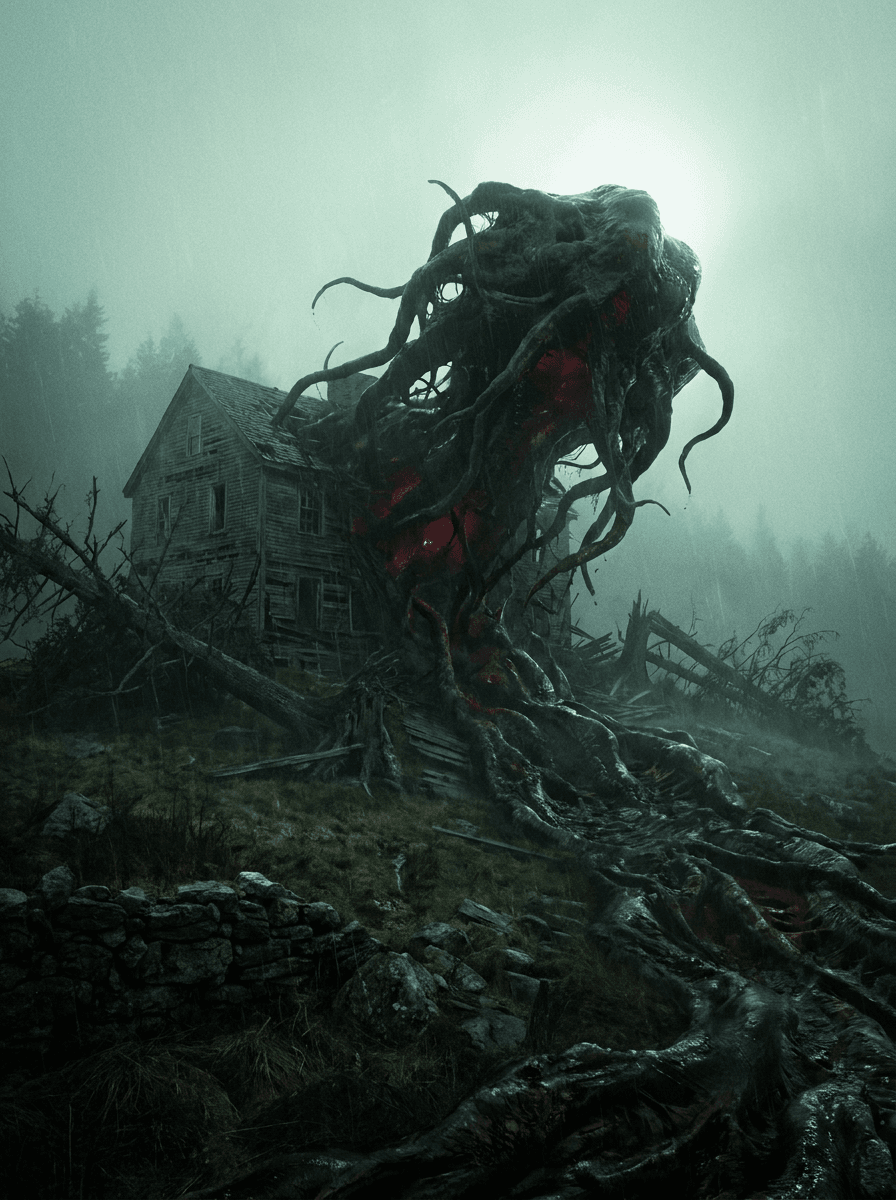
The Whateley house first gave out a tremendous noise in the night, as if some gigantic body had smashed through walls and beams. The next day, people saw that half the old place had collapsed, boards strewn everywhere. Across the waste ground lay enormous tracks. Grass had been crushed flat and branches snapped, but no one could see what had made the marks.
The thing was invisible.
It came out of the ruins of the Whateley house and moved along the slope. Wherever it passed, the ground sagged, and trees toppled as if pushed by unseen hands. Cattle and sheep were torn open, sheds crushed, and wet smears were left on the walls of certain homes. Villagers hid indoors, listening to heavy breathing and muffled cries outside, unable to see where the enemy stood.
Panic seized Dunwich. Some tried to flee, but when they saw roadside trees falling one after another, they retreated back inside. Others fired guns toward the sound, yet the bullets seemed to vanish into empty air. Above the valley, the whippoorwills screamed as though carrying messages for the thing.
By the time the news reached Arkham, Dr. Armitage was ready.
He came to Dunwich with two companions. They had not come to hunt an ordinary beast, and so they brought not only field glasses, powder, and instruments, but also copied spells. Armitage knew that the thing had the same source as Wilbur, yet was closer than Wilbur to its true paternal line. It had been shut inside the Whateley house for years and fed on cattle as it grew. Now Wilbur was dead, and the house could no longer hold it. It had come down from the hills seeking an outlet, or perhaps seeking what had been promised to it.
The three scholars followed the traces upward. Beside the path, shrubs had been pressed into mud, stone walls had been trampled flat, and the air held a sharp, foul smell. The unseen weight moved somewhere nearby, now and then breathing with a damp, heavy sound. Villagers followed at a distance, afraid to come closer, able only to watch the figures climbing against the gray sky.
The Spell on the Hilltop
At last Armitage and his companions found where the thing was.
They still could not see its full shape. They could only guess its enormity from the flattened grass, the leaning bushes, and the distortion in the air. It seemed to be moving toward an ancient stone circle, the place where Wilbur and Old Whateley had performed their rites, and from which many of the strange noises had once come.
Wind swept over the pass, lifting broken grass and dust. Armitage steadied himself, took out the powder he had prepared, and flung it toward the empty space. The powder did not fall at once. It clung instead to a colossal outline. For the first time, the others saw something of its form: not an ordinary beast, not a complete human shape, but a vast, deformed, grotesque body that reason could find no place for. Its edges shivered in the light, as if too many parts not meant for earth had been crowded together.
The monster sensed that it had been revealed and roared until the hillside shook. Far below, villagers heard the sound and dropped to their knees in terror. It struggled, trying to rush downhill, or perhaps toward some farther and higher place. But Armitage had already begun to recite the spell.
It was not a language meant for ordinary ears. The words came hard and fast, like flakes of stone pried from an ancient page. His two companions stood beside him, following the order of the rite step by step. The air grew heavy, and the hilltop seemed pressed down by an invisible hand. The monster's outline twisted violently; turf tore open, and earth and stones flew.
At the final moment, it gave a cry almost like human speech.
The voice came broken and full of pain, like an abandoned child calling for its father. Someone below understood enough of it to go white with terror. Only then did the people grasp that Wilbur Whateley had not been the Whateley family's only offspring. The thing hidden in the house was his twin brother, less human than he, and nearer to the place to which it truly belonged.
Armitage did not stop.
When the spell was finished, a terrible convulsion burst across the hilltop. The invisible bulk seemed to be torn bodily out of the world. Its outline swelled, collapsed, and then vanished into the air. Wind moved over the slope again, and the cries of the whippoorwills faded into the distance. On the ground remained only crushed grass, split stones, and a stain no one wished to approach.
What Remained in the Valley
Dunwich was saved, but the place could never again pretend that nothing had happened.
The old Whateley house was a ruin. Of the cattle shed, only a few leaning posts remained. In later days, villagers went out of their way to avoid that ground, preferring a long detour to passing it. On the hill, the stone circle still showed its gray-white edges in the wind, like a row of silent teeth.
After Dr. Armitage returned to Arkham, he did not tell outsiders every detail. He knew that some pages must not be opened carelessly, and some names must not be called aloud. What Wilbur had sought in the Necronomicon was not merely a handful of spells, but a crack through which the human world might be split apart.
The people of Dunwich remembered only the sounds of those days: the crash of the wooden house falling in, the unseen footsteps on the slope, the death cries of cattle, and the final call from the hilltop. That cry proved that horror does not always descend suddenly from beyond the stars. Sometimes it is raised slowly in one's own house, fed behind locked doors, boarded windows, and midnight rites.
After that, whenever the villagers heard whippoorwills calling on the hills, they stopped their work and looked up at the dark ridge. The wind moved through the coarse grass, and the ruin of the old house lay still. Yet everyone in Dunwich knew that something which should never have been born had once been there, and that it had almost opened the gate.