Cthulhu Mythos
The Call of Cthulhu — Cthulhu Mythos
While sorting through the papers left by his great-uncle, a scholar discovers that dreams, bas-reliefs, cult rites, and disasters at sea from all over the world point toward a single name: Cthulhu. When he finally fits the clues together, he understands that the ancient city drowned beneath the ocean has not truly died. It is only waiting for the stars to come right again.
Article
Summary
Francis Thurston is arranging the effects of his great-uncle, Professor Angell, when he finds a strange bas-relief, newspaper clippings, and notes inside an old wooden box. The carving was made by a young sculptor named Wilcox, who shaped it after a series of troubling dreams: in a vast and unfamiliar city, he had seen an enormous being that seemed to mingle octopus, dragon, and man, while an unintelligible call sounded again and again. Professor Angell discovered that during the days of Wilcox’s dreams, many sensitive people across the world were also seized by nightmares, delirium, strange poems and paintings, and unexplained unrest. Years earlier, Inspector Legrasse had broken up a secret cult in the Louisiana swamps, seized a stone idol strikingly like the bas-relief, and heard prisoners speak of Cthulhu, R'lyeh, and the legends of the Great Old Ones. Thurston continues the inquiry and finds clues to a sea disaster in an Australian newspaper and in Johansen’s surviving manuscript. After Johansen and his companions captured a suspicious vessel, they reached a part of the South Pacific where no land should have been. There they saw an ancient city rise briefly from the sea, and they witnessed Cthulhu awaken behind a tremendous gate. Johansen drove the ship straight at Cthulhu and escaped while the creature was briefly checked, and R'lyeh soon sank beneath the waves again. When Thurston joins the bas-relief, the swamp cult, the dreams, and the sea disaster into a single pattern, he understands at last that the most dreadful thing is not that the monster once awoke, but that it did not die. It still waits in the deep.
The Bas-Relief in the Wooden Box
After Professor Angell died, his grandnephew Francis Thurston took charge of sorting through the dead man’s papers.
In life, the professor had studied ancient writing and folklore, and his study was crowded with notebooks, letters, newspaper clippings, and rubbings. At first Thurston assumed these were only the disorderly remains of an old scholar’s long career. Then one day he opened a locked wooden box and found inside a small bas-relief made of clay.
The thing carved on it made him frown.
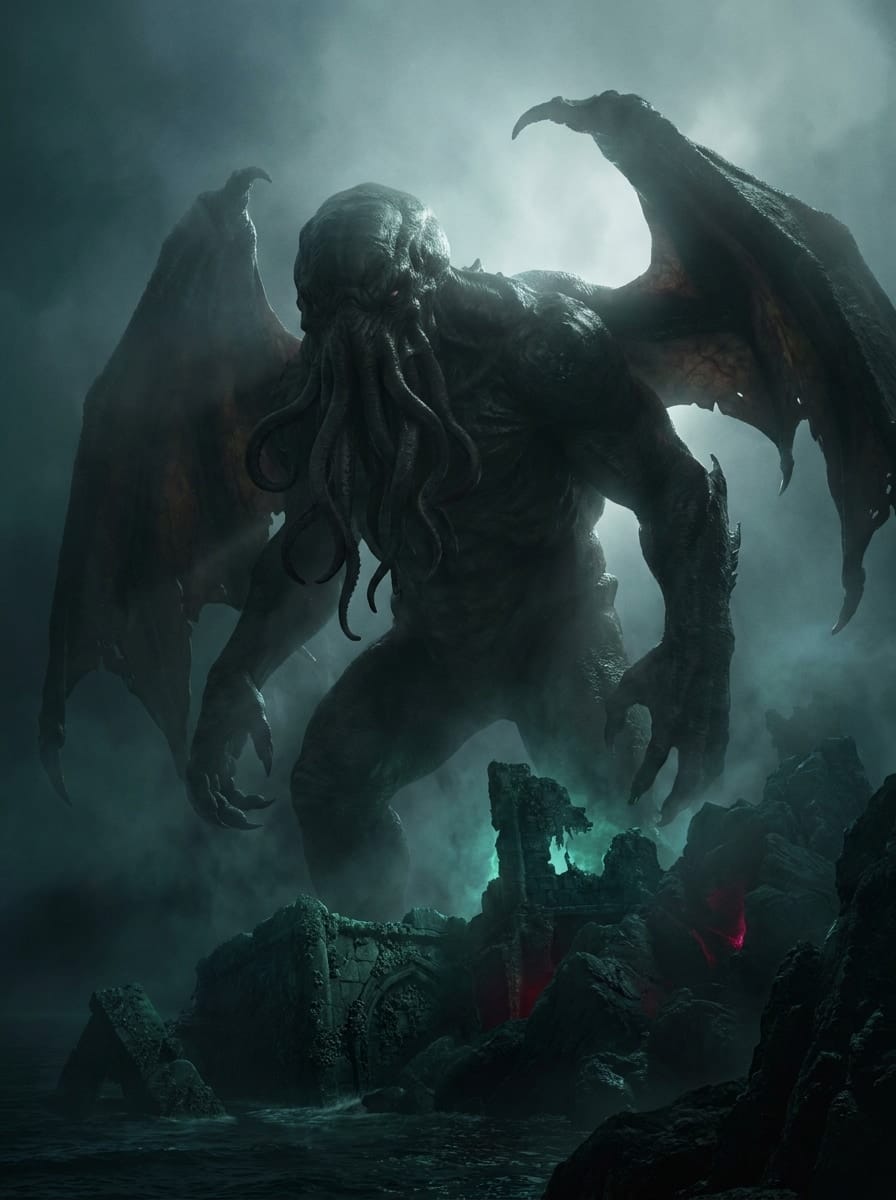
It was no ordinary idol, and it resembled no ancient design he had ever seen in a museum. Its head was like an octopus’s, hung with feelers; its body was roughly human; behind it were folded a pair of narrow, unnatural wings. The carving was not finely made, yet it had a disturbing force about it, as though the hand that shaped it had not been inventing freely, but hurrying to preserve something glimpsed in a dream.
Beside the bas-relief lay a packet of documents. On the top was a title referring to materials on the “Cthulhu cult.” As Thurston read on, he learned that the relief had come from a young sculptor named Henry Wilcox.
That spring, Wilcox had been living in Providence. One night he suddenly began to dream strangely. In the dream he saw neither familiar streets nor earthly mountains and rivers, but a city built of gigantic blocks of stone. The angles of those stones were wrong. Walls seemed about to topple yet did not fall; steps appeared to lead toward directions that should not exist. From deep within the damp air came a heavy sound, again and again, like a prayer and like a summons.
Wilcox woke soaked in sweat. He took up clay and carved the clearest shape he remembered from the dream. The next day he brought the bas-relief to Professor Angell and asked the old man to identify the symbols on it.
At first the professor treated it as the strange fancy of a young artist. But when Wilcox repeated the sound that had echoed through the dream, the old man’s expression changed. He had the young man write down the dream word for word, and he began recording the dates.
Before long, the professor found that the matter had not happened to one man alone.
Nightmares on the Same Nights
During the days when Wilcox was dreaming, disturbances appeared in many places.
Poets and painters fell suddenly into agitation, writing broken lines and drawing twisted cities by the sea. Some woke at night screaming that they had heard a deep call rising from beneath the water. In hospitals, the already deranged grew more violent and muttered similar syllables. Newspapers carried scattered reports as well: a riot with no clear cause, a person driven to some mad act, a strange religious rite in a remote corner of the world.
Professor Angell did not rush to a conclusion. He pasted the clippings in order by date, saved each letter that came to him, and recorded Wilcox’s dreams day by day in his notebook. The dreams were sometimes vivid and sometimes fragmentary, but always they returned to the wet stone city, the indistinct gigantic shadow, and that chant-like call.
Then Wilcox suddenly fell ill. He burned with fever, lost hold of his senses, and kept saying that he had seen some immense thing stirring in the depths of black water. When the illness passed, he woke and said the dreams had stopped. The city and the voice had receded from his mind like an ebbing tide.
Professor Angell did not forget. He set this affair beside another investigation from many years earlier, one that had come to him through an archaeological meeting and through a police inspector named Legrasse.
Drums in the Swamp
Years before, Inspector Legrasse had brought a dark greenish-black stone idol before a group of scholars and asked them to identify it.
The idol closely resembled Wilcox’s bas-relief: feelers hung before its face, the body was heavy, wings rose behind it, and it squatted on a base covered with symbols. Yet this thing had not been made recently. Its stone was peculiar, and its style could not be assigned to any known civilization. The scholars studied it for a long time, but none could say where it had come from.
Legrasse said the idol had been seized in a desolate swamp in Louisiana.
People had disappeared there, and there were rumors of drums heard deep in the night. Legrasse led his men into the swamp. Roots twisted everywhere, black water rose over their boots, and the air smelled of rotting leaves and mud. The farther they went, the clearer the drums became, mingled with the hoarse cries of a crowd.
At last they saw a clearing. Firelight leapt between the tree trunks, and many people were dancing around the idol. There were altars and remains on the ground, and the scene was dreadful. As the dancers moved, they shouted the same words over and over, their voices rising and falling in the dark. Legrasse did not understand them, but he remembered the harshest name among them: Cthulhu.
The police rushed in to make arrests. The rite broke into chaos at once. Some fled into the swamp; some fought back; some knelt in the mud and kept crying out. In the end, Legrasse took many prisoners, and he took the idol as well.
Under questioning, the prisoners spoke of a strange belief. They said that before humankind appeared, the Great Old Ones had come to the earth from the starry gulfs. Cthulhu slept beneath the sea in the city of R'lyeh. When the stars came right again, R'lyeh would rise from the waters, and the sleeper would awaken. Then the human race on earth would be no more than insects that had occupied the world for a little while.
They also said that Cthulhu was not dead, only waiting. Through dreams he could send shadowy messages to those sensitive enough to receive them; secret cults in many lands would remember the ancient cry and wait for that day to arrive.
Most of the scholars dismissed the story as the ravings of a savage cult. But Professor Angell wrote the words down. Many years later, when Wilcox’s dream and bas-relief came before him, the old material suddenly took on a new weight.
By the time Thurston read this far, a chill had begun to gather in him.
A Newspaper from Across the Sea
At first Thurston had only meant to arrange his great-uncle’s papers clearly. He did not want to believe the mad claims they contained. Yet the more he read, the more the clues from distant places seemed to knot together like hidden threads.
What truly shook him was a newspaper from Australia.
It reported a bizarre disaster in the South Pacific. A vessel called the Alert had been found at sea with only one survivor aboard, a Norwegian sailor named Johansen. Stranger still, this was not the ship on which Johansen had originally sailed. He had been aboard another vessel when it encountered an armed ship behaving suspiciously. A fight broke out, and Johansen’s party finally captured the other ship, though at terrible cost.
After that, they sailed on and came to a stretch of ocean where the charts showed no land at all.
Yet something like an island had risen from the sea—or rather, a portion of a gigantic city newly uncovered from the ocean floor. Black stones stood wet in the sunlight, hung with seaweed and slime. Walls, doorways, and steps were all terrifyingly large, and their angles were so disordered that they made the mind reel. When the sailors climbed over them, it did not feel as though they were walking on solid ground. It felt as though they had stepped into a dream from which they could not wake.
In that strange city of stone, they found a tremendous gate.
No one knew what lay behind it. But some force seemed to draw them nearer. Several men tried to force it open. The stone gate moved slowly, and from the crack poured the smell of an ancient seabed long shut away.
Then Cthulhu came out.
The Thing That Woke Behind the Gate
Johansen’s later account was incomplete, like the recollection of a man trying to set down a nightmare while stopping after every sentence. He did not clothe the thing in many elaborate words. He only said it was too vast to seem alive, and yet it moved. Feelers swayed before its face; the heavy wet body squeezed through the stone gate; the great wings behind it unfolded against its form. It had awakened in the sunken city and was advancing on the intruders.
The sailors broke.
Some screamed and ran. Some slipped and fell. Some seemed to have their wits torn away by the sight before them. The survivors fought their way back to the ship. Cthulhu followed, its enormous body crushing over the stones, bringing with it the mire and reek of the sea floor.
Johansen started the ship and steered away from the black land that had just risen. But Cthulhu had entered the water and was pursuing them. The sea foamed around it. The ship seemed no more than a splinter of wood, pressed forward by the vast shadow behind it with nowhere left to flee.
At last Johansen made a decision close to madness.
He swung the bow around and drove straight toward Cthulhu. The ship struck that dreadful body with a deep, muffled crash. For a moment seawater, mist, and the thick sound of rupture mingled together, and Johansen almost believed he too would be swallowed. But the vessel came through.
The thing behind him did not fall like ordinary flesh. It burst apart and then began to gather itself again in the fog, like a wound closing of its own accord. Yet the impact delayed it. Johansen used that brief reprieve to escape, carrying the broken ship and his broken memories back into the sea-lanes of humankind.
Not long afterward, the city that had risen from the ocean floor sank again. Cthulhu did not truly come ashore. The world kept turning as before: people went to work in the streets, students read in schools, ships entered and left their harbors. Only a few newspaper clippings and the manuscript of a survivor proved that such a thing had ever happened at sea.
The Call That Did Not End
When Thurston found Johansen’s manuscript, he finally fitted the fragments left by his great-uncle into a whole design.
Wilcox’s dreams, the swamp cult, the greenish-black idol, R'lyeh rising from the sea, Johansen’s flight—none of them had been isolated marvels. They were like one deep tremor passing through the world from beneath the ocean: sensitive minds heard it in dreams, secret cults shouted it beside their fires, and men at sea saw with their own eyes the brief awakening of what had sent it.
Only then did Thurston understand that the most terrifying thing was not the tragedy of one night, but that the tragedy had never truly ended.
Cthulhu had only sunk down again.
R'lyeh remained under the sea. Its worshippers might still be hiding in swamps, harbors, islands, and the shadows of cities, remembering the same ancient call. When the stars come right once more, the surface of the sea may split again, and the black city of stone may rise back into the light.
When Thurston closed the manuscript, he could no longer return to his old secure life. He knew too much, and he knew his great-uncle’s death might not have been merely an accident. Still, he set the materials in order, because if he too should die suddenly one day, those who came after him would at least be able to see the clues.
The story seems to stop in his record.
The surface of the world is calm, and the deep sea is silent. But far below, in the lowest darkness, Cthulhu still sleeps, still waits, and still sends his dim call into the world like a dream.