Cthulhu Mythos
The Shadow over Innsmouth — Cthulhu Mythos
While traveling through New England, a young man takes a detour to the decaying seaport of Innsmouth. There he hears old tales of an alliance between the townspeople and a race from the sea, and through flight and family secrets discovers that he too is caught beneath that shadow.
Article
Summary
The young traveler is at first only trying to save money. While asking about routes in a nearby town, he learns of a cheap bus that passes through Innsmouth, but he also notices how people recoil at the name. They say the seaport was once prosperous, then fell suddenly into ruin; its inhabitants have an odd look, and outsiders seldom choose to spend a night there. Still, the young man goes. He finds sagging roofs, empty streets, a rotten wind off the water, and watchful faces vanishing behind windows. From a clerk who is not native to the town, he hears of the Esoteric Order of Dagon. Then old Zadok Allen, drunk and terrified, tells him that Captain Obed Marsh once brought back a dreadful bargain from the South Seas: the townspeople offered sacrifices to a race beneath the ocean in exchange for gold and abundant fishing, and in time certain families began to intermarry with those beings from the deep. That night, when the bus is said to have broken down, the young man is forced to stay at the town hotel. There he realizes that people are quietly gathering outside his door. He escapes through a window, hides among dark alleys and abandoned houses, and hears his pursuers dragging themselves through the streets with voices that do not sound human. Before dawn he follows an old railway out of Innsmouth and reports what he has learned. Soon afterward, the authorities raid the seaport; many residents are taken away, and secret operations occur near the shore and the reef. Later, the horror follows him into his own bloodline. The young man discovers that his maternal grandmother's line is connected to Innsmouth, and that the so-called madness in his family may have been a sign of changing blood. He begins to see his own face alter in the mirror, and he dreams of undersea halls and kin waiting for him below. Fear slowly becomes a summons. In the end he understands that the shadow of Innsmouth did not fall only upon that town. It had always lain in his blood.
A Cheap Ticket and a Strange Seaport
One summer, a young man was traveling alone through New England. He had little money, but he loved old towns, harbors, and museums, and he planned his routes carefully to save even the smallest fare.
He meant to go from Newburyport to Arkham. While asking about the way, he heard of a bus line that passed through a seaside town and cost far less than the train. The town was called Innsmouth.
At the name, the people around the station grew uneasy. Some said the place was desolate. Others said its people wanted nothing to do with outsiders. A few lowered their voices and spoke of the Innsmouth look: bulging eyes, wrinkled necks, a strange gait, faces not quite right. The more questions the young man asked, the vaguer the answers became. Everyone seemed to know something, and no one wished to say it plainly.
He asked again in shops and at the library. There he learned that Innsmouth had not always been as it was. It had once been a busy port, with shipyards, mills, and goods brought in from distant seas. Then the town had suddenly declined. The railroad passed it by, strangers stopped visiting, many houses stood empty, and still the inhabitants remained, as if they would rather rot in the sea fog than leave.
The young man's curiosity grew. He could have taken a safer road, but he remembered the cheap ticket, and the old harbor marked so close to the coast on his map. He decided to see it for himself. If he arrived by day and left before evening, what harm could come of it?
The next day, a shabby bus carried him down the road toward the sea. Beyond the windows the fields grew wilder, stone walls collapsed, and weeds flourished unchecked. The nearer they came to the coast, the stronger the damp fishy smell in the air became. The driver gripped the wheel in silence. There were no other passengers. At last the bus descended a slope, and the young man saw Innsmouth.
It was not the ruin of an ordinary town.
A few old boats lay in the harbor, and black pilings leaned crookedly in the water. Many roofs had caved at the edges, windows were boarded shut, and the streets held almost no carriages and few pedestrians. Far out at sea a dark reef broke the surface. Waves struck it again and again, as though something lay there breathing. When the young man stepped down from the bus, several faces flashed behind windows and vanished at once.
The Faces in Town
He first went to the center of town. The square was unnaturally quiet. An old sign hung over the grocery store, the hotel walls were blackened, and the stone church looked as though it had long since passed into other hands. Now and then a local resident crossed the street, and the young man could not help staring.
Their skin was grayish and pale. Their eyelids blinked rarely, their eyes protruded, their lips were thick and slack, and odd folds marked the skin near their ears and necks. Some of the older people shuffled along with stooped shoulders, as if standing upright had grown difficult for them. When they saw the stranger, they did not welcome him, but neither did they wholly withdraw. They looked at him with a damp, slow, hostile attention.
The young man told himself that long isolation, disease, and poverty might account for such appearances. Still, he felt the unease settle deeper.
In the grocery store he met a young clerk from outside the town. Glad to speak with someone willing to listen, the clerk quickly poured out his anxiety. He said that the people of Innsmouth did not follow ordinary churches. There was a society in town called the Esoteric Order of Dagon, and many important families were connected with it. Outsiders seldom came in, and those who did were wise not to ask too much. If the traveler truly wanted old stories, he might look for a drunken ancient named Zadok Allen. The old man wandered near the edge of town, and if given liquor, he might tell what others kept hidden.
Following the route the clerk drew for him, the young man bought a bottle and went in search of the old man.
He found Zadok on a broken road near the water. The old man was lean as dead wood, his beard tangled, his eyes by turns cloudy and terrified. At first he would not speak. He only stared at the bottle. The young man handed it to him, and after a few swallows color crept back into the old face, though he looked more than ever like a man caught in an old nightmare.
The wind came off the ruined wharves, and the boards creaked beneath it. The old man looked toward the reef in the distance and muttered that Innsmouth's trouble had not begun yesterday.
The Old Man's Tale of a Bargain Under the Sea
Zadok said that long ago there had been a captain in town named Obed Marsh. Year after year he sailed to the South Seas and brought back spices, golden ornaments, and strange cargoes. In those days Innsmouth was poor. The fishing was bad, and the port had not yet enjoyed its later prosperity.
On remote islands, Marsh had seen a kind of worship. The islanders made offerings to beings who came from beneath the sea, and in return they received full nets and curious gold. Those undersea folk were not ordinary people, and they were not merely the fish of old sailors' tales. They lived in the deep water. They could speak with human beings, make bargains, and demand a price.
The young man thought the old drunk had gone too far into his liquor. Yet Zadok's voice sank lower and lower, as if he feared the wind itself might carry his words to listening ears.
He said Marsh brought that bargain back to Innsmouth. At first, the townspeople saw only the rewards: fish returned, holds filled, and gold found its way into certain family chests. But offerings had to be paid, and oaths could not be broken. Later, Marsh and his allies founded the Esoteric Order of Dagon and forced more people to join. Those who resisted disappeared. The old churches were taken over. At night the town heard drums and footsteps.
Worst of all were the marriages.
The beings from beneath the sea promised wealth to Innsmouth, but they demanded kinship with those on land. Children of mixed blood looked human enough when young. As they grew older, their faces began to change: eyes bulging, skin graying, necks folding and cracking. At last they would leave the land and go out beyond the reef into the deep. Zadok said this was not death. Those creatures lived for vast spans of time, and perhaps did not age as human beings did.
The more he spoke, the more frightened he became. He seized the young man's sleeve and pointed toward the reef, saying it was no ordinary rock. At low tide, shapes gathered there. Many people in town knew it, but none dared speak. Those not yet fully changed remained in the rotting houses, waiting for their time. Those who had changed already had gone down to the cities beneath the sea.
A chill ran up the young man's back. He wanted to ask more, but the old man stopped suddenly, trembling from head to foot. At the corner of the street several Innsmouth people were walking slowly toward them. As if sobered in an instant, Zadok shoved the young man away and stumbled into an alley, refusing to show himself again.
Footsteps in the Hotel
Toward evening, the young man hurried to the station, only to be told that the departing bus had broken down. The driver and the hotel people all said he would have to wait until morning. Uneasy as he was, he had no other choice, and took a room in the town's shabby hotel.
The corridor was narrow and dim, the wallpaper mildewed, and his room smelled of seawater, dust, and rotten timber. The proprietor gave him the key with a strange manner, his eyes repeatedly flicking over the young man's face as if he were checking something.
Once inside, the young man did not go to sleep. He braced a chair against the door and inspected the window. When night deepened, the whole hotel seemed as silent as something sunk at the bottom of the sea. Far away a dog barked once or twice, then stopped abruptly.
After a time, he heard a sound outside the door.
First the floorboards creaked softly. Then someone paused in the corridor. The doorknob turned slowly, but did not open. Whoever stood there was very quiet, too quiet for an ordinary thief. Then came movement from the room next door, as if someone were approaching his window from another side.
Cold with fear, the young man did not shout. In that town, a cry for help might not bring help at all. He moved the chair aside as quietly as he could, took what he could use from his luggage, opened the window, and climbed out onto the roof ledge. Night fog pressed over the street, and below him the darkness hid the ground. He edged along the ledge to an empty adjoining room, slipped inside, and found another stairway down to a rear exit.
Behind him came the crash of a door being forced. They had discovered his escape.
He ran into the alleys as hoarse shouts rose from the hotel. At street corners, in yards, and behind the doors of abandoned houses, figures began to stir. Innsmouth awoke like a sleeping monster. Windows that had been black suddenly filled with light.
Flight Through the Black Streets
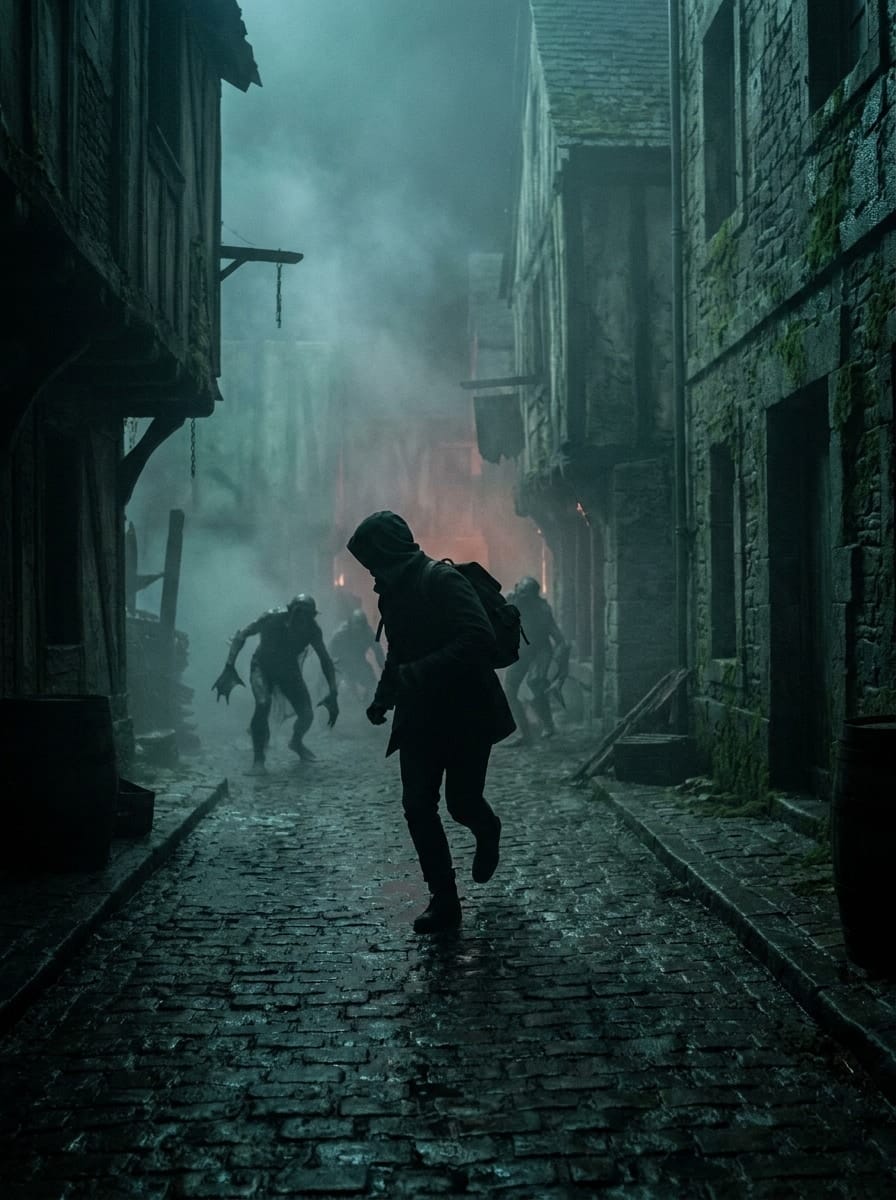
The young man dared not take the main roads. He plunged into ruined districts instead, climbed over broken walls, crossed weed-choked yards, and hid in an old house with no roof. His pursuers passed along the street outside, their steps dragging and slapping. Some sounded like soles on stone; others sounded like wet things striking the ground.
Holding his breath, he watched several shapes move through the fog. Their heads and shoulders lurched strangely, and from their throats came thick, muddled noises. He did not dare look closely. He knew only that these silhouettes were less human than the townspeople he had seen by day.
When the footsteps receded, he fled again. He remembered from the map that an abandoned railway led out of town. If he could find the tracks, he might get away. But by night every part of Innsmouth looked the same: leaning houses, broken stone steps, black windows like open holes. The surf kept sounding in the distance, until it seemed that what pursued him was not the town at all, but the entire sea.
Once he nearly ran straight into a procession coming from the harbor. They moved through the middle of the street in great numbers, carrying the stench of the tide with them. The young man threw himself into the weeds and pressed his face against the cold earth until the steps and low cries had passed.
In that moment he understood that old Zadok had not been wholly mad. What Innsmouth concealed was not ordinary crime, nor merely the eccentricity of a remote town. Something ancient, something from the depths, had truly drawn the place into its shadow.
Near dawn, he found the railway. The rails were rusted, and grass grew thick between the ties. He followed the track with all the strength left in him, until the rooftops and sea fog lay far behind. When the sun rose, he was exhausted, but alive.
After the Raid
Once he reached safety, the young man told the outside world what he knew. At first, not everyone believed him. Yet the clues he brought away were too numerous, and the records of Innsmouth too suspicious. In time, the authorities acted.
Before long, a secret raid fell upon Innsmouth. Many townspeople were seized, the streets were sealed, and the harbor was searched. Outsiders heard only of smuggling, cult activity, and a grave criminal organization. The newspapers wrote cautiously and vaguely. But the young man knew the full truth would never be printed there.
There were operations near the reef as well. Some said warships fired in the night. Others spoke of dull explosions from far beneath the sea. After that, Innsmouth was more desolate than ever, like a diseased wound cut open at last beneath the sun.
The young man thought he had escaped the shadow. He left that region and tried to return to an ordinary life. But some knowledge, once gained, never truly passes away.
He began to investigate his own family. At first it was only uneasiness. Then the search drew him deeper. On his mother's side he found blurred records, relatives no one wished to mention, and a grandmother who had come from Innsmouth. Her origins were obscure. In youth she had been beautiful, but later she avoided other people, and finally vanished from family memory.
The clues tightened around him like a wet, cold rope.
The Change in the Mirror
At first, the young man refused to believe. He told himself that many families had hidden histories, and that Innsmouth might have appeared in his genealogy by chance. But as the days passed, the face he saw in the mirror began to frighten him.
His eyes seemed more prominent than before. His skin had taken on a strange roughness. In sleep, he often heard the surge of seawater. He dreamed of immense stone steps descending into green depths, and of halls where one could breathe without air. The dreams were not always terrible. Sometimes the voices within them were almost gentle, like distant kin calling him home from the dark water.
He remembered another relative too, one who had been confined for reasons never clearly explained, with only the word madness set over the matter. The young man slowly began to suspect that it had not been ordinary insanity, but the awakening of the same blood.
Fear changed its flavor. At first, he had dreaded becoming like the people in the streets of Innsmouth. Later, in dreams, he saw deeper places: splendid and ancient cities beneath the sea, and many eyes watching him through the water without hatred. Those beings seemed to have known who he was all along. They seemed to know that one day he would understand.
At last he no longer wished only to flee.
He planned to free the imprisoned relative and leave the land together. Not to die, but to go below the waves, to the deep city waiting for them. Human rooms, streets, names, and terrors grew light and distant behind him. Innsmouth had given him more than pursuit and nightmares. It had given him a dreadful answer: he had never belonged only to the shore.
And so the shadow over Innsmouth did not vanish with the raid. It passed beyond sea fog, ruined houses, and the reef, and fell into a human bloodline. When the young man looked into the mirror, that decayed harbor was no longer merely a stop on the map. It had become the door through which he would one day return.