Cthulhu Mythos
Out of the Aeons — Cthulhu Mythos
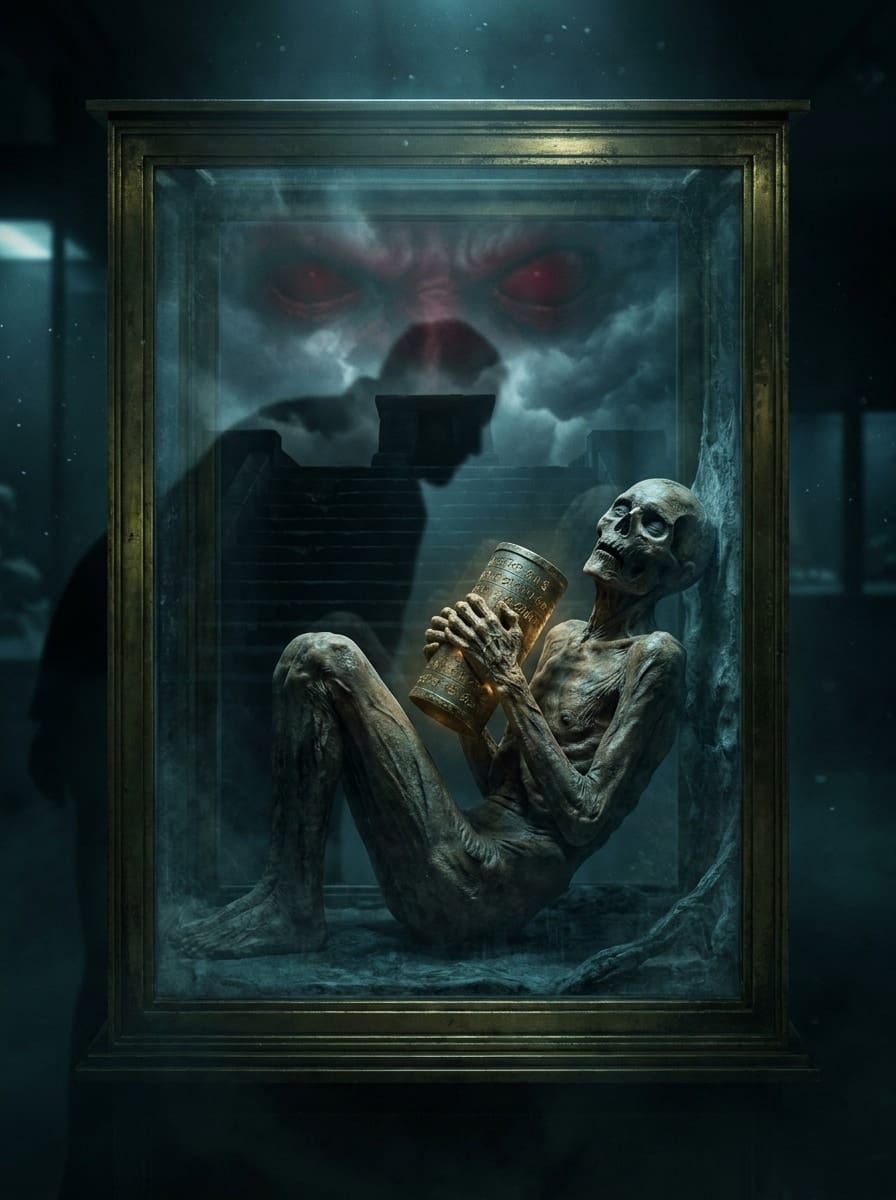
In a Boston museum, a strange mummy brought from a Pacific island draws the notice of secret worshippers. When the curator traces the scroll hidden upon its body, he discovers that the dried figure was once a priest of ancient Mu—and that it has not truly been dead, only silent, for uncounted ages.
Article
Summary
A Boston museum houses a bizarre mummy recovered from a remote island in the Pacific. Once it is put on display, secret devotees begin to watch it, and the curator realizes that it is no ordinary relic, especially because of the ancient scroll kept against its chest. As he investigates the scroll and the mummy’s origins, the curator learns that the body belonged to a priest from the lost continent of Mu. The deeper he goes, the clearer it becomes that the mummy’s long silence was never the stillness of simple death, but the endurance of something terrible through endless ages.
The Dry Mummy in the Museum
In Boston’s Cabot Museum of Archaeology there was once an exhibit no one could quite account for.
It was a mummy.
It was nothing like an Egyptian body swathed in linen, nor like the naturally desiccated remains found in South American caves. Its frame was twisted in an uncanny way, as though it had flinched backward in the final instant; its arms were drawn tight across its chest, its fingers clenched into rigid claws; and on its face there was none of the peace of the dead, only a fixed and everlasting terror. Worse still, those who stood too long before the glass case often felt that the shriveled face was not empty at all. It seemed to be looking back at the gallery, at the lights, at the visitors who bent near.
This mummy had come from a chance discovery in the Pacific. Years before, a lonely island had once again drawn notice, and there were fallen stone walls there, steps worn smooth by salt wind, and carvings unlike anything any known people had left behind. When explorers found the body amid the ruins, it was not lying in a coffin; it seemed instead to have been seated alone in a stone chamber, guarding an ancient scroll tube pressed to its breast. The ship later carried it to America, where it changed hands more than once before ending up in the Cabot Museum.
At first the museum treated it merely as a rare anthropological specimen. But soon matters turned strange.
Someone muttered unfamiliar words before the case; someone came back day after day and stood only in front of the mummy, staring at the place where the scroll tube rested against its chest; and then letters reached the curator demanding that the display be removed, insisting that the body ought not to be exposed to the world. No real name was signed to the letters, but crude black symbols were drawn on the paper—symbols like eyes, or like a mountain’s mouth gaping downward.
The curator, Dr. Richard H. Johnson, did not at first believe any of it. He had seen too many people dressing up simple antiquities as occult marvels, and too many collectors inventing dreadful legends around an object they coveted. Yet this time, the deeper he looked, the more uneasy he became.
The Scroll Against Its Chest
Dr. Johnson decided to begin with the scroll tube.
The mummy’s arms were locked tightly around its chest, as though in the final extremity it had tried to hold something fast. The museum staff labored long before they could remove the tube without damaging the body. Its outer casing was dark metal etched with minute patterns, and inside lay a narrow, tough roll of ancient material covered in strange writing.
At first no one in the museum could read it. The symbols were unlike Egyptian hieroglyphs, unlike Mayan script, unlike any Asian archaic lettering. Dr. Johnson sent copies to several experts, and most replies were cautious and vague. Only one scholar, a student of Pacific legends, spoke plainly: it might have some connection with the fabled continent of Mu.
In many odd traditions, Mu was said to be an ancient land long sunk beneath the sea. There were stories of great cities there, of stone stairways leading to temples lost in cloud, and of priests on mountaintops burning braziers in sacrifice to beings no human had ever been meant to meet. Ordinary scholars dismissed such tales as fantasy, but the words on the scroll were like a cold hand, slowly drawing fantasy into fact.
With the help of damaged parallels and old notes, Dr. Johnson at last managed to piece together the meaning.
The scroll told of a priest named Tiyog. He had lived in the age of very ancient Mu, when human city-states were scattered among mountains and valleys, and on Mount Yaddith-Gho there dwelt the dreadful Ghatanothoa.
Ghatanothoa was neither an ordinary deity nor some creature imagined by men. The legend said that anyone who beheld its true form would at once stiffen and wither, the flesh shrinking into a substance like stone and leather combined. Yet the victim’s mind would not go out. They could not speak, could not move, could not close their eyes, and would remain awake within that darkness year after year, until the world itself had changed around them.
For that reason the people of Mu feared the mountain. They sent offerings at set times, and the priests recited their old prayers, hoping only that what dwelt above would not turn its gaze upon them.
Tiyog, however, no longer wished to live so.
Tiyog’s Resolve
Tiyog had once served another ancient goddess. He had read many secret writings and heard the elders speak of older times still. He believed that Ghatanothoa was not invincible; if one climbed Mount Yaddith-Gho armed with the proper talisman and spell, one might face the thing directly and free Mu from its endless fear.
The moment he said as much, the city was first stunned and then thrown into disorder.
The common people feared his failure. If he angered the being on the mountain, the suffering might not be his alone. Other priests feared his success even more, for their rank and wealth rested upon terror of Ghatanothoa. So long as offerings were sent upward and the people bowed generation after generation, they could stand by the altar and command.
Tiyog did not yield. He prepared a roll of spells said to have been sought from still older powers. The scroll contained secret words meant to veil the eyes and withstand the gaze. He placed it in the tube and wore it against his breast, waiting for the day of the ascent.
Yet just before he set out, someone tampered with it.
Priests who opposed him slipped in by night and exchanged the true protective scroll for another, useless roll of writing. The substitute looked equally ancient, equally crowded with signs, but it could save no one. Tiyog did not know. He put on his ritual garb, took up the tube, and left the city alone for Mount Yaddith-Gho.
The climb was long. Stone steps cut through black rock, and the higher he went, the quieter the wind became, as though something vast were breathing in the clouds. Behind him the city dwindled until even its braziers and rooftops sank into mist. By the time Tiyog reached the temple on the summit, he may still have believed that he carried his last hope with him.
Then he saw Ghatanothoa.
No one can truly recount that sight. The scroll gives only the result: Tiyog’s body at once withered, and his motion froze in the instant of horror. He did not fall. He did not die cleanly. His flesh became a hard shell, his eyes lost the light of life, and yet his mind remained locked within.
There was no cry of triumph on the mountain. Only a body that could not move, could not speak, and could not end its suffering, swallowed by ancient darkness.
A Display Case After Countless Ages
Countless ages passed.
The cities of Mu crumbled, altars broke apart, the sea swallowed the plains, and the mountains became islands. Everyone who knew Tiyog’s name died; the dynasties that feared Ghatanothoa vanished as well. Yet the body remained. It stayed silent in the ruins, silent in the salt wind, silent through who knows how many quakes and tides, until modern explorers opened the stone chamber and carried it off as a curiosity.
And so Tiyog came to Boston.
By day, children stared at him through the glass; ladies drew back with a frown; reporters wrote of a museum curiosity. By night, when the gallery lights went out and only the streetlamps outside shone faintly on the case, no one knew whether some ancient priest’s awareness still lay trapped inside that dried body, listening to footsteps fade across the floor, hearing the guard lock the doors, hearing the cars pass in the street.
Once Dr. Johnson had deciphered the scroll, he began to understand why the secret visitors had come.
They were not merely curious. They knew the name Ghatanothoa; they knew the old tales of Mu; they knew that Tiyog had once hidden a scroll tube against his chest. To them, the mummy was no exhibit at all, but a relic—a terrible piece of evidence preserved from prehistory.
By 1932 the strange events around the mummy had grown more frequent. Men loitered near the museum; someone tried to bribe a museum employee; strangers asked about the night watch schedule. Dr. Johnson strengthened security, never suspecting that the true event would come so abruptly.
The Intruders at Night
On the night of December 1, two men broke into the museum.
They avoided the front entrance and came in through a rear window, carrying tools and shaded lamps. The gallery was cold, and every step rang thinly over the marble floor. They ignored the gold, the pottery, and the other objects that might be sold, and went straight for the mummy.
The glass case was pried open.
One of them plainly knew what he was after. They searched among the mummy’s surrounding display materials, trying to take the scroll tube and the records connected with it. Perhaps they even meant to carry off the whole body and bear it to some hidden altar. But when they drew near that shriveled face, the matter changed.
By morning the staff found the gallery in chaos. One intruder lay on the floor, his face locked in absolute terror, as if in death he had seen something no living person should ever behold. The other’s condition was worse; the official account afterward grew vague and reluctant, almost refusing to say what had happened. His body had undergone a change like the mummy’s own, as though in a single night some unseen force had drawn out all life and moisture, leaving behind only a rigid, twisted shell that could not rest.
When Dr. Johnson arrived, he saw the broken glass, the scattered tools, and the ancient mummy still posed as it had been before. Then he understood that Tiyog had brought more than a legend. The curse of Ghatanothoa might never have ended when Mu sank beneath the sea. Its shadow might still cling to certain objects, certain writings, certain things once seen, waiting for some reckless hand to reach out.
The museum quickly hushed the affair. The papers received a mutilated version of the story, saying only that thieves had broken in and that something uncanny had resulted in death. The mummy was soon removed from display and never shown publicly again. The museum announced that the specimen had deteriorated and was no longer fit for exhibition, but Dr. Johnson knew that was not the real reason.
The thing had been preserved too well.
Preserved like a punishment that had survived from prehistory to the present day.
An Antique No Longer Displayed
Later, the Cabot Museum returned to calm. Visitors came again to see pottery, stone axes, and inscriptions. Few ever spoke of the mummy, and if anyone asked after it, the staff would only say that it had been put away and could not be viewed.
Dr. Johnson locked the records concerning it away. He did not give the full truth to the newspapers, nor did he speak of Mu, Mount Yaddith-Gho, or Ghatanothoa in public lectures. He had seen the body, read the scroll, and witnessed the fate of the intruders. To him, some knowledge did not make men braver; it only led them back to the case, back to that shriveled face, and made them unable to resist looking once more.
And that glance might be the beginning of disaster.
So the museum lost one exhibit and gained a rumor no one wished to tell whole. The rumor said that ancient Tiyog had never truly died; the rumor said that the old land beneath the sea still turned in dreams; the rumor said that certain buried names, once spoken again, could pass through the aeons and return to the bright cities of the modern world.