Cthulhu Mythos
The Curse of Yig — Cthulhu Mythos
An ethnologist goes to Oklahoma in search of the serpent god Yig, only to hear the tale of an old horror from within an asylum in Guthrie. A pioneer family, driven by fear and one terrible mistake, falls under a curse that leaves behind only a mad survivor and a child no ordinary reason can explain.
Article
Summary
An ethnologist travels to Oklahoma to investigate local tales of the serpent god Yig, and ends up at the asylum in Guthrie to learn the truth behind them. There he hears of a tragedy from the pioneer days: a settler family, terrified of snakes and of Yig’s vengeance, is swept into panic, and an accidental killing convinces them that they have brought a curse upon themselves. What begins in fear becomes an irreparable disaster. The family is destroyed by the legend of Yig and by calamity in the real world alike. In the end, all that remains of the old story is a deranged survivor in the asylum and a child whose existence no sane mind can easily explain—grim proof for the scholar who came seeking only a local myth.
The Asylum in Guthrie
In 1925, a scholar of Native American lore came to Oklahoma. At first he meant only to gather a few snake tales, especially the local stories about Yig, the serpent god. But he soon discovered that this name was not one people spoke of lightly.
The new oil hands knew nothing of it, and the younger farmers only shook their heads. It was the older pioneers and Native people who fell silent at the sound of “Yig,” their faces tightening. They did not like to speak of him after sunset, or near grasses, stone piles, and riverbanks.
At last someone told the scholar, in a lowered voice, “If you want the truth, go to the asylum in Guthrie. Dr. McNeil will show you something.”
So he went.
The asylum stood at the edge of town, its white walls blazing in the sun, its windows barred with iron. Dr. McNeil was no longer young. He spoke carefully, as if every word had to be chosen so as not to disturb something he would rather leave sleeping. When he understood the reason for the visit, he did not begin with the legend. Instead, he asked whether the scholar truly wanted to see.
“Many hear the story and take it for frontier nonsense,” the doctor said. “But I watched over her here. And over the child she left behind.”
He led the scholar down the corridor. Behind the doors came murmurs, laughter, and weeping. The air smelled of medicine and damp old wood. At last they stopped outside a locked room. Inside sat a woman grown old, her hair gray, her eyes still hunted by something no one else could see. She cowered in the corner of her bed, her lips trembling as though she still expected the faint rattle of scales in the grass.
It was Audrey Davis.
Dr. McNeil said that everything began many years before, in the days of the great westward settlement.
A New Home on the Prairie
Oklahoma was not yet what it is now. The prairies stretched out in immense emptiness, and the wind moved through the knee-high grass as though countless small things were stirring within it. The pioneers came in wagons, bringing crates, iron pots, guns, axes, and whatever furniture they could spare, to claim land, raise cabins, and make a living from the soil.
Among them were Walker Davis and his wife, Audrey. Walker was sturdy and hardworking, a man who wasted no words. He could mend a wheel, nail planks together, and find his way across the open prairie. Audrey was young and not frail, but she carried a fear that others could scarcely understand: she was afraid of snakes, afraid so deeply that even the brushing of grass could freeze her in place.
As they traveled west, they passed Native settlements and heard many warnings. Some told them that not all snakes should be killed. In that country, they said, snakes had a father of their own: Yig. Half man and half serpent, he was the father of all snakes. So long as no one harmed snakes without cause, Yig might take no notice. But let a man kill them for sport, or destroy their nests, and Yig would remember.
Walker took it as one more frontier superstition. He did not mock it, but neither did he dwell on it. Life on the edge of the wilderness left little room for old taboos. There were water and food to think of, stock to tend, wolves at night, and weather that could turn in an instant. Snakes were dangerous enough, yes—but danger was meant to be met with gun and club.
Audrey, however, heard the warnings and kept them close to her heart. She feared not only snakes, but Yig himself. She felt eyes under the grass, coils hidden in dry gullies, and even the chatter of insects at night seemed like some tiny, patient threat.
At last they settled on a broad stretch of land. Walker cut logs, set posts, and built a rough little house. The roof was poorly laid and leaked in rain. The door never quite shut tight, so the wind could slip through the cracks. Yet to two weary pioneers, it was home.
Audrey set out the pots, made the bedding, and sorted the food sacks. She was with child, and that made her move a little more slowly than before. Walker comforted her, saying that once the land was cleared, once the corn came up and the cattle were growing, they would have a safe life.
But the prairie had never really been safe.
The Killed Snake
As autumn drew near, the weather remained heavy and hot. One day Audrey was carrying firewood outside when she saw a snake glide from beside the woodpile. She screamed, and the sticks spilled from her arms. Walker came running, killed the snake with a club, and carried the body away.
Audrey’s face went white as cloth. “Will it tell Yig?” she asked.
Walker almost laughed, then stopped himself. “It’s only a snake. It won’t tell anyone.”
But the matter did not end there. A few days later, they found more signs of snakes near the house. There were winding tracks in the dirt, and shed skins caught among the roots of the grass. Worried for his wife and for the house itself, Walker began clearing the weeds, moving stones, and sealing any hole that might hide a snake.
Once, he found a nest.
It lay beneath rotten logs and broken rock. Tiny snakes darted wildly in every direction, their thin bodies like living cords of grass. Audrey saw it from a distance and nearly could not stand. Walker took up his shovel and club and beat the snakes down one by one, then tore the nest apart.
The prairie wind blew hot with dust. Audrey stood in the doorway listening to the dull blows, and instead of feeling relief, she only grew more frightened. She remembered the warnings of the Native people: Yig did not forgive those who killed snakes without cause, and least of all those who destroyed their nests.
After that she slept less and less. At night she would jerk awake, seize Walker’s arm, and say she had heard a rattlesnake. Walker would light the lamp and search the corners, finding only the trunks, the food sacks, and the shadows. Audrey would insist the sound was there, as unmistakable as dry beans shaking in a gourd.
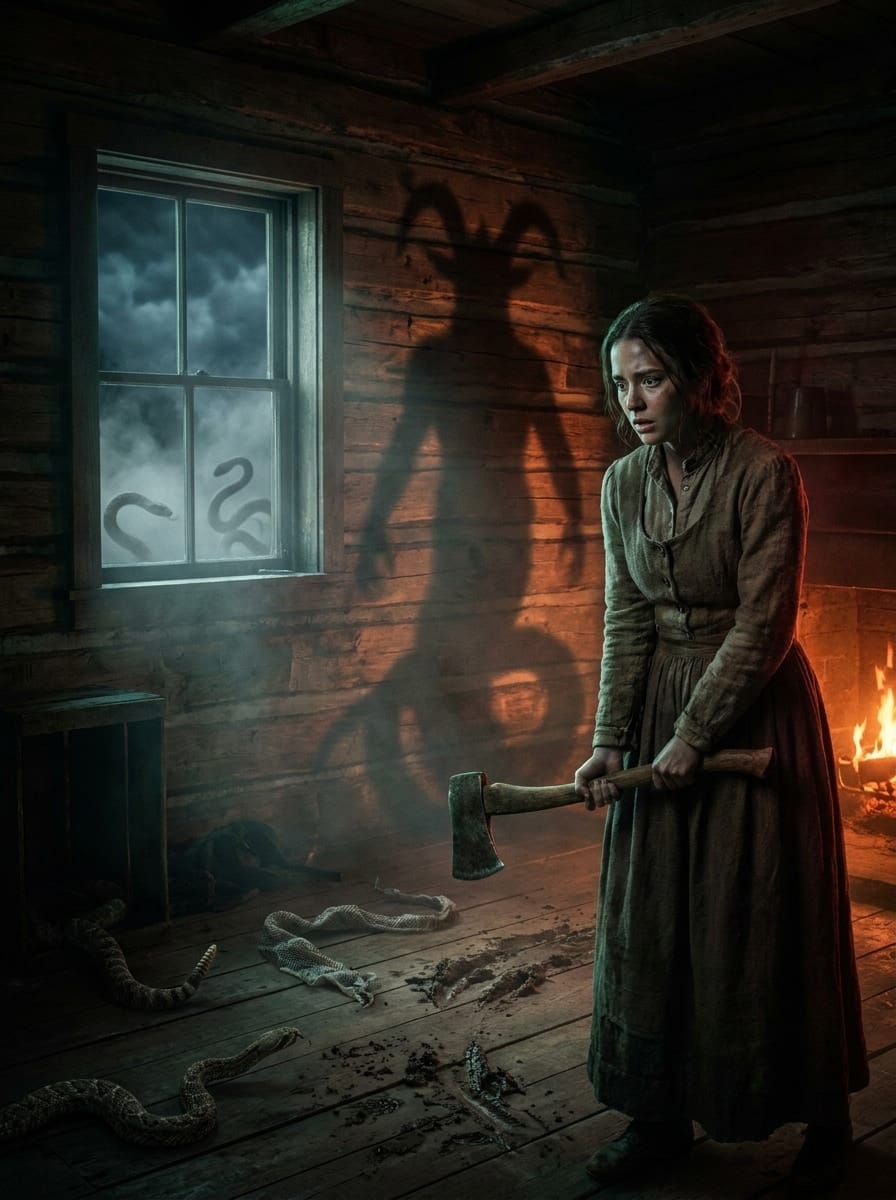
At last Walker’s patience began to wear thin. He was exhausted by day and kept being roused at night. He told her fear could make a person hear things that were not there. Audrey did not argue. She only set an axe beside the bed, where she could reach it at once.
“If they come,” she said, “I won’t face them empty-handed.”
Walker looked at her, and did not take the axe away.
The Sound in the Night
Around Halloween, the prairie nights turned cold. Daylight still brought warmth, but after dark it was as though the earth itself exhaled chill. The grass outside bent under the wind, and now and then the roof gave a little creak.
That night Walker stayed up late. He checked the latch, looked over the corners, and made sure no snake had found its way in. Audrey lay on the bed, her eyes wide open. When the lamp went out, the room was left with only the dim red glow of the hearth.
In the middle of the night, she heard it.
At first it was only the faintest scrape, like dry grass underfoot. Then came a clearer rustling. Audrey held her breath and slowly reached for the axe beside the bed. She meant to wake Walker, but found that he did not move.
Then the sound changed into the one she feared most: quick, tiny, and sharp, like rattles trembling in the dark.
Audrey sprang up. The dim red glow from the hearth did little to show the room, but she could make out a blur by the bed. It seemed to rise from the floor, or to come crawling toward her. She smelled a damp, fishy odor, and one thought filled her mind: Yig had come. The snakes had come for revenge.
She snatched up the axe and screamed as she struck.
Once. Twice. A third time.
The room rang with heavy blows and her own cries. She did not know what she was hitting, only that something fell in the dark, something thrashed. When she finally stopped, her arms had gone numb, and the axe handle was slick enough to slip from her hands.
The neighboring pioneers heard the screaming and came running with a lamp. They kicked open the door and found Audrey standing beside the bed, her hair wild, her clothes and face covered in blood. Walker Davis lay on the floor.
He had not been dragged off by snakes. He had not turned into one. He had simply been killed by his wife’s axe.
Some said he seemed to bear the mark of a snakebite; others said that in all the confusion, people had only imagined it. Whatever the truth, Audrey could no longer hear reason. She crouched in the corner, repeating the same words over and over:
“They came. Yig came.”
The Child Left by the Curse
After Walker was buried, Audrey was taken away. Sometimes she was quiet, sometimes she screamed. She feared rope, whips, the roots of split trees, even the crooked tracks left in mud by someone’s boots. And the child she carried became something no one wished to speak of.
Later, the baby was born.
Dr. McNeil’s voice grew lower when he came to this part. He did not give all the details, only said that it was not what any normal child should have been. The midwife was horrified; one woman prayed on the spot, while another fled outdoors to retch. The child bore a dreadful deformity, as though some trace of serpent flesh had been mixed into human blood.
No one dared speak of it openly. On the frontier, there had been too many deaths and too much madness already, and many secrets were buried in haste. Yet this one was never fully buried. It remained in the asylum at Guthrie, in Dr. McNeil’s records, and in the lowered voices of the old people.
The scholar listened and thought he understood why the locals feared Yig. Perhaps it had all been a chain of ordinary disasters: the strain of pioneer life, Audrey’s terror of snakes, the coincidence of Walker’s destruction of the nest, the fatal confusion in the night, and a child born with deformities. Each thing could be explained in the language of common sense.
But then Dr. McNeil took him to see the story’s surviving remnant.
Beyond the door and the iron bars, the scholar saw something alive. It was kept under strict guard, away from the ordinary patients. It still bore something of a human shape, yet was far from a complete human being. In its movement, its skin, and the outline of its head, there was something that recalled a snake coiled among the stones.
The scholar stood there, his throat tight. He thought of the prairie, the snake nest, the axe in the night, and the words the locals had spoken: Yig did not always hurry to exact vengeance. Sometimes he let people live, so that fear might continue to crawl through the bloodline.
After leaving the asylum, he could never again look at snakes as he once had. At the least rustle in the grass, he would stop. At the sight of a winding mark in the road, he would step aside. Reason told him it was only an old frontier tragedy and a horror in a hospital room, but another voice kept whispering inside him: there was a reason people in that country did not speak Yig’s name aloud.
Audrey Davis remained in her room. She had grown old and mad, yet she still remembered that night. Whenever the wind moved through the dead grass outside her window, she would fold herself in on the bed as she had years before, waiting for the faint rattle to come again.